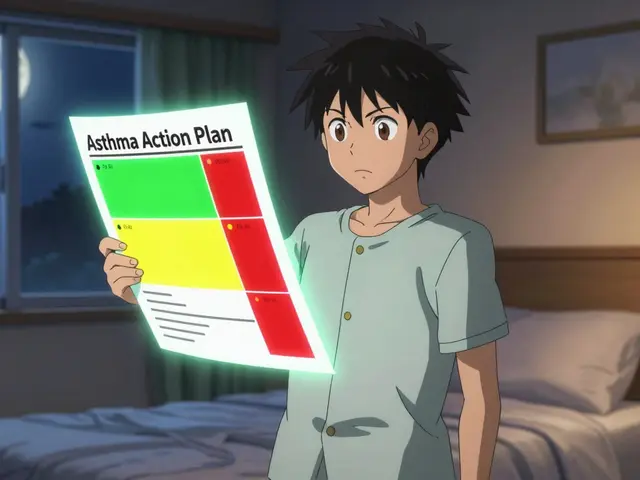

Imagine waking up in the middle of the night, chest tight, gasping for air. You know you have an inhaler, but do you know exactly how many puffs to take? Do you know if this is just a bad day or a medical emergency? For millions of people with asthma, a chronic respiratory condition affecting over 339 million people globally according to the Global Initiative for Asthma (GINA), that uncertainty can be terrifying. The difference between a manageable cough and a trip to the emergency room often comes down to one thing: having a clear, written roadmap.
That roadmap is your Asthma Action Plan, a personalized medical document created with your healthcare provider that provides specific instructions for managing symptoms based on three color-coded zones. It’s not just paperwork; it’s a survival tool. Research from the National Heart, Lung, and Blood Institute (NHLBI) shows that when these plans are properly implemented, they can reduce emergency department visits by up to 70%. Yet, despite their proven effectiveness, only about 30% of asthma patients consistently use them. Why? Because many people don’t realize that an action plan is a living document, not a static piece of paper you file away after your first doctor’s visit.
Understanding the Three-Zone Traffic Light System
The core of any effective asthma action plan is the traffic light system. This visual guide simplifies complex medical decisions into three clear categories: Green, Yellow, and Red. This structure was standardized by the NHLBI in their comprehensive guidelines, updated in 2020, to ensure consistency across healthcare providers. The beauty of this system is its simplicity. When you’re struggling to breathe, you don’t have time to read dense paragraphs of text. You need immediate, actionable steps.
| Zone | Status | Symptoms & Peak Flow | Action Required |
|---|---|---|---|
| Green | Go / Good | No symptoms. Peak flow is 80-100% of personal best. | Continue daily controller medications as prescribed. |
| Yellow | Caution | Coughing, wheezing, chest tightness. Peak flow is 50-79% of personal best. | Use quick-relief rescue medication (e.g., albuterol). Monitor closely. |
| Red | Danger | Severe shortness of breath. Peak flow is below 50%. Rescue meds don't help. | Medical emergency. Use rescue meds and call emergency services immediately. |
In the Green Zone, you are in control. You can sleep through the night without waking up coughing, and you can perform normal activities like walking up stairs or playing sports without getting winded. Your peak flow meter, a handheld device that measures how fast you can blow air out of your lungs, reads between 80% and 100% of your "personal best." This is where you want to be most of the time. Here, you simply continue taking your long-term control medications, such as inhaled corticosteroids like fluticasone, exactly as prescribed.
The Yellow Zone is where things get tricky. This is the warning sign. You might notice mild wheezing, a persistent cough, or difficulty sleeping because of breathing issues. Your peak flow drops to between 50% and 79% of your personal best. This is not the time to ignore symptoms and hope they go away. According to clinical guidelines, this is when you start using your quick-relief rescue medication, typically albuterol, a bronchodilator that relaxes muscles in the airways to improve breathing, at 2-4 puffs every 4-6 hours. You also need to monitor your symptoms every hour. If you stay in the yellow zone or slip into red, you need to act faster.
The Red Zone is a crisis. Your breathing is severely restricted, you can’t speak in full sentences, and your peak flow is below 50% of your personal best. Even after using your rescue inhaler, you feel no relief. This is a medical emergency. The plan dictates that you use your rescue medication again and seek immediate medical attention. There is no home remedy for the red zone. Delaying care here can be life-threatening.
Why Peak Flow Numbers Matter More Than You Think
You might wonder why you need to measure your airflow. Can’t you just rely on how you feel? Unfortunately, human perception of breathing difficulty is notoriously unreliable. Many people adapt to slowly worsening lung function, thinking their constant wheeze is "normal." This phenomenon, known as hypervigilance fatigue, can keep you stuck in the yellow zone for months without realizing it.
This is where the Peak Flow Meter serves as an objective gauge of your lung health. To make your action plan work, you first need to establish your "personal best" number. This isn’t a guess. It requires measuring your peak flow twice a day for two to four weeks while you are feeling healthy and symptom-free. Once you have that baseline, your doctor calculates the percentages for your green, yellow, and red zones.
Without these numbers, your action plan is incomplete. As one user noted in an online community discussion, knowing what "50%" actually looks like for *your* body changes everything. It removes the ambiguity. If your personal best is 400 liters per minute, then dropping to 200 is a clear signal to escalate treatment. If you don’t have a meter, ask your doctor for one. They are inexpensive and widely available. Just remember to calibrate yours annually to ensure accuracy within ±10% of actual values, as recommended by the American Academy of Allergy, Asthma & Immunology.
Making Your Plan Work: Practical Implementation Tips
Creating an asthma action plan takes about 15 to 30 minutes during a standard medical appointment. But creating it is only half the battle. Using it effectively requires some behavioral adjustments. Here is how to bridge the gap between having the paper and following the advice.
- Keep it Visible: Don’t hide your plan in a drawer. Post it on your refrigerator, tape it to your bathroom mirror, or save it as the lock screen on your phone. A survey by the Asthma and Allergy Foundation of America found that 41% of patients didn’t follow their plans simply because they forgot where they put them.
- Share It Widely: If you have children, share their plan with teachers, coaches, and babysitters. Dr. Catherine Fuller, a board-certified allergist, emphasizes that consistent management across environments is crucial. Adults should share their plans with close family members so someone knows what to do if they become too distressed to think clearly.
- Review Seasonally: Asthma triggers change with the seasons. Pollen counts rise in spring, mold spores increase in damp autumn weather, and cold air irritates lungs in winter. Your plan should be reviewed and potentially adjusted every few months, especially if your environmental triggers shift.
- Use Technology: Modern tools can help. Apps like those offered by the AAFA can send medication reminders and track symptom patterns. Some smart inhalers, like those made by Propeller Health, sync with apps to provide data that can inform your action plan updates.
It’s also important to address literacy barriers. If reading small print or understanding medical terms is difficult, ask your doctor for a simplified version or one with larger fonts and pictures. The goal is clarity, not complexity. If you have color vision deficiency, which affects about 8% of males, ask for a version that uses patterns or symbols instead of just colors.

The Role of Medications in Your Strategy
Your action plan revolves around two types of medications: controllers and relievers. Understanding the difference is vital.
Controller Medications, such as inhaled corticosteroids (ICS), are taken every day, even when you feel fine. They work by reducing inflammation in your airways over time. Think of them like brushing your teeth; you do it daily to prevent problems, not just when you have a toothache. Common examples include fluticasone (Flovent) and budesonide (Pulmicort).
Reliever Medications, also known as rescue inhalers, are used only when symptoms occur. Albuterol is the most common example. It works quickly to open up your airways but does not treat the underlying inflammation. Relying solely on relievers without using controllers is a major risk factor for severe asthma attacks. If you find yourself using your rescue inhaler more than twice a week (excluding pre-exercise use), your asthma is not controlled, and you need to revisit your plan with your doctor.
When to Update or Change Your Plan
An asthma action plan is not set in stone. It evolves with you. You should update your plan whenever there is a significant change in your health status. This includes:
- After an Emergency Visit: If you ended up in the ER or hospital, your previous plan failed to prevent that crisis. Work with your doctor to adjust your thresholds or medications.
- Change in Triggers: Did you move to a new city with different pollen levels? Did you get a new pet? These changes can alter your baseline.
- Pregnancy or Growth Spurts: Hormonal changes and physical growth can affect lung capacity and asthma severity.
- New Medications: If your doctor prescribes a new drug or changes your dosage, your action plan must reflect these changes immediately.
Dr. Robert Lemanske, a professor at the University of Wisconsin School of Medicine, noted that patients with personalized, regularly updated plans have 47% fewer hospitalizations. The key word is "personalized." A generic template downloaded from the internet is better than nothing, but a plan tailored to your specific peak flow numbers, triggers, and medication regimen is infinitely more effective.

Overcoming Common Barriers
Even with the best intentions, sticking to an action plan can be hard. Forgetfulness is the biggest enemy. Integrating asthma management into your daily routine helps. Link checking your peak flow to another habit, like brushing your teeth or drinking morning coffee. Consistency builds muscle memory.
Another barrier is fear. Some people avoid checking their peak flow because they are afraid of seeing a low number. But ignoring the problem doesn’t make it go away; it makes it worse. Facing the data allows you to intervene early, usually in the yellow zone, preventing a slide into the red zone. Early intervention is always easier and safer than emergency care.
Finally, cost can be a concern. While peak flow meters are cheap, medications can be expensive. Talk to your pharmacist about generic alternatives or patient assistance programs. Never skip doses of your controller medication to save money. The cost of an ER visit for an asthma attack far exceeds the price of monthly prescriptions.
Looking Ahead: Digital Integration and Future Trends
The future of asthma management is digital. We are moving away from static paper documents toward dynamic, integrated health ecosystems. Researchers at the University of California San Francisco are currently testing AI-driven algorithms that analyze symptom diaries and local environmental data to predict asthma flare-ups with 82% accuracy. Imagine receiving a notification on your phone saying, "High pollen count today; consider pre-treating with your rescue inhaler before going outside." While this technology is still emerging, you can start leveraging digital tools today. Use smartphone apps to log your symptoms and peak flow readings. This data provides your doctor with a much clearer picture of your asthma control than a vague recollection of "how I’ve been feeling." The combination of traditional medical expertise and modern data tracking offers the best chance for long-term control.
How do I determine my personal best peak flow number?
To find your personal best, measure your peak flow twice a day (morning and evening) for two to four weeks while you are feeling healthy and free of symptoms. Record all your readings. The highest number you achieve during this period is your personal best. Share this data with your doctor to calculate your green, yellow, and red zone percentages.
What should I do if my rescue inhaler doesn't work?
If you use your rescue inhaler (like albuterol) and do not feel improvement within 15-20 minutes, or if your symptoms return quickly, this is a sign of a severe attack. Follow the Red Zone instructions: use your rescue medication again if directed by your plan, and seek immediate medical attention or call emergency services. Do not wait to see if it gets better on its own.
Can I download an asthma action plan template online?
Yes, organizations like the NHLBI and the Asthma and Allergy Foundation of America offer free, downloadable templates. However, a template is just a starting point. It must be filled out and signed by your healthcare provider with your specific medication names, dosages, and peak flow numbers to be effective and safe.
How often should I review my asthma action plan with my doctor?
You should review your plan at least once a year, or more frequently if your asthma symptoms change. Ideally, bring your plan to every asthma-related visit. If you have had an asthma attack requiring emergency care, review and update your plan immediately afterward to prevent future occurrences.
Is an asthma action plan necessary for mild asthma?
Yes. Even if your asthma is well-controlled most of the time, you can still experience sudden exacerbations due to viruses, allergies, or other triggers. Having a plan ensures you know exactly how to respond before a minor issue becomes a major crisis. Guidelines recommend a written plan for all patients with asthma, regardless of severity.