
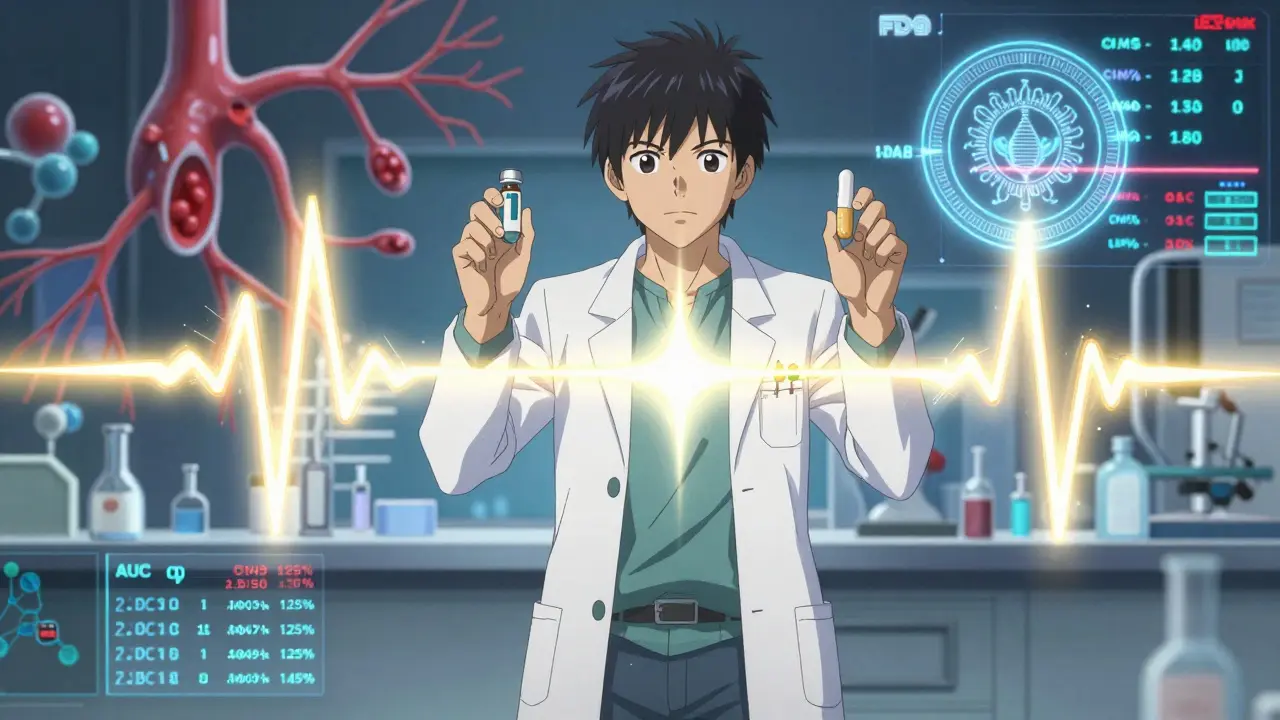
When you pick up a prescription at the pharmacy, you might not think twice about whether it’s the brand-name pill or the generic version. But behind that simple swap is a rigorous scientific process that keeps millions of patients safe every day: bioequivalence testing. This isn’t just a regulatory checkbox-it’s the foundation of trust between patients, doctors, and the generic drug industry. Without it, switching from a brand-name drug to a cheaper generic could mean unpredictable effects, dangerous side effects, or even treatment failure. And that’s why this testing matters more than most people realize.
What Bioequivalence Really Means
Bioequivalence isn’t about two drugs looking the same or having the same color or shape. It’s about whether they work the same way inside your body. Specifically, it means the generic version delivers the same amount of active ingredient to your bloodstream at the same speed as the brand-name version. That’s measured through two key numbers: AUC (how much of the drug gets absorbed over time) and Cmax (how high the drug peaks in your blood). For a generic to be approved, its AUC and Cmax must fall within 80% to 125% of the brand-name drug’s values. This isn’t arbitrary-it’s based on decades of clinical data showing that within this range, the body responds identically.
Take levothyroxine, a thyroid hormone replacement. Even small differences in absorption can cause fatigue, weight gain, or heart palpitations. After the FDA tightened bioequivalence standards for this drug in 2012, manufacturers had to prove their generics matched the brand’s absorption profile exactly. The result? A drop in patient complaints and more consistent dosing across pharmacies. That’s bioequivalence in action.
How Testing Works: The Science Behind the Standard
Bioequivalence studies don’t happen in hospitals or clinics. They’re done in controlled research units with healthy volunteers. A typical study gives participants one dose of the brand-name drug, then after a washout period, the same dose of the generic. Blood samples are taken every 15 to 30 minutes for up to 72 hours. The data is fed into statistical models to calculate whether the 80-125% window is met.
But it’s not that simple for every drug. For drugs with a narrow therapeutic index-like warfarin, lithium, or cyclosporine-the margin is tighter: 90-111%. Why? Because too little doesn’t work, and too much can be deadly. For highly variable drugs, like some antibiotics or epilepsy medications, regulators use a method called scaled average bioequivalence. This lets the acceptance range widen to 75-133% but only if the drug’s own variability is high, and the average difference between the two drugs stays close to 100%. It’s a smarter, more flexible system that still protects safety.
And it’s not just about swallowing a pill. For inhalers, creams, or eye drops, testing gets even more complex. The drug has to reach the right tissue at the right concentration. The FDA’s 2022 initiative on complex generics introduced new in-vitro tests and imaging techniques to measure how well a topical cream penetrates the skin. These aren’t theoretical-they’re required before a generic skin cream can be sold.
Why This Keeps Patients Safe
Some patients worry that generics are “less effective” because they’re cheaper. But the data says otherwise. In 2022, the National Community Pharmacists Association surveyed over 1,200 U.S. patients who had switched to generics. Eighty-seven percent said the generic worked just as well. The FDA’s own adverse event database (FAERS) shows that only 0.07% of all reported drug side effects involved generics with confirmed bioequivalence. Meanwhile, brand-name drugs accounted for 2.3%-not because they’re more dangerous, but because they’re prescribed more often.
Consider sertraline, an antidepressant. There have been online stories about people feeling worse after switching to a generic. But when pharmacists and regulators dig into those reports, they almost always find other causes: a change in diet, a new medication, or even stress. The FDA monitors these closely. If a generic caused real, systemic problems, it would be pulled from the market within weeks. No generic has been recalled for bioequivalence failure since 2018.
That’s because bioequivalence isn’t a one-time test. It’s an ongoing requirement. Every batch of a generic drug must meet the same quality standards as the brand. The FDA inspects manufacturing facilities regularly. If a company changes its formula-even slightly-it must retest. That’s why you can trust that the generic you get today will behave the same as the one you got last month.

Global Standards: Not All Countries Are the Same
Bioequivalence rules aren’t universal. Japan requires fasting studies even if the brand-name drug is meant to be taken with food. Australia and the EU require both fasting and fed studies. Brazil mandates specific blood tests before enrollment. These differences aren’t red tape-they’re safeguards. For example, if a drug is absorbed differently when taken with food, a study done only on an empty stomach could miss a dangerous interaction. That’s why global manufacturers often run multiple studies to meet each country’s rules.
The International Pharmaceutical Regulators Programme (IPRP), which includes 16 countries, is working to harmonize these standards. But until then, companies must navigate a patchwork of requirements. That’s one reason why some generics aren’t available everywhere-it’s not about cost, it’s about compliance.
Biosimilars vs. Generics: A Crucial Difference
Don’t confuse generics with biosimilars. Generics are exact chemical copies of small-molecule drugs-like aspirin or metformin. Biosimilars are copies of complex biological drugs-like insulin or Humira. They’re made from living cells, not chemicals. Even tiny changes in the manufacturing process can alter how they work. That’s why biosimilars need way more testing: structural analysis, animal studies, immune response checks, and full clinical trials. They can’t rely on bioequivalence alone. The FDA requires a “totality of evidence” approach. It’s a higher bar, and for good reason.
For patients, this means biosimilars aren’t “generic biologics.” They’re scientifically distinct. But they’re still safe. In fact, biosimilars have saved U.S. patients over $20 billion since 2015. The testing is just more complex.

Cost vs. Safety: The Real Trade-Off
Generic drugs make up 90% of prescriptions in the U.S. but only 23% of drug spending. In 2020 alone, they saved the healthcare system $313 billion. Without bioequivalence testing, that savings wouldn’t exist. Patients would pay more. Hospitals would struggle. Insurance premiums would rise.
But here’s the truth: you can’t have low-cost drugs without rigorous testing. Cutting corners on bioequivalence doesn’t save money-it creates long-term costs. A patient who has a seizure because their epilepsy drug wasn’t absorbed properly doesn’t just need emergency care-they need months of rehab, lost wages, and possibly lifelong care. Bioequivalence testing prevents that.
What’s Next? AI, Modeling, and the Future of Testing
The field is evolving. The FDA now accepts 17 submissions per year using physiologically-based pharmacokinetic (PBPK) modeling-computer simulations that predict how a drug behaves in the body. These models reduce the need for human studies, especially for drugs that are hard to test on volunteers. In 2023, the FDA started using AI to predict bioequivalence based on dissolution profiles. If a generic dissolves the same way as the brand in lab tests, the model can estimate whether it’ll perform the same in the body.
But these tools don’t replace testing-they support it. The 80-125% rule still stands. AI just helps scientists focus on the hardest cases. For example, a topical cream that’s hard to measure in blood? AI can simulate skin absorption. A drug that’s too dangerous to test in healthy volunteers? PBPK models can predict how it behaves in patients with liver disease.
By 2027, experts predict AI and modeling will cut bioequivalence study times by 30-40%. That means faster access to affordable drugs without sacrificing safety.
Final Thought: Trust, But Verify
Generic drugs aren’t second-rate. They’re science-backed alternatives that make healthcare accessible. Bioequivalence testing is the invisible shield that keeps them safe. It’s why you can switch from Lipitor to atorvastatin without fear. Why you can refill your asthma inhaler at a different pharmacy and still breathe easy. Why millions of seniors on Medicare can afford their meds.
When someone tells you generics are risky, ask: have they checked the data? The FDA, EMA, WHO, and independent researchers all agree: when bioequivalence is proven, the drug is safe. The science is solid. The results are clear. And the cost savings? They’re real.
Are generic drugs as safe as brand-name drugs?
Yes, when they meet bioequivalence standards. The FDA and EMA require generics to deliver the same amount of active ingredient at the same rate as the brand. Studies show no meaningful difference in safety or effectiveness. In fact, adverse event reports for approved generics are far lower than for brand-name drugs.
Why do some people say generics don’t work for them?
Anecdotal reports often come from unrelated factors: changes in diet, stress, other medications, or even the placebo effect. For drugs with narrow therapeutic windows like levothyroxine, even small changes in formulation can cause symptoms-but only if the generic failed bioequivalence testing. The FDA tracks these cases closely and recalls any product that shows a pattern of failure. Most reported issues are isolated and not linked to the drug’s quality.
Do all countries test generics the same way?
No. While most major regulators use the 80-125% bioequivalence window, some have unique requirements. Japan mandates fasting studies even if the brand is taken with food. The EU requires both fasting and fed studies. Brazil requires specific medical tests before enrollment. These differences exist to account for local populations, diets, and health systems. Global manufacturers must tailor their studies to meet each country’s rules.
What’s the difference between a generic and a biosimilar?
Generics are chemically identical copies of small-molecule drugs, like ibuprofen or metformin. They rely on bioequivalence testing. Biosimilars are copies of complex biological drugs like insulin or Humira, made from living cells. They require extensive testing beyond bioequivalence-including immune response, structural analysis, and clinical trials-because tiny manufacturing changes can affect safety and effectiveness.
Can a generic drug be recalled for failing bioequivalence?
Yes, but it’s extremely rare. Since 2018, no generic has been recalled in the U.S. for bioequivalence failure. The FDA requires all generics to pass strict testing before approval. If a batch fails post-market testing, it’s pulled immediately. The system is designed to catch problems before they reach patients.



Nicole Blain
March 17, 2026 AT 20:20Kathy Underhill
March 18, 2026 AT 16:23Srividhya Srinivasan
March 19, 2026 AT 21:50Prathamesh Ghodke
March 21, 2026 AT 00:07Stephen Habegger
March 22, 2026 AT 12:10Justin Archuletta
March 23, 2026 AT 21:33Sanjana Rajan
March 24, 2026 AT 03:46Kyle Young
March 26, 2026 AT 01:54Aileen Nasywa Shabira
March 27, 2026 AT 23:59Kendrick Heyward
March 28, 2026 AT 11:30Melissa Starks
March 29, 2026 AT 10:20Lauren Volpi
March 30, 2026 AT 17:29