
CBD Medication Interaction Checker
Check Your Medications
Enter medications you're taking. This tool identifies potential interactions with CBD oil based on CYP450 enzyme inhibition.
How This Works
CBD oil inhibits key liver enzymes (CYP450) that break down prescription medications. This can cause dangerous drug levels in your body, leading to:
- Increased sedation
- Bleeding risk (for blood thinners)
- Overdose risk (for opioids)
- Serotonin syndrome (with antidepressants)
⚠️ Important: This tool provides general information. Always consult your doctor or pharmacist before mixing CBD with prescription medications.
When you take CBD oil alongside your prescription meds, something quiet but powerful is happening inside your body - and it can be dangerous if you don’t know about it. You might think CBD is just a natural supplement, safe to mix with anything. But the science says otherwise. CBD oil doesn’t just sit there quietly. It gets into your liver and starts blocking the enzymes that break down your medications. This isn’t theory - it’s happening in real people, right now.
How CBD Stops Your Medications From Being Broken Down
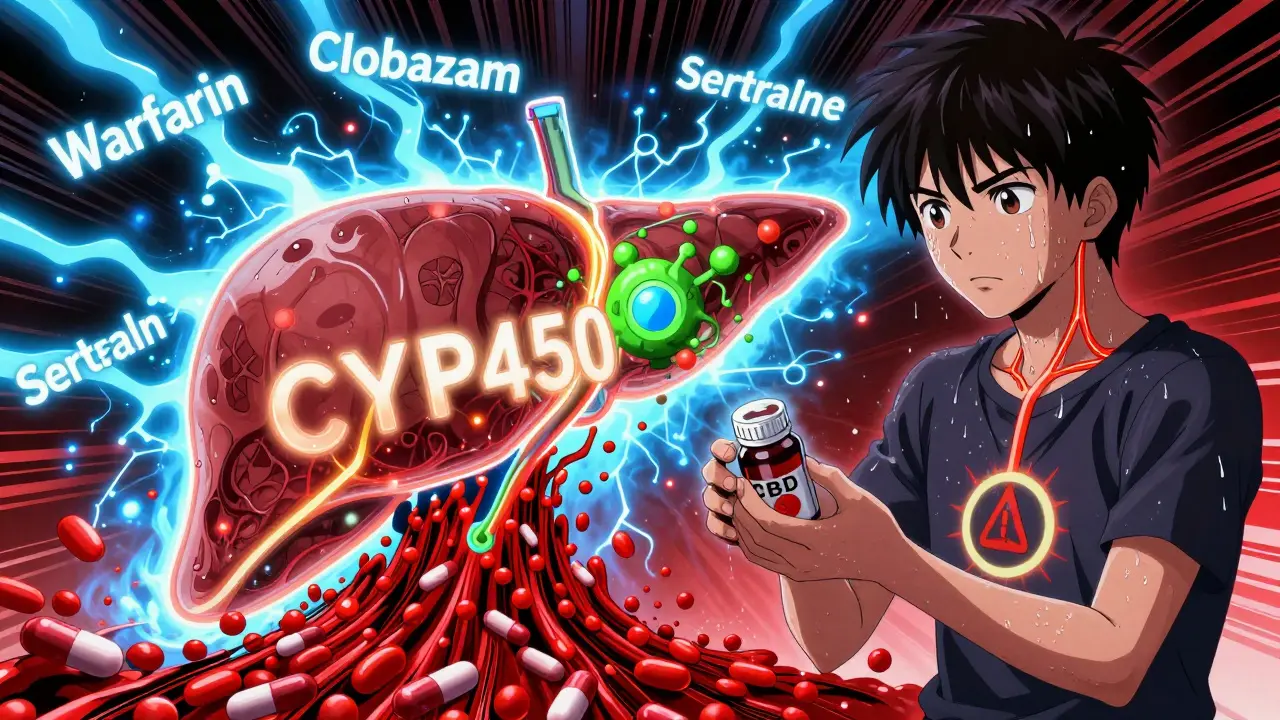
Your body uses a group of enzymes called CYP450 to process most prescription drugs. These enzymes are like the body’s recycling system - they take apart medications so they can be cleared out safely. About 70-80% of all prescription drugs rely on this system. CBD oil interferes with at least six of these enzymes, including CYP3A4, CYP2C9, CYP2C19, and CYP2D6. These are the same enzymes that handle blood thinners like warfarin, anti-seizure drugs like clobazam, and antidepressants like sertraline.
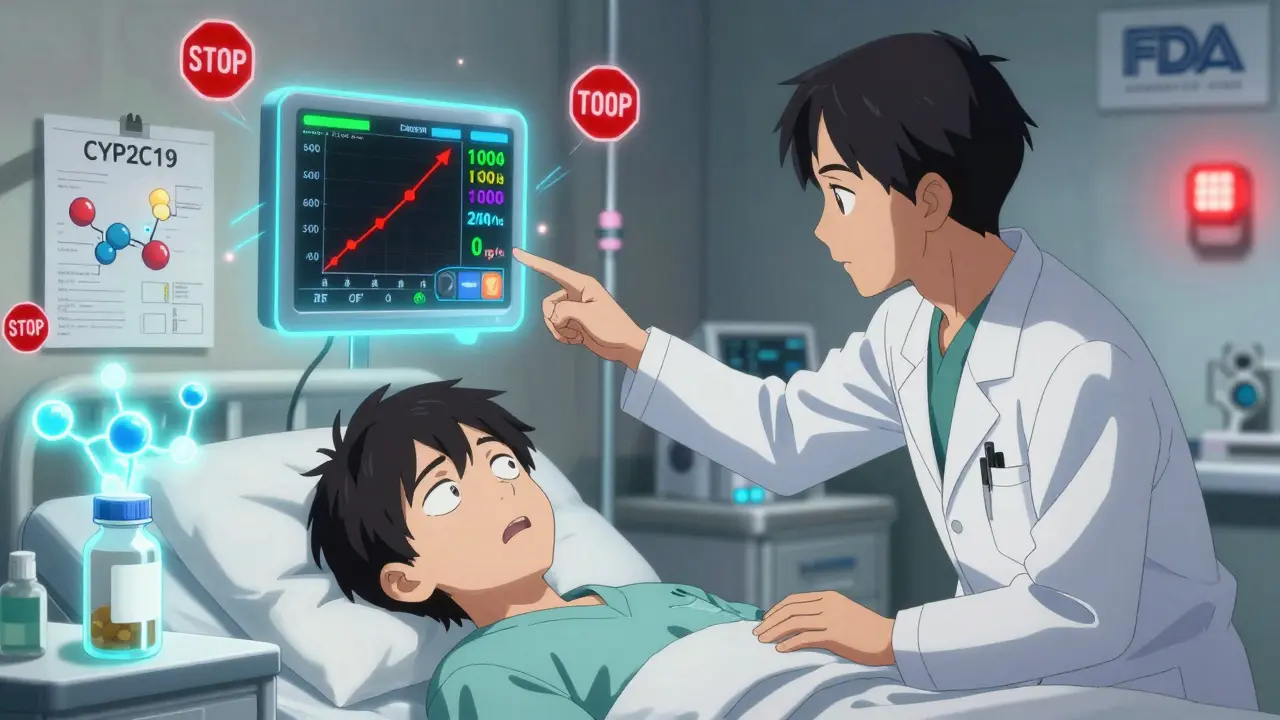
Studies show CBD is a potent inhibitor. At typical doses (1-2 μM), it shuts down CYP2C19 and CYP2C9 hard. That means if you’re taking clobazam for epilepsy, your body can’t break it down fast enough. The drug builds up in your blood. One study found clobazam levels jumped 60% when taken with CBD. That’s not a small change - it’s enough to cause serious side effects.
The Sedation Problem: Why You Feel Drugged
Sedation is the most common complaint from people mixing CBD with their meds. It’s not just feeling tired. It’s heavy eyelids, slurred speech, confusion, or falling asleep during the day. Why? Because when CBD blocks the enzymes that clear sedatives, those drugs stick around longer. Benzodiazepines, sleep aids, even some painkillers - they all get amplified.
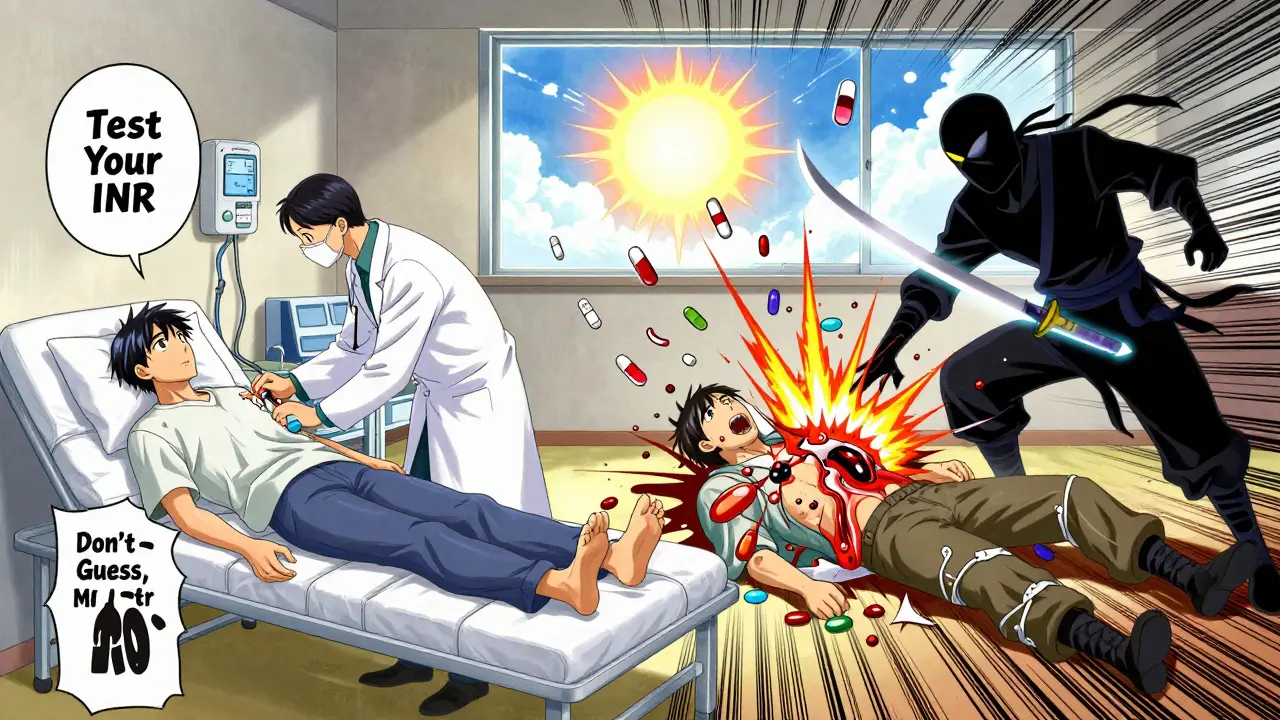
Real-world reports back this up. A patient on Reddit shared that after starting Epidiolex (medical-grade CBD), their clobazam levels went from 600 ng/mL to over 1,000 ng/mL. They were so sedated they couldn’t drive. Their neurologist had to cut their clobazam dose in half. Another person on PatientsLikeMe saw their INR - a measure of blood thinning - spike from 2.5 to 5.8 after adding CBD. That’s a dangerous level. They needed emergency vitamin K to stop the risk of internal bleeding.
A 2023 study of 217 people using CBD with prescription drugs found 34% reported increased sedation. But if you were taking a drug metabolized by CYP2C19 - like clobazam, diazepam, or some antidepressants - the rate jumped to 58%. That’s more than half.
Which Medications Are Most at Risk?
Not all drugs are equally affected. Some are like ticking time bombs when mixed with CBD. Here are the biggest red flags:
- Warfarin (Coumadin) - metabolized by CYP2C9. CBD can cause dangerous bleeding.
- Clobazam - metabolized by CYP2C19. CBD can double or triple its levels.
- SSRIs like sertraline and fluoxetine - handled by CYP2D6. Risk of serotonin syndrome.
- Statins like simvastatin - broken down by CYP3A4. CBD can raise muscle damage risk.
- Opioids like fentanyl - processed by CYP3A4. CBD can extend their effect, increasing overdose risk.
Even if you’re not on these drugs, you might be. Many blood pressure pills, heart medications, and even some antibiotics are metabolized by these same enzymes. If your doctor didn’t warn you about CBD, they might not know the full risk.
The FDA Warning You Probably Missed
The FDA approved Epidiolex - a purified CBD product - in 2018 for rare seizure disorders. But the label doesn’t say "safe for all." It says: "Concomitant use with clobazam increases N-desmethylclobazam levels by up to 60%. Dose reduction of clobazam may be necessary." That’s a direct admission: CBD changes how other drugs work.
And it’s not just Epidiolex. Non-prescription CBD products? They’re even more unpredictable. A 2022 study found 42-121% of the CBD listed on labels was actually in the bottle. One bottle might have 10 mg, another 25 mg - same brand, same label. You can’t know what you’re taking. And without regulation, no one is checking for interactions.
What Happens in Real Clinics
Doctors aren’t ignoring this. The American Society of Health-System Pharmacists (ASHP) says: Avoid CBD with drugs that have a narrow therapeutic index - where the difference between a safe dose and a toxic one is tiny. That includes warfarin, lithium, and some anti-seizure meds.
Hospitals are starting to act. Cleveland Clinic’s Medical Marijuana Program found 78% of CBD-related interactions were fixed by adjusting the dose of the prescription drug - not by stopping CBD. That’s key. You don’t always have to quit CBD. You might just need less of your other meds.
Therapeutic drug monitoring - regularly testing blood levels of your medication - is the gold standard. If you’re on warfarin and start CBD, get your INR checked within 3-5 days. If you’re on clobazam, ask your neurologist to check your drug levels. It’s not optional anymore.
What About Other Cannabinoids?
Not all cannabinoids act the same. CBD is the biggest offender. THC? It inhibits enzymes too, but less broadly. CBN? It’s stronger on CYP2E1, which affects fewer drugs. CBG? Early data suggests it’s much milder. That’s why some clinics are starting to recommend CBG over CBD for patients on multiple meds - but research is still early.
And don’t assume "full-spectrum" is better. Those products contain THC and other cannabinoids, which means more enzyme interference. Isolated CBD (like Epidiolex) is more predictable - but even then, interactions still happen.
What Should You Do?
If you’re on prescription medication and thinking about CBD - or already using it - here’s what to do:
- Stop guessing. Tell your doctor or pharmacist you’re using CBD. Don’t wait for them to ask.
- Check your meds. Look up your drugs. If they’re metabolized by CYP2C9, CYP2C19, CYP2D6, or CYP3A4, you’re at risk.
- Get tested. Ask for blood level checks if you’re on warfarin, clobazam, or other narrow-window drugs.
- Space out doses. Take CBD and your medication at least 4 hours apart. It doesn’t eliminate risk, but it helps.
- Don’t switch brands. CBD content varies wildly. Stick to one product, and know its exact dose.
Some people do benefit. One patient used CBD to reduce their fentanyl dose by 40% because CBD slowed its breakdown. That’s a win - but only because their doctor was monitoring them closely. This isn’t about avoiding CBD. It’s about using it wisely.
The Bigger Picture
The CBD market hit $28.6 billion in 2023. Over 64 million Americans use it. And nearly half of them are taking it with prescription drugs. That’s a public health issue waiting to happen. The FDA has sent warning letters to 15 CBD companies for not listing drug interaction risks. Pharmacists in 2024 are now required to complete 3 hours of training on these interactions.
Research is moving fast. A major NIH study is testing CBD’s effect on warfarin in 120 people. A new tool called the "Cannabis-Drug Interaction Checker" will launch in mid-2024 to help doctors make decisions. But until then, you can’t rely on apps or Google. You need real medical guidance.
CBD isn’t evil. But it’s not harmless either. It’s a powerful biological actor - and it plays by rules most people don’t know. If you’re taking meds, your body is already balancing a tightrope. CBD doesn’t help you walk it. It changes the rope.
Can CBD oil make my blood thinner more powerful?
Yes. CBD strongly inhibits CYP2C9, the enzyme that breaks down warfarin. This can cause your INR to rise dangerously - from a safe level of 2.5 to over 5.8, which puts you at high risk of bleeding. Emergency treatment like vitamin K may be needed. If you take warfarin, never start CBD without checking your INR within 3-5 days.
Does CBD interact with antidepressants?
Yes, especially SSRIs like sertraline, fluoxetine, and citalopram, which are metabolized by CYP2D6. CBD can raise their levels in your blood, increasing side effects like dizziness, nausea, and in rare cases, serotonin syndrome - a life-threatening condition. If you’re on antidepressants and feel unusually anxious, agitated, or confused after starting CBD, contact your doctor immediately.
Is it safe to take CBD with seizure medication?
It can be - but only under medical supervision. Epidiolex, a purified CBD product, is FDA-approved for epilepsy. But it’s known to increase levels of clobazam by 60%, causing sedation. Neurologists often reduce clobazam doses by 25-50% when starting CBD. Blood tests for drug levels are essential. Never self-adjust your seizure meds.
How do I know if my CBD product is safe to mix with my meds?
You can’t. Non-prescription CBD products aren’t regulated. A 2022 study found CBD content varied by up to 79% from what’s on the label. Even if a product says "10 mg," it might have 18 mg or only 5 mg. The only safe way to use CBD with meds is under a doctor’s care with a known, consistent product - like Epidiolex - and regular blood monitoring.
Can I avoid interactions by taking CBD at a different time of day?
Spacing doses by 2-4 hours can help reduce peak interaction, but it doesn’t eliminate the risk. CBD stays in your system for hours, and the enzyme inhibition lasts longer. The best approach is not timing - it’s monitoring. If you’re on a critical drug like warfarin or clobazam, blood tests are the only reliable way to know if it’s safe.


Jack Havard
February 10, 2026 AT 16:03So let me get this straight - we’re treating a plant extract like it’s a pharmaceutical with FDA-grade precision, but the market is a Wild West of unregulated bottles with no quality control? Brilliant. We regulate aspirin but let some guy in Ohio sell ‘CBD tincture’ with a QR code that links to a blog post from 2019? This isn’t healthcare. It’s a cult with a side of capitalism.
Stacie Willhite
February 11, 2026 AT 07:26I’ve been on sertraline for years and started CBD for anxiety. I didn’t realize how much it was affecting me until I felt like I was moving through syrup all day. My doctor checked my levels - sertraline was nearly double what it should’ve been. We lowered the dose and now I’m fine. It’s scary how little people know. Please, if you’re on meds, talk to your pharmacist. They’re the unsung heroes here.
Jason Pascoe
February 11, 2026 AT 21:37From down under - we’ve got similar issues here. The TGA (Therapeutic Goods Administration) doesn’t classify CBD as a medicine unless it’s prescribed, so most products fly under the radar. I’ve had patients on warfarin who swear by CBD for pain, but never mention it until their INR spikes. We need better education, not just warnings. Maybe pharmacists should be required to ask about supplements during med reviews. Simple. Effective.
Brad Ralph
February 12, 2026 AT 13:35So CBD is the new warfarin? Cool. Next up: ‘I took a mushroom and my blood pressure dropped’ - turns out, the mushroom was just a placebo with a side of existential dread. 🤷♂️
christian jon
February 14, 2026 AT 11:39OH MY GOD. OH MY GOD. OH MY GOD. PEOPLE ARE DYING. NOT BECAUSE OF CBD - NO - BECAUSE THEY’RE TOO STUPID TO ASK THEIR DOCTOR BEFORE MIXING A PLANT WITH A DRUG THAT KEEPS THEM ALIVE. I’VE SEEN IT. I’VE SEEN THE HOSPITAL RECORDS. I’VE SEEN THE INR NUMBERS. 5.8?! THAT’S NOT A NUMBER - THAT’S A DEATH SENTENCE WRITTEN IN BLOOD. AND YET - STILL - PEOPLE JUST ‘TRY IT’ LIKE IT’S A NEW FLAVOR OF CHIPS. WE NEED A NATIONAL CAMPAIGN. A TV SPOT. A MOTHER’S DAY AD WHERE A WOMAN SAYS, ‘I LOST MY HUSBAND BECAUSE HE THOUGHT CBD WAS HARMLESS.’
steve sunio
February 15, 2026 AT 20:38Ernie Simsek
February 15, 2026 AT 21:27My cousin took CBD with his statin and woke up with muscle pain so bad he couldn’t lift his arm. ER visit. CK levels through the roof. Turns out, simvastatin + CBD = rhabdo waiting to happen. He’s fine now, but he’s not touching CBD again. My point? Don’t be the guy who ‘just tried it’ and ended up in the hospital because you thought ‘natural’ meant ‘safe.’
Gloria Ricky
February 15, 2026 AT 22:22I’m a nurse and I’ve had three patients come in with bleeding issues after starting CBD with warfarin. One didn’t even know CBD could interact - he thought it was like taking a vitamin. We need better labeling. Like, actual warning labels on every bottle. Not just fine print. Something that says: ‘WARNING: MAY CAUSE LETHAL BLEEDING IF TAKEN WITH WARFARIN.’ And maybe a little picture of a bleeding brain? Just a thought.
Sonja Stoces
February 17, 2026 AT 08:16Oh wow, so now we’re blaming CBD for people not doing their own research? Let me guess - the same people who think ‘organic’ means ‘no side effects’ are the ones taking 50mg of CBD with 5 different prescriptions. You can’t protect people from their own stupidity. If you’re on clobazam and add CBD without checking levels - you’re not a patient. You’re a liability. And yes, I’m talking to you, Karen.
Annie Joyce
February 19, 2026 AT 06:59Here’s what I tell my patients: CBD isn’t the villain - ignorance is. If you’re on a drug with a narrow therapeutic index - warfarin, lithium, clobazam - treat CBD like you’d treat a new antibiotic. Ask your provider. Get a blood test. Don’t guess. And if your doctor shrugs? Find a new one. There are clinicians out there who actually know this stuff. You just have to look. Also - keep a log. What time you took it. How you felt. Even a note in your phone helps. Knowledge is power. And power keeps you alive.
Rob Turner
February 20, 2026 AT 07:52As a Brit who’s seen the NHS struggle with herbal supplements, I can say this: the UK’s approach is a bit more regulated, but still messy. We classify CBD as a ‘novel food’ - not a medicine - so again, no oversight. I’ve had patients come in with bottles labeled ‘200mg CBD’ that contained 60mg. And they wonder why they’re drowsy. The real issue? We’ve outsourced our health literacy to influencers on TikTok. We need to rebuild trust in science - not demonize the compound. CBD isn’t the enemy. Our system is.
Luke Trouten
February 20, 2026 AT 14:42The deeper issue here isn’t CBD. It’s the commodification of health. We’ve turned medicine into a product, and wellness into a market. The CYP450 system doesn’t care if your CBD is organic, vegan, or sourced from ‘mountain-grown hemp.’ It only cares about concentration and bioavailability. The fact that we’re having this conversation at all - about a biochemical pathway - means we’ve lost touch with the idea that the body is a system, not a collection of isolated parts. CBD doesn’t ‘cause’ interactions. It reveals how fragile our pharmacological balance really is. We need humility. Not fear.
Gabriella Adams
February 22, 2026 AT 01:24As a clinical pharmacist, I can confirm: the data is unequivocal. CBD is a potent CYP3A4 and CYP2C19 inhibitor. The clinical significance is well-documented in peer-reviewed journals. The FDA’s warning for Epidiolex is not an outlier - it’s a template. Non-prescription products are unregulated, untested, and unpredictable. The onus is on the consumer to seek professional advice. But we, as providers, must also proactively ask about cannabinoid use - not wait for patients to volunteer it. Screening questions belong in every intake form. This isn’t optional. It’s standard of care.
Kristin Jarecki
February 22, 2026 AT 19:58It’s not about demonizing CBD. It’s about respecting pharmacokinetics. The liver doesn’t care if you believe in holistic healing. It has enzymes. They have names. They have functions. And when you interfere with them, you change the fate of every drug that passes through. Warfarin’s half-life isn’t a suggestion - it’s a biological reality. If you’re on it, and you take CBD - you must monitor. Not because you’re paranoid - because you’re responsible. Your life depends on it. Not your Instagram influencer.
Jonathan Noe
February 22, 2026 AT 21:25Look - I get it. People want relief. I get anxiety too. But here’s the thing: if you’re taking CBD with your meds, you’re not ‘self-medicating’ - you’re playing Russian roulette with your liver. And if you think the guy selling CBD on Etsy is more qualified than your pharmacist? You’re not just wrong. You’re dangerous. I’ve seen people die from this. Don’t be one of them. Talk to someone who went to medical school. Not a guy with a YouTube channel and a hemp farm.