

Fexofenadine Timing Calculator
Enter when you take your fexofenadine and when you want to drink juice to see if it's safe. The FDA recommends waiting 4 hours before or after taking fexofenadine to drink grapefruit, orange, or apple juice.
Results
Take fexofenadine with a glass of orange juice - it seems harmless, even smart. Juice is healthy, right? But if you’re using fexofenadine (sold as Allegra) for allergies, that habit could be making your symptoms worse. Not because the juice is bad, but because it’s fexofenadine’s worst enemy.
What Happens When You Mix Fexofenadine and Juice?
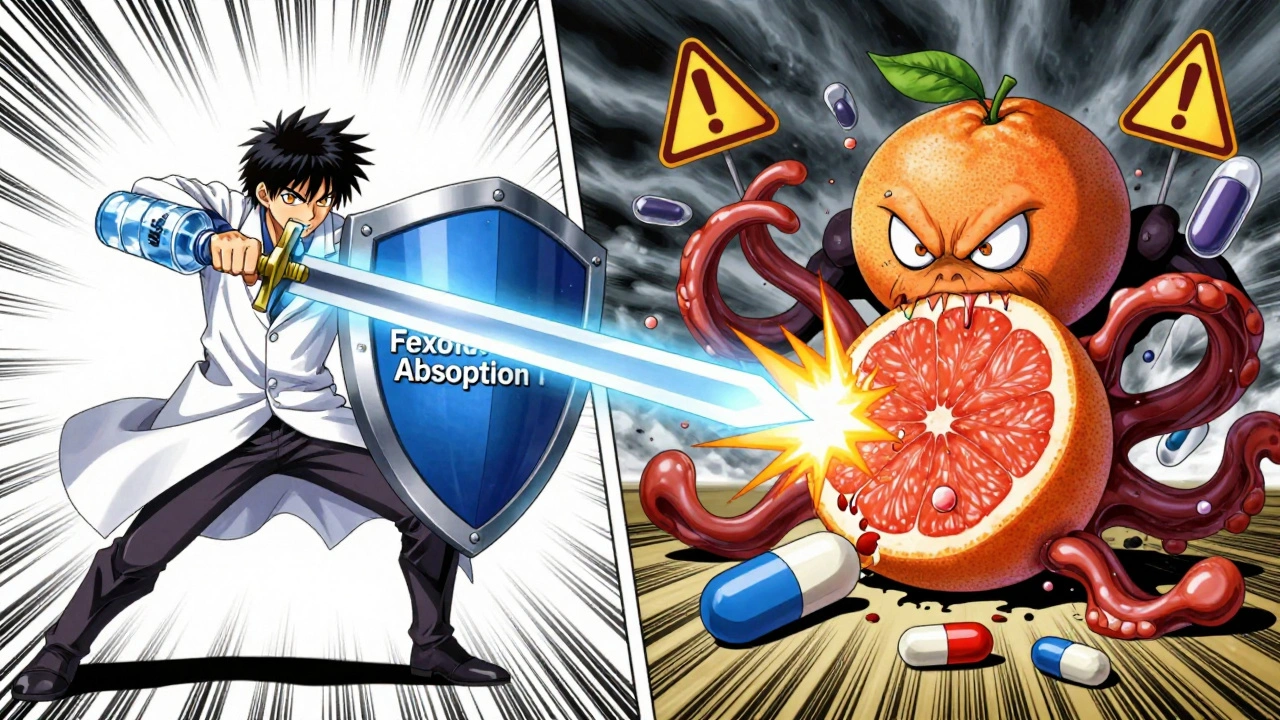
Fexofenadine doesn’t work the same way as other antihistamines like loratadine or cetirizine. It needs special transporters in your gut to get into your bloodstream. These are called OATP proteins - think of them as doorways that let fexofenadine slip into your body. Grapefruit, orange, and apple juice don’t just sit there. They block those doorways.
Research from the University of Western Ontario in 2002 showed that drinking 1.2 liters of grapefruit juice cut fexofenadine absorption by 67%. Orange juice? 72% drop. Apple juice? A shocking 77%. Even a single 8-ounce glass of orange juice reduced absorption by 23%. That’s not a small effect - it’s enough to make your allergy medicine stop working.
The problem isn’t your liver or stomach acid. It’s not metabolism. It’s absorption. Fexofenadine never even makes it into your blood in full force. So even if you take your full 180 mg dose, your body might only get 50 mg worth of the drug. That’s why your sneezing doesn’t stop. Your eyes still itch. Your nose still runs.
Why Only These Juices?
You might think all fruit juices are dangerous. But no. Tomato juice? Fine. Pineapple? Safe. Banana smoothie? No problem. Only grapefruit, orange, and apple juice have enough of certain flavonoids - like naringin and hesperidin - to shut down those OATP transporters.
These compounds are naturally occurring plant chemicals. In grapefruit, it’s bergamottin. In orange juice, it’s hesperidin. Apple juice has quercetin. They’re not toxic. They’re not harmful to your health. But they’re perfect at blocking fexofenadine.
And here’s the twist: this isn’t like grapefruit’s effect on statins or blood pressure meds. Those interactions make drugs too strong. This one makes fexofenadine too weak. It’s the opposite of what most people expect from grapefruit juice.
How Much Juice Is Too Much?
The studies used large amounts - 1.2 liters - which is more than most people drink at once. But here’s the catch: you don’t need that much to feel the effect. The FDA’s warning isn’t based on extreme cases. It’s based on real variability.
Some people absorb fexofenadine poorly even with small amounts of juice. Others might not notice a difference. But if you’re one of the 63% of users who don’t know about this interaction (according to a 2022 Sanofi survey), you’re guessing. And guessing with allergy medicine is risky.
One Reddit user, u/AllergySufferer2023, described taking Allegra with orange juice for weeks and thinking the medication was losing its power. Only after switching to water did their symptoms vanish. That’s not anecdotal - it’s repeatable.
What About Whole Fruit?
Yes, eating a whole grapefruit or an apple right before your pill can do the same thing. The same compounds are there. A small glass of juice contains as many of these blockers as the whole fruit. So if you’re eating fruit for breakfast and then popping your allergy pill, you’re still at risk.
There’s no official study saying “eat a grapefruit and your fexofenadine stops working,” but the mechanism is identical. If the juice blocks absorption, the fruit does too. Better safe than sorry.
What Should You Do Instead?
The fix is simple: use water. Only water.
The FDA and the Medical Letter both recommend waiting at least 4 hours before or after taking fexofenadine to drink any of these juices. That’s because the transporter-blocking effect lasts 2 to 4 hours. After that, your gut resets.
If you’re someone who always has orange juice with breakfast, take your fexofenadine at night instead. Or take it at lunch, and save the juice for dinner. It’s not about giving up juice - it’s about timing.
Also avoid green tea. It contains similar compounds and can interfere too. And don’t take fexofenadine with antacids that have magnesium or aluminum - they can also reduce absorption.
How This Compares to Other Antihistamines
This problem is unique to fexofenadine. Cetirizine (Zyrtec) and loratadine (Claritin) don’t use the same gut transporters. They’re absorbed differently. That’s why Zyrtec ads say: “Unlike some allergy medicines, Zyrtec doesn’t interact with fruit juice.”
It’s not marketing fluff. It’s science. And it’s why more people are switching - not because Zyrtec is stronger, but because it’s more predictable. If you’re someone who drinks juice daily, this might be the reason your fexofenadine isn’t working, and why your doctor might suggest a switch.

Why This Matters More Than You Think
Fexofenadine is used by an estimated 20 million Americans each year. That’s a lot of people who might be taking it wrong. Sanofi’s own data shows 41% of users consume juice within an hour of dosing. That’s a huge number of people getting less medicine than they paid for.
And it’s not just about allergies. If you have chronic hives and fexofenadine isn’t working, you might be told to increase the dose. But the real issue? Your morning OJ. No need for higher pills - just change your drink.
This isn’t a rare edge case. It’s one of the most well-documented food-drug interactions in modern medicine. The FDA even uses it as a textbook example in their training materials for drug developers.
What’s Being Done About It?
Sanofi has patented a new version of fexofenadine that releases the drug later, avoiding the window when juice blockers are active. It’s still in development, but it shows how seriously this is taken.
Meanwhile, patient education is slowly improving. The American Academy of Allergy, Asthma & Immunology now includes timing charts in their patient handouts. Sanofi’s website has a medication timing calculator. These aren’t gimmicks - they’re necessary tools.
But awareness is still low. A 2023 IQVIA report found patient inquiries about this interaction jumped 12% after a major meta-analysis confirmed the effect even at normal juice volumes. That means people are starting to notice - and they’re asking questions.
If you’ve been struggling with allergies despite taking your meds, this might be the missing piece. Not your environment. Not your stress. Not your diet. Just the juice you drank with your pill.
Bottom Line: Water Only
Take fexofenadine with a full glass of water. Wait 4 hours before drinking grapefruit, orange, or apple juice. If you can’t do that, switch to a different antihistamine like cetirizine or loratadine. Don’t assume your allergy medicine is broken. It might just be getting blocked by something you thought was healthy.
This isn’t about fear. It’s about control. You’re taking medicine to feel better. Don’t let a glass of juice undo that.



Maria Elisha
December 9, 2025 AT 07:14So I’ve been taking Allegra with orange juice for years and thought I was just allergic to everything. Turns out I was just drinking my medicine away. 😅 Water now. No more juice with pills.
Ajit Kumar Singh
December 10, 2025 AT 15:14Why is everyone so shocked by this I mean come on its basic pharmacology juice blocks absorption its not magic its science if you dont know this you probably also think vitamins cure colds
Tejas Bubane
December 12, 2025 AT 05:32Let me guess you think this is some groundbreaking revelation. The OATP transporter inhibition by flavonoids was published in the Journal of Clinical Pharmacology in 2001. We’ve known this for over two decades. People just ignore it because they like their morning OJ more than their health. Classic.
Sabrina Thurn
December 13, 2025 AT 11:33This is such an important but under-discussed interaction. Fexofenadine’s reliance on OATP3A1 makes it uniquely vulnerable compared to other second-gen antihistamines. The clinical impact is substantial - reduced AUC and Cmax directly correlate with diminished symptom control. Patients on 180mg daily who consume citrus within 2 hours may as well be on 50-70mg. That’s not just suboptimal - it’s therapeutically inadequate. Always use water. Always.
Larry Lieberman
December 14, 2025 AT 16:18Wait so apple juice is worse than grapefruit?? 😱 I just drank a whole bottle with my pill this morning… should I panic? 🤯
Iris Carmen
December 15, 2025 AT 16:14so i just took my allegra with apple juice and now i feel like a dumbass
Richard Eite
December 16, 2025 AT 14:41Americans drink juice with meds because they think fruit is medicine. In other countries we just take pills with water like normal people
Ronald Ezamaru
December 18, 2025 AT 07:19I used to take Allegra with orange juice for years. My allergies got worse over time until I switched to water. Then it worked like magic. I wish I’d known this sooner. Thanks for sharing this - it’s the kind of practical advice that actually helps.
Lisa Whitesel
December 18, 2025 AT 19:01People are still surprised by this? The FDA has had warnings since 2005. This isn’t a mystery. It’s negligence. If you’re taking fexofenadine and drinking juice, you’re not just misinformed - you’re actively undermining your own treatment. Stop being lazy and read the label.
Simran Chettiar
December 20, 2025 AT 15:16It is truly a paradox of modern pharmacology that the very substances which are heralded as natural and wholesome - the citrus fruits, the apples - become the silent saboteurs of therapeutic efficacy. One is led to believe that health is found in the orchard, yet the orchard, in its benevolent abundance, conspires to render our pharmaceutical interventions impotent. A poetic tragedy, if one considers the body as a temple and the juice as a Trojan horse.
Noah Raines
December 21, 2025 AT 01:53Green tea too? 😳 I drink two cups a day with my pill… guess I’m switching to coffee now. Thanks for the heads up.
Delaine Kiara
December 21, 2025 AT 15:07Someone’s gonna say ‘but I drink juice and I’m fine’ - yeah, you’re one of the 37% who absorb it okay. The rest of us? We’ve been suffering for years thinking our meds were broken. This isn’t anecdotal. It’s data. And if you’re still drinking OJ with your Allegra, you’re not just being careless - you’re being stubborn.
Darcie Streeter-Oxland
December 22, 2025 AT 16:14It is indeed a matter of considerable clinical significance that the ingestion of flavonoid-rich fruit juices may substantially impede the gastrointestinal absorption of fexofenadine, thereby compromising therapeutic outcomes. One would be prudent to administer this agent exclusively with aqueous medium, and to defer consumption of citrus or apple-derived beverages by a minimum of four hours, as per the directives of regulatory authorities.