
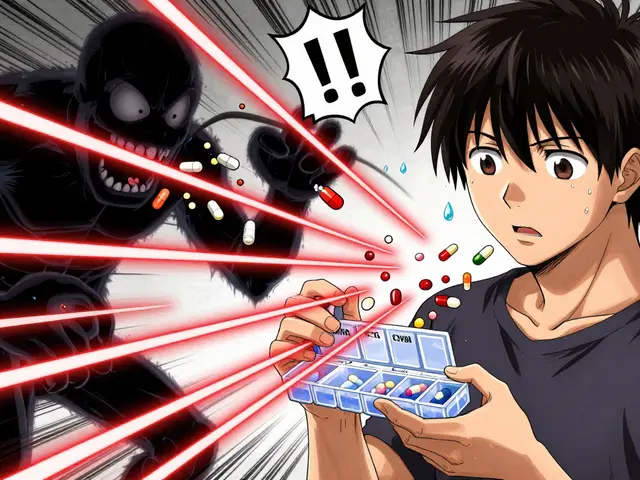
It’s not rare. You take your pill, and something feels off. Maybe the color’s wrong. Maybe you were told to take two, but the label says one. Or maybe you started feeling dizzy, nauseous, or breaking out in a rash after a new prescription. You’re not overreacting. You’re not being difficult. You’re doing exactly what you should do: paying attention to your body and your meds.
Medication errors happen more than you think. About 1.3 million people in the U.S. are injured every year because of mistakes with prescriptions, dosages, or drug interactions. Many of these errors never get reported-because people don’t know how, or they’re afraid they’ll get blamed. But here’s the truth: reporting a mistake isn’t about pointing fingers. It’s about stopping the next person from getting hurt.
Recognize the Error First
You can’t report what you don’t notice. Medication errors come in many forms:
- Wrong drug (you got amoxicillin instead of azithromycin)
- Wrong dose (you were supposed to take 5mg, but got 50mg)
- Wrong route (a pill meant to be swallowed was given as an injection)
- Wrong patient (someone else’s meds ended up in your bottle)
- Missing allergy warning (you’re allergic to sulfa, but it wasn’t checked)
- Drug interaction (your blood pressure med clashes with your new antibiotic)
Don’t wait for a crisis. If something feels off-your heart races, your skin turns red, you’re unusually confused-that’s a red flag. Even if you’re not sure, write it down. Note the time, what you took, how you felt, and when the symptoms started. Take a photo of the pill bottle if the label looks incorrect. Keep the container. Don’t throw it away.
Start with Your Provider
Before you call the FDA or file a report online, talk to the person who prescribed or dispensed the medication. That’s usually your doctor, pharmacist, or nurse. Call their office. If you’re in a hospital, ask for the charge nurse or patient advocate.
Be clear. Don’t say, “I think something’s wrong.” Say: “I was given metoprolol 100mg twice daily, but my old prescription was 25mg once daily. Since taking it, I’ve had dizziness and my heart rate dropped to 48. I’m concerned this is an error.”
Bring your records. Have your list of all medications, including over-the-counter and supplements. If you have a printed prescription or pharmacy label, bring it. This makes it easier for them to verify what was ordered versus what was given.
Ask: “Can we review my chart and the pharmacy record together?” Most providers will. If they brush you off, say: “I’m not asking for blame-I’m asking for safety. Can you help me document this so it doesn’t happen to someone else?”
Know Your Reporting Options
You have choices. You don’t have to pick just one.
1. Internal Hospital or Clinic Reporting
If you’re in a hospital, clinic, or long-term care facility, ask for their incident reporting system. Most have a form or online portal for patients to report errors. This is the fastest way to get a correction made in your own care. It also helps the facility fix their process-like double-checking labels or updating their EHR alerts.
But here’s the catch: if the culture is punitive, staff might be afraid to report too. That’s why your voice matters. When patients report, it pushes the system to change.
2. FDA MedWatch Program
The FDA’s MedWatch program collects reports from patients and providers about bad reactions or errors with medications, vaccines, and medical devices. It’s not just for doctors. Anyone can file a report.
Go to fda.gov/medwatch and click “Voluntary Reporting.” The form now takes under 10 minutes to fill out. You’ll need:
- Your name and contact info (optional-you can report anonymously)
- Name of the medication (brand and generic)
- Dosage and how you took it
- When the error happened
- Your symptoms and when they started
- Any medical history that might matter (allergies, other conditions)
Attach photos of the pill bottle, prescription label, or rash if you have them. The FDA gets about 140,000 reports a year. About 14% come from patients like you. But when they get detailed reports, they act. In 2023, a patient’s photo of a mislabeled insulin vial led to a nationwide recall within 72 hours.
3. Institute for Safe Medication Practices (ISMP)
ISMP runs a confidential reporting system that’s designed to learn from mistakes-not punish people. They don’t share your name with the hospital or pharmacy. They just analyze patterns.
If you saw a nurse give the wrong dose, or a pharmacy filled the wrong pill, you can report it to ISMP. They publish safety alerts that go out to thousands of hospitals. Since 1991, they’ve helped prevent over 200 major medication risks. You can report online at ismp.org.
What to Do If They Dismiss You
It happens. A lot. A 2022 study found that 82% of patients who reported medication errors felt their concerns were ignored at first. That’s not okay.
If your provider won’t take you seriously:
- Ask to speak to the patient advocate or ombudsman. They exist to help you.
- Request a copy of your medical records. Under HIPAA, they have to give them to you within 30 days. If they delay, file a complaint with HHS.
- Write a letter. Send it certified mail. Keep a copy. Say: “I reported a medication error on [date]. I have not received a response or correction. I am requesting documentation of how this will be addressed to prevent recurrence.”
- If it’s a school, nursing home, or long-term care facility, contact the state health department. They regulate those places.
Don’t let silence stop you. The system only improves when people speak up.
Special Cases: Kids and Schools
If your child was given the wrong medication at school, act fast. In 48 states, schools are required to report medication errors to the district and state health department within 24 hours.
Here’s what to do:
- Get the incident report. Schools must document what happened, who gave the med, and what symptoms appeared.
- Ask: “What steps are being taken to prevent this again?”
- If they don’t respond, contact your school board or state department of education. In Iowa, 87% of parents want follow-up on prevention-but only 41% get it.
- File a MedWatch report too. School errors are often missed by the system, but the FDA tracks them.
Why This Matters More Than You Think
One report won’t fix everything. But 100 reports? 1,000? That’s how systems change.
Studies show that hospitals with open, non-punitive reporting cultures reduce medication errors by up to 75%. When nurses feel safe reporting mistakes, they report 300-400% more. That means more chances to catch problems before someone gets hurt.
And it’s not just about big hospitals. A pharmacy in a small town made a mistake with blood pressure pills. A patient reported it. The pharmacy fixed their labeling. The next week, they caught another error in the system. That’s how safety grows.
The FDA’s new online MedWatch portal cuts reporting time from 25 minutes to under 10. The 21st Century Cures Act will require all electronic health records to have built-in error reporting by 2025. But none of that matters if people don’t use it.
You’re not a nuisance. You’re a safety net.
What Happens After You Report?
Don’t expect a call back. Most consumer reports to the FDA don’t get individual responses. That doesn’t mean nothing happened.
Here’s what usually follows:
- If the error is widespread (like a mislabeled batch), the FDA issues a recall.
- If it’s a pattern (like a common dosing mistake), ISMP publishes a safety alert to all hospitals.
- If it’s a local pharmacy issue, the state board of pharmacy may investigate.
- Your provider may update their protocols-like adding a second check for high-risk drugs.
Some reports lead to bigger changes. In 2023, a patient reported that a diabetes medication was being dispensed without a warning about kidney risk. That report helped trigger a new FDA safety communication.
Don’t report hoping for a thank-you. Report because someone else deserves to be protected.
Final Checklist Before You Report
Before you submit anything, make sure you have:
- ✅ The name of the medication (brand and generic)
- ✅ The correct dose vs. what you received
- ✅ The date and time the error occurred
- ✅ Your symptoms and when they started
- ✅ Photos of the pill bottle or label (if available)
- ✅ Your medical history (allergies, other meds)
- ✅ A copy of your prescription (if you have it)
Report it today. Don’t wait for someone else to get hurt. Your voice is the most powerful tool we have to make healthcare safer.

Kristi Pope
December 10, 2025 AT 20:03Just took my blood pressure med and noticed the pill looked different. I didn’t panic-I snapped a pic, called my pharmacist, and they caught a mix-up before I swallowed it. Thank you for this guide. You’re right, it’s not being difficult. It’s being alive.
Aman deep
December 12, 2025 AT 03:58in india we dont always have access to good pharamacies but i learned the hard way-always check the name on the strip, not just the bottle. once i got diabetes meds meant for someone else. i felt like crap for days. now i keep a little notebook. even if you think its nothing, write it down. it saves lives.
Monica Evan
December 14, 2025 AT 02:03My mom got the wrong anticoagulant dose last year. The pharmacy blamed her for not reading the label. She cried for hours. I made her call the FDA. They responded within 48 hours and flagged the pharmacy. She’s fine now. But if you’re scared to speak up? You’re not alone. Just do it anyway. Your voice is armor.
Jean Claude de La Ronde
December 14, 2025 AT 17:10So let me get this straight-we’re supposed to trust a system that gets medication dosing wrong 1.3 million times a year… but the solution is to ask nicely and fill out a form? Wow. I’m so glad the FDA doesn’t have a union or anything. Maybe next they’ll ask us to send a postcard to the CEO of Pfizer with crayons.
Katherine Liu-Bevan
December 16, 2025 AT 01:01One of the most underused tools in healthcare is the patient’s ability to document. I keep a meds journal on my phone-time, dose, symptoms, photo of the pill. I’ve caught three errors in the last year. Two were pharmacy mistakes, one was a doctor’s typo in the e-script. Never underestimate the power of a timestamp.
Lisa Stringfellow
December 17, 2025 AT 19:18Ugh. Another one of these ‘you’re a hero for speaking up’ guilt trips. I reported a mislabeled antibiotic and got a form letter from the pharmacy saying ‘we value your feedback.’ Then they kept giving out the same error. Who cares? The system’s broken. You’re not a hero. You’re a data point.
Aidan Stacey
December 19, 2025 AT 02:48MY SISTER ALMOST DIED BECAUSE A PHARMACIST GAVE HER A DRUG THAT INTERACTED WITH HER HEART MEDS. SHE WAS 22. SHE WASN’T EVEN SUPPOSED TO BE TAKING IT. THEY SAID ‘OH WE THOUGHT YOU WERE ON IT.’ I CRIED FOR WEEKS. I FILED A MEDWATCH REPORT. THEY NEVER CALLED BACK. BUT I DID IT ANYWAY. BECAUSE IF I DON’T, WHO WILL?
Jim Irish
December 19, 2025 AT 08:49Reporting is a civic duty. The system does not self-correct. It responds to pressure. Your report may never reach you, but it reaches someone who will change a policy. That is the quiet power of accountability.
Mia Kingsley
December 19, 2025 AT 13:34Wait so now we have to be medical detectives just to not die? I didn’t sign up for this. My doctor told me to take the blue pill. I took the blue pill. Now I’m supposed to know what’s in it? What if the label is printed wrong? What if the pharmacy is run by a raccoon? This is insane. Also I think the FDA is run by aliens.
Taylor Dressler
December 21, 2025 AT 10:12One thing people overlook: always ask for the original prescription printout from the pharmacy. It’s printed on a receipt. Compare it to the label. I’ve caught three dosage errors this way. The pharmacy staff never notices-they’re rushing. But you can. Be the second set of eyes.
Courtney Blake
December 23, 2025 AT 09:12I reported a wrong dose and got a call from the state board. They shut down the pharmacy for 3 days. The owner cried. I didn’t feel bad. We’re not in a democracy here-we’re in a capitalist machine that treats patients like disposable data. If you’re not angry, you’re not paying attention.