
The FDA doesn't wait for sick people to pile up before acting. When an outbreak of E. coli hits a dozen states, investigators don't start calling every farm or processor. They pick up a phone, ask for one thing: the lot number. That simple string of letters and numbers is the key to finding the source of contamination in minutes, not weeks.
What the FDA Actually Needs to Trace a Problem
Before 2026, tracing contaminated food was like following a trail of breadcrumbs in the dark. Each company kept its own records. A shipment of romaine lettuce might have one lot code from the farm, another from the packer, and a third from the distributor. If someone got sick, it could take weeks to piece together where the lettuce came from-and by then, more people were already sick. The FDA changed that with the Food Traceability Rule, part of the Food Safety Modernization Act (FSMA) Section 204. This rule, finalized in November 2022, says: if you handle certain high-risk foods, you must assign a unique Traceability Lot Code (TLC), a descriptor-often alphanumeric-that uniquely identifies a batch throughout the entire supply chain. It’s not just any internal code. It’s the one that stays with the product from farm to store.Which Foods Are Covered?
Not every food needs this. The FDA drew a line. They picked the ones most likely to cause outbreaks. That’s the Food Traceability List (FTL), a list of 16 high-risk foods that must carry a TLC. This includes:- Leafy greens (like romaine, spinach)
- Tomatoes
- Onions
- Fresh-cut fruits and vegetables
- Soft cheeses (like brie, feta)
- Eggs
- Nut butters
- Specific seafood (like shrimp, tuna, and oysters)
When and How Is the Lot Code Assigned?
You can’t just slap a code on anytime you want. The rule says TLCs must be assigned at three specific points:- When raw agricultural commodities (like lettuce or tomatoes) are first packed (except seafood from fishing vessels)
- When seafood from fishing vessels is first received on land
- When food is transformed-meaning it’s chopped, mixed, cooked, or repackaged
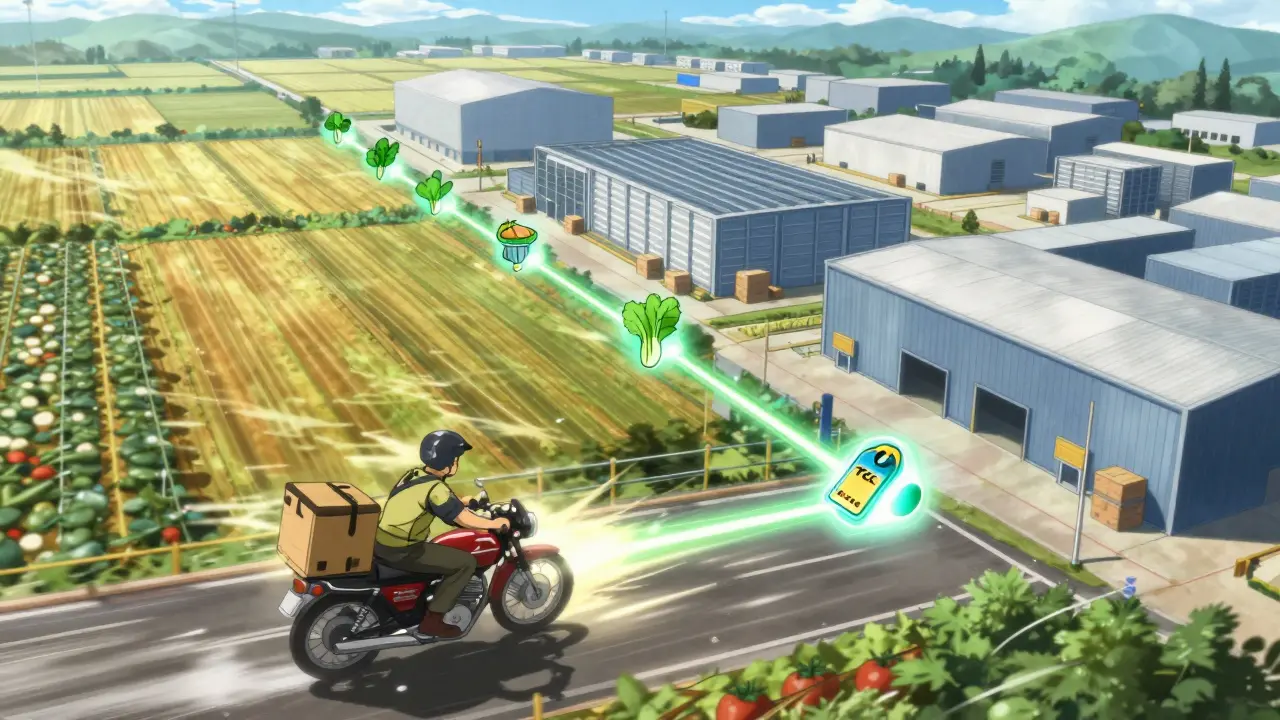
The Seven Key Data Elements That Tie It All Together
The TLC alone isn’t enough. The FDA needs context. For every TLC, companies must record and share seven Key Data Elements (KDEs), critical pieces of information that link the lot to its history:- The TLC itself
- The TLC Source (where and when it was assigned)
- Product description
- Quantity
- Unit of measure (pounds, cases, pallets)
- Transaction information (who sent it, who received it)
- Location of each transfer (physical address)
How Is This Different from Old Lot Codes?
Before this rule, companies used lot codes for internal quality checks. A dairy might label a batch of cheese as "CHEESE-021526" for shelf-life tracking. That’s fine for them-but useless for the FDA if the code doesn’t match up with the farm, the truck, or the distributor. The TLC system is different. It’s not about internal control. It’s about end-to-end traceability. The code must be passed along exactly as assigned. No renumbering. No dropping the trail. And crucially, the FDA made it clear: your existing internal code can be your TLC-if it meets the requirements. You don’t need two codes. One good one is enough.What Happens When an Outbreak Happens?
Imagine this: 12 people in three states get sick from E. coli after eating pre-packaged salad. The CDC spots the pattern. The FDA gets the alert. Within hours, they call the retailer: "What lot numbers did you get from your supplier?" The retailer pulls their records, finds the TLC, and passes it to the distributor. The distributor checks their logs and says: "We got that from GreenLeaf Farms, lot #GL-2026-047." The FDA calls GreenLeaf. They check their records: "That batch was harvested on January 12 from Field 3B, packed on January 14." Within 48 hours, they’ve isolated the source. The product is pulled. The outbreak stops. Before this system? That process could take 40 days. Now? It’s under 5.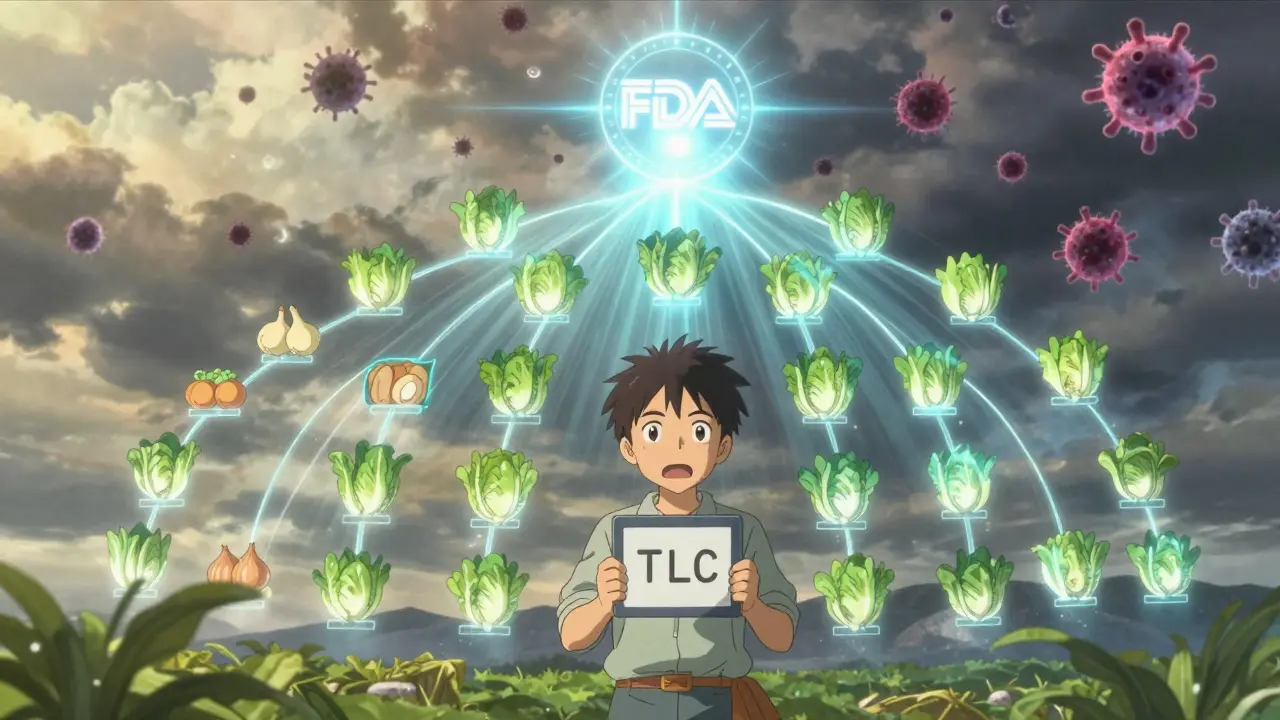
Who’s Affected? And What’s the Cost?
About 15,000 food facilities in the U.S. are impacted-mostly farms, processors, packers, and distributors handling FTL foods. The FDA estimates the annual cost to the industry will be $6.5 million. But the benefit? Up to $60 million a year from fewer illnesses, fewer recalls, and faster responses. Small businesses got some relief. The FDA created the Traceability Assistance Program, a free resource offering templates, training, and technical help to small farms and processors. Many small companies are using simple spreadsheets. Larger ones are upgrading their ERP systems. A 2023 survey found 78% of produce companies had already updated their systems.Challenges and Criticisms
Not everyone’s happy. Some say the FTL is too narrow. Melons, for example, have caused major outbreaks-but they’re not on the list. Consumers Union pointed out that this leaves a dangerous gap. Others worry about "tandem coding"-having to run both a TLC and an internal code. But the FDA clarified: if your internal code meets the rules, it counts as the TLC. No need for double work. The real issue? Interoperability. If one company uses a barcode, another uses a QR code, and a third uses a manual log, the system breaks. The FDA is working on standard formats for data exchange, with draft rules expected in 2024.What’s Next?
The compliance date was originally January 20, 2026. But after industry pushback, the FDA proposed a 30-month extension-pushing it to July 20, 2028. That gives companies more time to adapt. Looking ahead, the FDA is exploring blockchain and IoT sensors to track temperature and handling conditions in real time. They’re also considering adding melons, deli meats, and ready-to-eat foods to the FTL. The bottom line? Lot number tracking isn’t about bureaucracy. It’s about speed. When people get sick, time is the enemy. The TLC system gives the FDA the tool they need to act fast-and that saves lives.What is a Traceability Lot Code (TLC)?
A Traceability Lot Code (TLC) is a unique alphanumeric identifier assigned to a batch of food on the FDA’s Food Traceability List. It must be maintained throughout the supply chain and linked to key data elements like location, quantity, and transaction history. Unlike internal lot codes, a TLC is designed to be passed between entities to enable rapid tracing during foodborne illness outbreaks.
Which foods require a Traceability Lot Code?
The FDA’s Food Traceability List (FTL) includes 16 high-risk foods: leafy greens, tomatoes, onions, fresh-cut fruits and vegetables, soft cheeses, eggs, nut butters, and certain seafood products. These foods account for about 15% of the U.S. food supply by volume but are linked to the majority of foodborne illness outbreaks.
When must a TLC be assigned?
A TLC must be assigned at three points: (1) when raw agricultural commodities are first packed (excluding seafood from fishing vessels), (2) when seafood from fishing vessels is first received on land, and (3) when food is transformed-such as being chopped, mixed, cooked, or repackaged. The code must remain unchanged unless the food is transformed, at which point a new TLC is created while linking back to the original.
Can I use my existing lot code as the TLC?
Yes. The FDA explicitly states that any existing lot code used internally can serve as the Traceability Lot Code, as long as it is unique, passed along the supply chain, and linked to all required Key Data Elements. Companies do not need to create a second code unless their current one doesn’t meet the rule’s requirements.
What happens if I don’t comply with the TLC rule?
Non-compliance can lead to enforcement actions, including detention of products at the border, refusal of entry into the U.S., or mandatory recalls. While the FDA prioritizes education and assistance, especially for small businesses, repeated failures to provide requested traceability data during an outbreak may result in penalties or loss of market access.
How long do I have to provide records to the FDA?
When the FDA requests traceability records during an investigation, you must provide all required Key Data Elements-including the TLC and its associated information-within 24 hours. Failure to meet this deadline can delay outbreak response and increase public health risks.
Is blockchain required for TLC compliance?
No. Blockchain is not required. The rule allows any format for records-as long as they are electronic, sortable, and exportable (like CSV or Excel). Some large retailers like Walmart use blockchain for enhanced tracking, but it’s not part of the FDA’s mandatory requirements. Electronic records in standard formats are sufficient.


Natanya Green
February 23, 2026 AT 20:12Ashley Johnson
February 25, 2026 AT 16:14Lillian Knezek
February 27, 2026 AT 07:14Dominic Punch
February 27, 2026 AT 23:11Brooke Exley
February 28, 2026 AT 14:22Cory L
March 2, 2026 AT 13:29William James
March 3, 2026 AT 11:42Joanna Reyes
March 4, 2026 AT 08:15Stephen Archbold
March 6, 2026 AT 03:24Nerina Devi
March 8, 2026 AT 01:22Dinesh Dawn
March 8, 2026 AT 23:32Vanessa Drummond
March 9, 2026 AT 09:06Nick Hamby
March 10, 2026 AT 00:04kirti juneja
March 10, 2026 AT 01:46