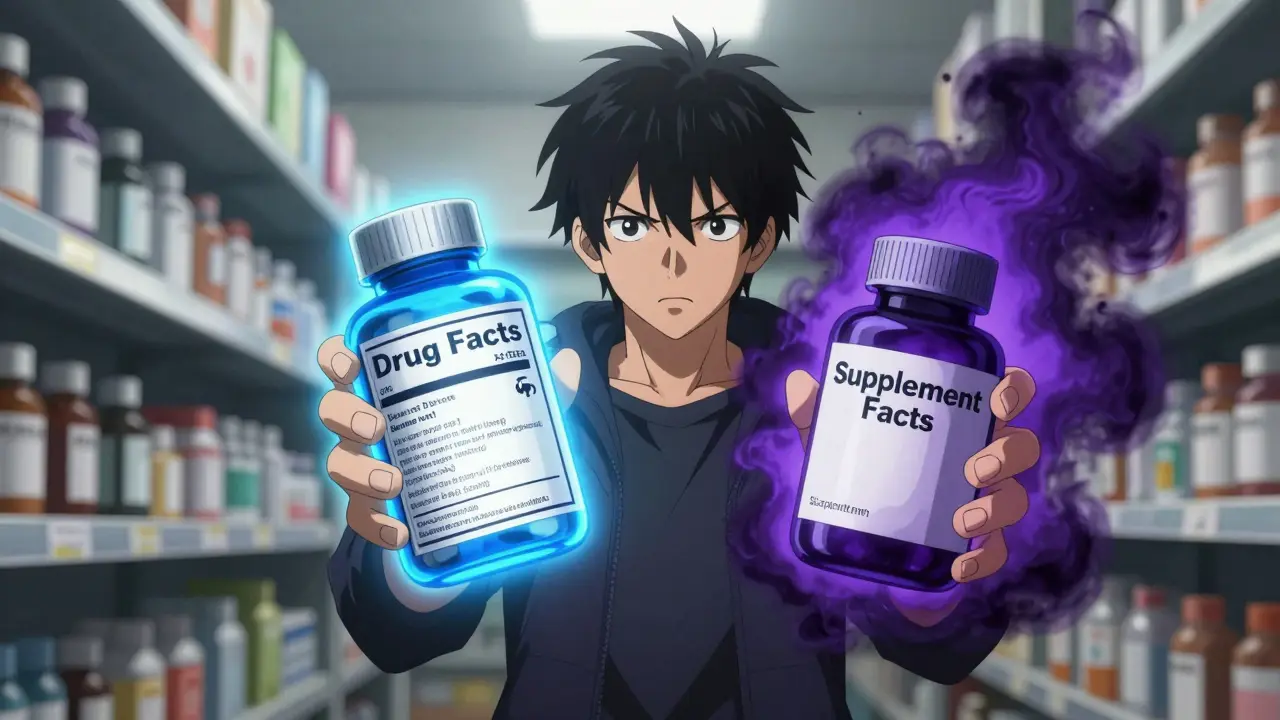
You walk into a pharmacy and grab two items. One is an over-the-counter pain reliever for your headache. The other is a multivitamin to boost your energy. You assume both are safe because they are sitting on the same shelf next to each other. You assume the government checked them out before they got there. But here is the hard truth: that assumption is wrong.
The Drug Facts label you see on that pain reliever is a strict legal requirement designed to keep you from harming yourself. It lists exact doses, warns about dangerous interactions, and tells you when not to use the product. Now look at the vitamin bottle. It has a Supplement Facts panel. It looks similar, but it is missing critical safety information. In fact, it is legally allowed to omit warnings that could save your life or prevent serious side effects. This isn't a conspiracy; it's just how the law works in the United States, and most people don't realize the difference until it is too late.
The Two Different Worlds of Regulation
To understand why your vitamin bottle lacks warning labels, you have to look at the laws governing these products. They operate under completely different rulebooks. OTC medications fall under the authority of the Food and Drug Administration (FDA) as drugs. Since 1999, the FDA has mandated the standardized Drug Facts label format. This means every OTC drug must list active ingredients with precise measurements, therapeutic uses, detailed warnings about contraindications, dosage directions, and pregnancy precautions.
Dietary supplements, however, are regulated as food products under the Dietary Supplement Health and Education Act (DSHEA) of 1994. This distinction is massive. Because they are classified as food, they do not need to prove their safety or efficacy before hitting the market. Instead, manufacturers can sell them immediately and only face consequences if the FDA proves later that the product is "adulterated" or "misbranded." This reactive approach creates a significant gap in consumer protection. While an OTC drug must be proven safe before you buy it, a supplement is assumed safe until proven otherwise.
This regulatory split leads to confusion. A 2022 study published in the AMA Journal of Ethics found that 72% of consumers incorrectly believe supplements undergo the same rigorous FDA safety review as medications. When you hold a bottle of ibuprofen, you are holding a product that passed multiple clinical trials. When you hold a bottle of turmeric capsules, you are holding a product that simply had its label approved by the manufacturer. The visual similarity between the Drug Facts and Supplement Facts panels tricks your brain into thinking they offer the same level of oversight.
What’s Missing from Your Supplement Bottle?
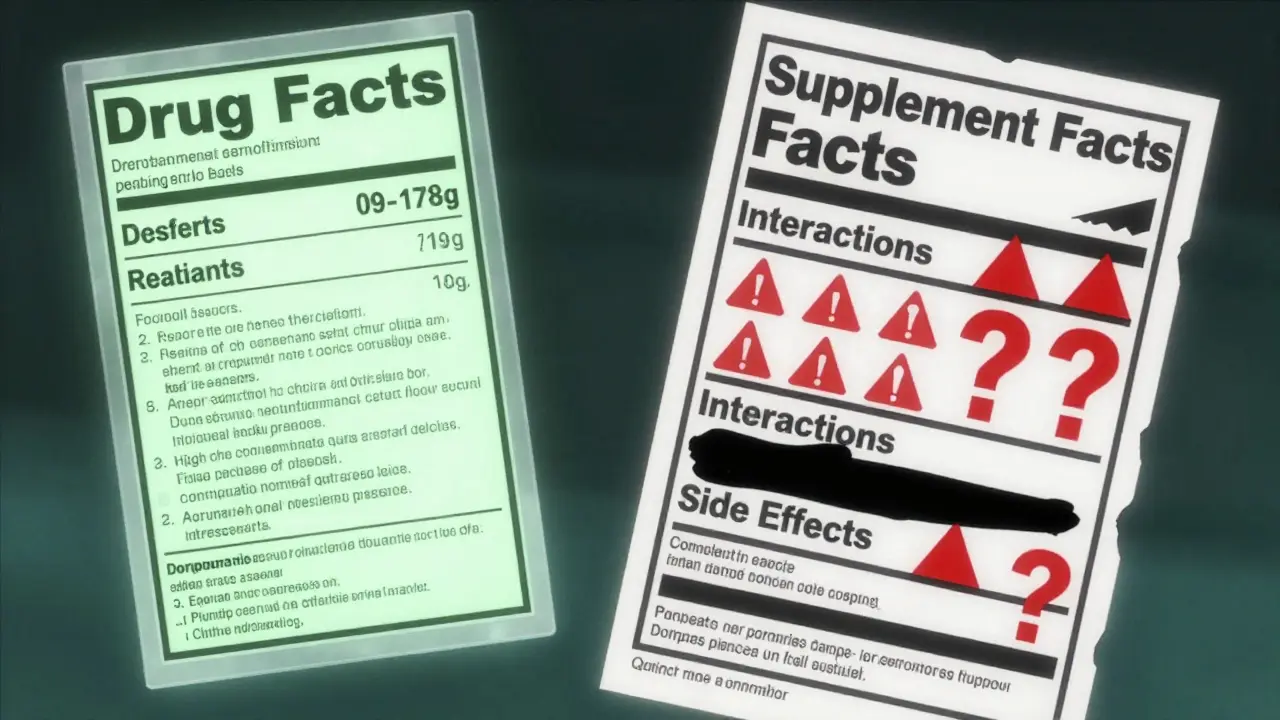
If you compare a Drug Facts label to a Supplement Facts panel side-by-side, several glaring omissions appear. These aren't minor details; they are critical safety data points that help you make informed health decisions.
- Precise Dosage Instructions: OTC drugs tell you exactly how much to take for specific symptoms (e.g., "take 1 tablet every 4 hours for pain"). Supplements often give vague advice like "take one capsule daily" without explaining what happens if you take more or less, or how long you should continue taking them.
- Drug Interaction Warnings: This is perhaps the most dangerous gap. OTC medication labels must list potential interactions with prescription drugs. Supplement labels rarely do. A 2021 study in JAMA Internal Medicine revealed that only 17% of supplement labels warn about interactions with prescription medications, compared to 100% of OTC drug labels. If you are on blood thinners, for example, knowing that St. John’s Wort interacts dangerously is vital information that your supplement bottle likely hides.
- Contraindications: Drug labels explicitly state who should NOT use the product (e.g., "do not use if you have liver disease"). Supplement labels seldom include these negative constraints, leaving patients with underlying conditions unaware of potential risks.
- Side Effects: While some supplements list common side effects, they are not required to disclose rare but severe adverse reactions in the same prominent way OTC drugs must.
Consider Vitamin A. High doses of retinol (a form of Vitamin A) are teratogenic, meaning they can cause birth defects. OTC acne treatments containing isotretinoin require strict Risk Evaluation and Mitigation Strategy (REMS) programs, including mandatory pregnancy tests and contraception requirements. Yet, vitamin A supplements containing 10,000 IU or more-levels associated with similar risks-often bury any pregnancy warning in fine print or omit it entirely. Furthermore, labels may list Vitamin A in International Units (IU) without specifying whether it comes from risky retinol or safer beta-carotene, making it impossible for you to assess your actual risk.
The Hidden Dangers of Proprietary Blends
Another major issue with supplement labeling is the prevalence of proprietary blends. Unlike OTC drugs, which must list the exact milligram amount of every active ingredient, supplements can hide individual quantities behind a collective total weight. For instance, a pre-workout powder might list "Energy Blend: 500mg" containing caffeine, taurine, and guarana, but won't tell you how much caffeine is actually in there.
This practice affects nearly half of all protein supplements and over 60% of weight loss supplements, according to a 2022 analysis by NSF International. Why does this matter? Because you cannot determine if the dose is safe or effective. You might be consuming double the recommended limit of a stimulant without realizing it. This lack of transparency turns supplement consumption into a guessing game, whereas OTC medication dosing is a calculated science.
| Feature | OTC Medication (Drug Facts) | Dietary Supplement (Supplement Facts) |
|---|---|---|
| Pre-market Safety Review | Required by FDA | Not Required |
| Active Ingredient Quantities | Exact amounts listed | Proprietary blends allowed (hidden amounts) |
| Drug Interactions | Mandatory warnings | Rarely listed (only 17% compliance) |
| Pregnancy Warnings | Strict, prominent requirements | Often vague or omitted |
| Claims Allowed | Treats/cures specific conditions | Structure/function claims only (e.g., "supports bone health") |
| Sodium Content | Must be listed per dose | Not required |
Why Does This Gap Exist?
You might wonder why the FDA doesn't just force supplements to follow the same rules as drugs. The answer lies in lobbying power and industry size. The U.S. dietary supplement industry generated $54.2 billion in sales in 2022, growing rapidly year over year. This massive economic footprint translates into political influence. In 2022 alone, the supplement industry spent $8.2 million on federal lobbying to resist stricter labeling and testing requirements.
Regulatory enforcement remains slow and reactive. The Government Accountability Office (GAO) reported in 2023 that the FDA takes an average of 427 days to act on reports of dangerous supplements. Compare that to 45 days for problematic OTC medications. During those 14 months, potentially harmful products remain on shelves. The burden of proof is on the regulator to show the product is unsafe, rather than on the manufacturer to prove it is safe. This systemic delay protects profits but compromises public health.
Consumer confusion fuels this status quo. Many shoppers trust the pharmacy environment itself. If a product is sold at CVS or Walgreens, they assume it meets high standards. However, pharmacies stock supplements primarily for revenue, not because they have vetted the contents. Pharmacists frequently field questions about why vitamins lack interaction warnings, with Walgreens reporting over 14,000 such inquiries in just the first quarter of 2023. This rising awareness suggests consumers are beginning to notice the disparity, even if regulators haven't caught up.

How to Protect Yourself Without a Drug Facts Label
Since you cannot rely on the label alone, you must become your own investigator. Here are practical steps to bridge the information gap between supplements and OTC drugs.
- Check for Third-Party Certification: Look for seals from independent organizations like NSF International, USP (United States Pharmacopeia), or ConsumerLab.com. These groups test products for purity, potency, and contaminants. As of September 2023, only 2,147 products held NSF/ANSI Standard 173 certification, meaning the vast majority of supplements on the shelf have never been independently verified.
- Use Independent Databases: Don't trust the marketing website. Use resources like Examine.com or the NIH Office of Dietary Supplements' Supplement Label Database. These platforms provide unbiased, evidence-based summaries of what the science says about a supplement, including known interactions and side effects that the manufacturer omits.
- Consult Your Pharmacist or Doctor: Before starting any new supplement, especially if you take prescription medications, ask a professional. They can check for interactions that aren't listed on the bottle. Remember, the pharmacist is trained to read Drug Facts labels; leverage that expertise for your supplements too.
- Avoid Proprietary Blends: If a label hides the specific amount of each ingredient, put it back. You deserve to know exactly what you are putting into your body. Transparent brands will list every ingredient and its exact milligram count.
- Watch for Vitamin A Forms: If you are pregnant or planning to become pregnant, avoid supplements listing "Retinol" or "Vitamin A Palmitate" in high doses. Opt for "Beta-Carotene" instead, which the body converts to Vitamin A only as needed, reducing the risk of toxicity.
The Future of Supplement Labeling
There are signs that change may be coming. In June 2023, the FDA issued draft guidance proposing enhanced labeling for high-dose Vitamin A supplements, requiring amounts to be listed in Retinol Activity Equivalents (RAE) rather than ambiguous IUs, along with more prominent pregnancy warnings. Additionally, the Dietary Supplement Listing Act of 2022 aims to require manufacturers to register all products with the FDA, improving traceability.
However, these changes are incremental. The fundamental classification of supplements as food rather than drugs remains intact. Until Congress passes legislation reclassifying supplements or mandating Drug Facts-style labels, the responsibility falls on you. The Drug Facts label is a shield provided by law for OTC medications. For supplements, you must build your own shield through research, skepticism, and professional advice. Do not let the familiar packaging fool you into a false sense of security. Know what you are buying, and demand transparency from the brands you support.
Are vitamins considered OTC drugs by the FDA?
No. Vitamins and dietary supplements are regulated as food products under the Dietary Supplement Health and Education Act (DSHEA) of 1994, not as drugs. This means they do not require pre-market approval for safety or efficacy, unlike OTC medications which must pass rigorous FDA review.
Why don't supplement labels list drug interactions?
Federal law does not require supplement manufacturers to list drug interactions on their labels. Studies show that only 17% of supplement labels include these warnings, whereas 100% of OTC drug labels must. This creates a significant safety gap for consumers taking both prescriptions and supplements.
What is the difference between Drug Facts and Supplement Facts?
The Drug Facts label is mandatory for OTC medications and includes precise dosages, therapeutic uses, and detailed safety warnings. The Supplement Facts panel is used for dietary supplements and lacks requirements for many safety disclosures, such as specific drug interactions, contraindications, and sometimes exact ingredient amounts due to proprietary blends.
Is it safe to take supplements if I am pregnant?
You should exercise extreme caution. Many supplements, particularly those high in Vitamin A (retinol), can cause birth defects. Unlike OTC drugs, which have strict pregnancy warnings, supplement labels often omit these risks. Always consult your doctor and check for third-party certifications before taking any supplement during pregnancy.
How can I verify if a supplement is safe?
Look for third-party testing seals from organizations like NSF International, USP, or ConsumerLab.com. Additionally, use independent databases like Examine.com or the NIH Supplement Label Database to research ingredients and potential interactions. Avoid products with proprietary blends that hide ingredient dosages.
Does the FDA approve supplements before they are sold?
No. The FDA does not approve dietary supplements before they reach the market. Manufacturers are responsible for ensuring their products are safe and that label claims are truthful. The FDA only takes action against supplements after they are marketed if they are found to be adulterated or misbranded, a process that can take hundreds of days.