
Most people don’t realize pancreatic cancer can be silent for months-sometimes years-before it shows up. By the time symptoms appear, it’s often too late. That’s why understanding the early warning signs and recent treatment breakthroughs isn’t just helpful-it could save your life or someone you love.
Why Pancreatic Cancer Is So Dangerous
The pancreas sits deep behind your stomach, hidden from routine exams. It’s not like a lump in the breast or a cough that won’t go away. Pancreatic cancer doesn’t scream for attention. It whispers. And by the time it’s loud enough to notice, it’s usually spread. This cancer kills more than 50,000 people in the U.S. every year. Only 12% of patients survive five years after diagnosis. That number jumps to 44% if the cancer is caught before it spreads. But here’s the problem: 80% of cases are diagnosed at stage III or IV. Most people aren’t screened because there’s no standard test for the general public. The good news? Survival rates are improving. Ten years ago, someone with advanced pancreatic cancer lived about six months. Now, with new treatments, many live over a year-and some even longer. The key? Catching it early and using the right tools.Early Symptoms You Can’t Ignore
These symptoms are vague. They look like the flu, stress, or aging. But if they show up together-or suddenly-you need to pay attention.- Unexplained weight loss: Losing 10 pounds or more without trying is a red flag. In 60% of cases, this is one of the first signs. It’s not just appetite loss-it’s your body breaking down muscle and fat even when you’re eating.
- Abdominal or back pain: A dull ache that won’t go away, especially if it radiates to your back. This happens in 65-75% of patients. It’s often mistaken for muscle strain or gallbladder issues.
- Jaundice: Yellow skin or eyes. This happens when a tumor blocks the bile duct. You’ll also notice dark urine (like cola) and pale, greasy stools that float. Itching is common too-60% of people with jaundice report severe skin itch.
- New-onset diabetes: If you’re over 50 and suddenly develop diabetes with no family history or weight gain, get checked. Research shows 80% of pancreatic cancer patients develop diabetes within 18 months of cancer starting. Blood sugar jumps from normal (under 100 mg/dL) to diabetic levels (over 126 mg/dL) in just months.
- Loss of appetite and nausea: Food starts to feel repulsive. You might feel full after a few bites. This isn’t just a stomach bug-it’s the pancreas failing to produce digestive enzymes.
- Depression or anxiety: This one surprises people. A 2018 study found that nearly half of pancreatic cancer patients had major depression or anxiety before physical symptoms appeared. Some doctors now call it a “psychiatric warning sign.”
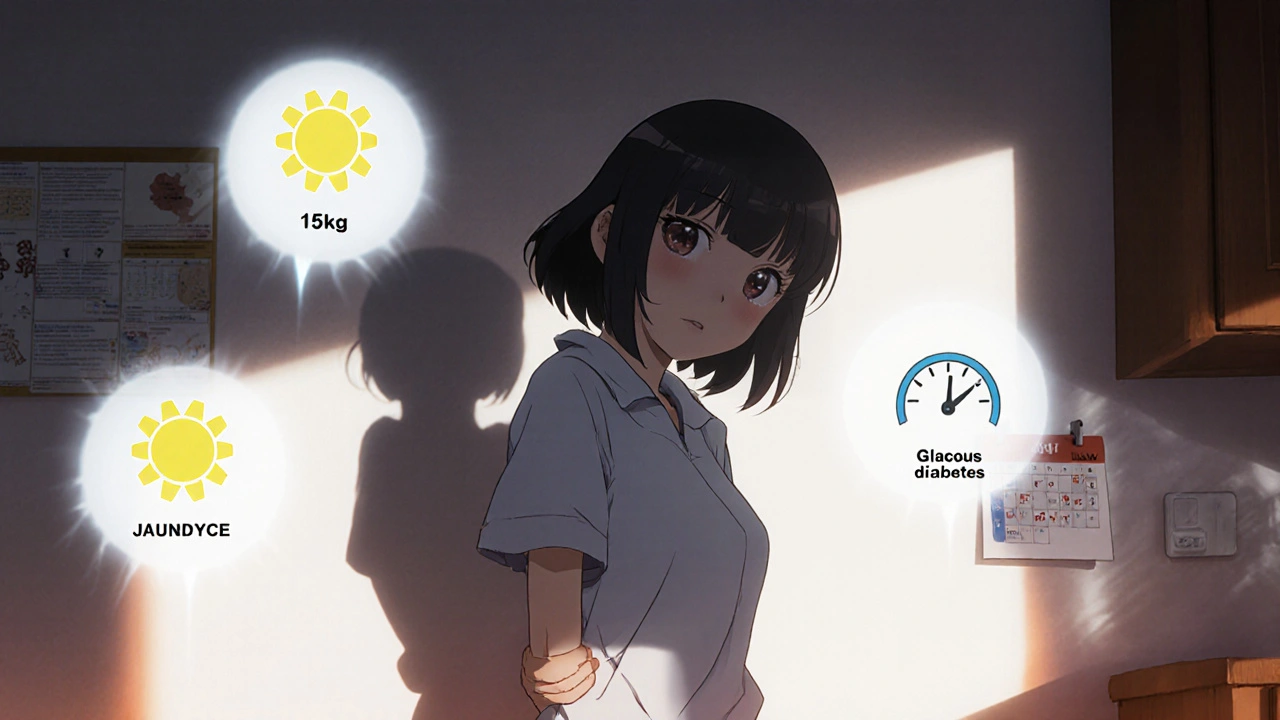
One patient in Melbourne, 58, thought her back pain was from gardening. She lost 15 kilos over three months. Her doctor blamed stress. Then her eyes turned yellow. By the time she got a CT scan, the cancer had spread. She later found out her fasting blood sugar had been rising for six months-her GP never flagged it.
Why Diagnosis Is So Hard
There’s no blood test you can take at your annual checkup that catches pancreatic cancer early. CA 19-9 is the most common marker, but it’s only accurate in advanced cases. In early stages, it misses more than half the tumors. Imaging helps, but it’s not perfect. A CT scan can miss tumors smaller than 2 centimeters. That’s about the size of a grape. By then, the cancer may already be growing into nearby nerves or blood vessels. The best diagnostic tool right now is endoscopic ultrasound (EUS). A thin tube with a camera is passed through your mouth into your stomach. From there, it can get close to the pancreas and take a tiny tissue sample. It’s accurate 95% of the time when done right. But it’s not routine. Most doctors only order it after other tests raise suspicion.
Treatment Advances That Are Changing Outcomes
Surgery is still the only chance for a cure. The Whipple procedure-removing part of the pancreas, duodenum, and sometimes part of the stomach-is the most common. It’s complex. But survival rates have improved. At top centers, 20-25% of patients with early-stage cancer live five years or more. But here’s the big shift: surgery isn’t always the first step anymore. Neoadjuvant therapy means giving chemotherapy before surgery. It shrinks tumors, kills hidden cells, and makes surgery safer. The FOLFIRINOX combo (a mix of four chemo drugs) has been a game-changer. In borderline cases-where tumors were once considered inoperable-58% responded well enough to be removed. For patients with advanced cancer, the difference is stark. In 2010, median survival was six months. Today, with modified FOLFIRINOX, it’s over 54 months. That’s more than four and a half years. Targeted therapies are now real options for some. If you have a BRCA gene mutation (often linked to breast or ovarian cancer), the drug olaparib can slow progression by nearly eight months. For the rare 3-4% with MSI-H or dMMR tumors, pembrolizumab (a checkpoint inhibitor) can shrink tumors in 40% of cases.What’s on the Horizon
The future of pancreatic cancer isn’t just about better drugs-it’s about finding it earlier. Johns Hopkins developed a blood test called PancreaSeq. In high-risk groups-like people with inherited gene mutations-it detects early cancer with 95% accuracy. Another test, being tested in the DETECTA trial, looks for tumor DNA and protein markers in blood. Early results show 85% accuracy. AI is helping too. Google’s LYNA algorithm can spot cancer cells on biopsy slides with 99.3% accuracy. That means faster, more reliable diagnosis. Even your gut bacteria might hold clues. A 2023 study found that people with pancreatic cancer have a different mix of microbes in their mouths and intestines than healthy people. A simple stool or saliva test could be coming soon.
Who Should Be Screened
You don’t need screening unless you’re at high risk. That includes:- People with BRCA1, BRCA2, PALB2, or Lynch syndrome mutations
- Those with hereditary pancreatitis
- People with two or more close relatives who’ve had pancreatic cancer
- Anyone with new-onset diabetes after age 50 and no other explanation
If you fit one of these, talk to your doctor about annual MRI or endoscopic ultrasound. Programs at Johns Hopkins, Mayo Clinic, and MD Anderson offer these for free or low cost to eligible patients.
What You Can Do Now
Don’t wait for a diagnosis. If you’re noticing any of these symptoms-especially in combination-push for answers.- Ask for a fasting blood glucose test if you’ve gained weight or feel tired all the time.
- Get an ultrasound or CT scan if you have persistent back pain and unexplained weight loss.
- Don’t brush off depression as “just stress.” Mental health changes can be physical.
- Know your family history. If a parent or sibling had pancreatic cancer, get genetic counseling.
Survival isn’t just about luck anymore. It’s about awareness, timing, and knowing what questions to ask. The tools are here. The science is moving fast. What’s missing is the urgency.
Can pancreatic cancer be detected early with a blood test?
There’s no routine blood test for the general public yet. The CA 19-9 test is used mostly to monitor treatment, not detect early cancer-it misses half of early-stage tumors. But new tests like PancreaSeq and the DETECTA trial’s blood test are showing over 85% accuracy in high-risk groups. These aren’t available everywhere, but they’re coming fast.
Is jaundice always a sign of pancreatic cancer?
No. Jaundice can come from gallstones, hepatitis, or liver disease. But if you’re over 50, have no history of liver problems, and develop jaundice with weight loss or new diabetes, pancreatic cancer must be ruled out. The combination matters more than the symptom alone.
Why does pancreatic cancer cause new-onset diabetes?
The tumor interferes with insulin-producing cells in the pancreas. It doesn’t destroy them all at once-it slowly disrupts their function. This causes blood sugar to rise months before the tumor is big enough to cause pain or jaundice. That’s why doctors now treat new diabetes in older adults as a potential red flag.
Can you survive pancreatic cancer if it’s caught early?
Yes. If the cancer is confined to the pancreas and hasn’t spread to blood vessels or nerves, surgery can offer a real chance of cure. Five-year survival jumps from 3% in metastatic cases to 39% in early, resectable tumors. That’s why catching it early changes everything.
What’s the best treatment for advanced pancreatic cancer?
Modified FOLFIRINOX is now the standard first-line treatment for fit patients with advanced disease. It extends survival to over four years in some cases. For those who can’t handle the side effects, gemcitabine plus nab-paclitaxel is still effective. Targeted drugs like olaparib work only if you have a BRCA mutation-so genetic testing is critical.
Should I get genetic testing if I have pancreatic cancer?
Yes. About 1 in 5 pancreatic cancer patients have an inherited gene mutation-like BRCA, PALB2, or Lynch syndrome. Finding this changes treatment options (like using olaparib) and helps your family members get tested too. Most major cancer centers now offer free genetic counseling for all pancreatic cancer patients.
Is pancreatic cancer hereditary?
About 10% of cases are inherited. If you have two or more close relatives with pancreatic cancer, or if someone in your family had BRCA-related breast, ovarian, or prostate cancer, your risk is higher. Genetic testing can identify mutations before cancer develops.
Why do so many people get misdiagnosed with IBS or gallstones?
Because the symptoms overlap. Pain in the upper abdomen, bloating, nausea, and fatty stools are common in both IBS and early pancreatic cancer. Doctors don’t jump to cancer unless there’s a clear red flag-like weight loss or jaundice. That’s why patients often see multiple doctors before getting the right diagnosis.




Justina Maynard
November 28, 2025 AT 16:44Unexplained weight loss? Jaundice? New diabetes at 58? I had a neighbor who ignored all three until she couldn’t stand up. By then, the cancer had eaten through her bile duct and was kissing her liver. They told her it was ‘just stress’ for eight months. Eight months. I still cry thinking about it. Don’t wait for a textbook presentation-your body whispers before it screams.
And if your doctor brushes off new-onset diabetes in someone over 50 without a family history? Fire them. That’s not negligence-it’s malpractice waiting to happen.
Also, the part about depression being a symptom? That hit me hard. My aunt was diagnosed after she stopped answering texts. No pain. No jaundice. Just… silence. Turns out her pancreas was dying and her brain knew before her body did.
Genetic testing isn’t optional if you have a family history. My cousin’s BRCA2 mutation was found because she asked. She’s alive today because she didn’t trust ‘it’s probably nothing.’
And yes-EUS is the gold standard. If your doc hasn’t mentioned it, ask. Not ‘maybe’-ask. Like, right now.
I’m not a doctor. But I’ve seen enough people die because they trusted silence over suspicion.
Know your risk. Push. Advocate. Don’t let bureaucracy bury you before the tumor does.
Evelyn Salazar Garcia
November 29, 2025 AT 07:33Another US medical scam. Why do we even have this post? We’re being sold fear to sell scans and chemo.
Most of this is just ‘maybe’ and ‘could be.’
My uncle had all these symptoms and it was just gallstones.
Stop scaring people.
Also, why is everyone in the US obsessed with ‘early detection’? We’re not Japan. We don’t have free healthcare.
Save your money.
Clay Johnson
November 30, 2025 AT 03:19The pancreas is not a silent organ. It is a neglected one.
Our medical system does not reward vigilance. It rewards reaction.
That is why we have 80% late-stage diagnoses.
The science exists.
The tools exist.
But the incentive structure does not.
Until we pay doctors to prevent disease instead of treat it, nothing will change.
And until we stop treating patients like data points, we will keep losing people to whispers.
It is not a failure of biology.
It is a failure of systems.
And systems are designed.
Which means they can be redesigned.
Will we?
Jermaine Jordan
December 1, 2025 AT 03:04This isn’t just medical information-it’s a lifeline.
Every single sentence here could be the difference between life and death for someone you love.
Think about it: your mom, your dad, your best friend-what if they’re ignoring that back pain because they think it’s ‘just aging’?
What if their new diabetes is the first sign of something far worse?
This isn’t a blog post.
This is a wake-up call written in blood, sweat, and tears by people who didn’t make it.
And now? We have the power to change the outcome.
Don’t just read this.
Share it.
Text it to your family.
Print it and put it on the fridge.
Because awareness doesn’t just save lives.
It gives them back.
And that’s worth more than any drug, any scan, any surgery.
Chetan Chauhan
December 1, 2025 AT 05:54Bro this is all just big pharma propaganda.
Jaundice? Diabetes? Weight loss? That’s what happens when you eat too much sugar and sit on your ass.
Why do you think they push all these tests? To sell you MRIs and chemo.
My cousin got diagnosed with ‘pancreatic cancer’ after a CT scan-turns out it was just a cyst.
And now he’s broke.
Also, AI detecting cancer? LOL.
Google’s LYNA? That’s just a fancy filter.
And genetic testing? That’s how they track your DNA for insurance.
Wake up.
This is a money grab.
And the ‘survival rates’? They just redefined ‘early’ to make numbers look better.
Trust your gut. Not the internet.
And definitely not Johns Hopkins.
They’re paid to scare you.
They’re not your friends.
Phil Thornton
December 2, 2025 AT 16:36I’ve had back pain for months. Lost 8 pounds. Started getting really tired.
Went to the doc.
They said ‘maybe you need more sleep.’
Went back.
They said ‘maybe your diet’s off.’
Third time? I asked for a glucose test.
Turns out my sugar was 142.
They did an ultrasound.
Nothing.
But I’m not stopping.
I’m getting an EUS.
Because I’d rather be paranoid than dead.
And if you’re reading this and you’ve been ignoring symptoms?
Do the same.
Pranab Daulagupu
December 3, 2025 AT 14:30As someone who’s seen pancreatic cancer up close in my family, I want to say: this is one of the most accurate summaries I’ve ever read.
The part about depression as an early sign? That’s real. My sister stopped painting, stopped calling friends-no one connected it to the tumor.
And yes-genetic testing saved my nephew’s life.
He didn’t have symptoms. Just a family history.
Screened at 38.
Found a 1.2 cm lesion.
Removed it.
Now he’s 41 and hiking in the Rockies.
Don’t wait for pain.
Don’t wait for jaundice.
Ask for the test.
Even if your doctor says ‘you’re too young.’
They’re wrong.
And if you’re at risk? Get help.
Mayo, Hopkins, MD Anderson-they’ll help you.
It’s not fear.
It’s power.
Barbara McClelland
December 4, 2025 AT 23:53You’re not alone if you’ve been brushed off by doctors.
I’ve been there.
Three visits. Two ‘stress’ diagnoses. One ‘maybe it’s IBS.’
Then I printed out this exact article and handed it to my new PCP.
She said, ‘You’re right. Let’s move fast.’
Turns out my fasting glucose had been creeping up for 14 months.
CT scan showed a 1.5 cm tumor.
Neoadjuvant chemo started two weeks later.
Now I’m in remission.
So if you’re reading this and you’re scared?
Be scared. Then act.
Write down your symptoms.
Bring this post to your appointment.
Ask for EUS.
Ask for genetic testing.
Ask for a second opinion.
You have more power than you think.
And you deserve to be heard.
I’m rooting for you.
Now go make your doctor listen.
Alexander Levin
December 5, 2025 AT 23:03They’re hiding the truth.
Why don’t they just give everyone a free blood test?
Because then they’d lose billions in chemo sales.
And the FDA? They’re bought.
AI? Just a distraction.
They want you scared.
So you’ll pay.
And die.
Meanwhile, the real cure? Curcumin. Vitamin D. Fasting.
But you won’t hear that on CNN.
They’re not your allies.
They’re the system.
And they profit from your suffering.
Stay woke.
And don’t trust any doctor who doesn’t mention ‘alkaline diets.’
Ady Young
December 6, 2025 AT 01:11Just wanted to say thank you to everyone who shared their stories here.
I’m a nurse in Ohio. I see this every day.
People come in with all these symptoms, and they’re told to ‘wait and see.’
But I’ve seen what happens when someone pushes.
One woman, 62, came in with weight loss and new diabetes.
She didn’t have insurance.
So I helped her find a free screening program at the county clinic.
Turns out she had a resectable tumor.
She had surgery. Now she’s back at work.
It’s not magic.
It’s persistence.
And community.
If you’re reading this and you’re afraid to speak up?
Find someone who’ll help you.
A friend.
A family member.
A nurse.
You don’t have to fight alone.
And you deserve to be heard.
Keep going.
You’ve got this.