

What Exactly Is Hyperpigmentation?
Hyperpigmentation isn’t one thing-it’s a symptom. It’s when patches of skin get darker than the rest, not because of a tan, but because too much melanin is being made in certain spots. You might see it as brown or grayish spots on your face, hands, or arms. Two of the most common types are melasma and sun damage (also called solar lentigines). They look similar, but they’re caused by different things-and they need totally different treatments.
Melasma: More Than Just a Tan
Melasma shows up as big, patchy areas of darkening, usually on the cheeks, forehead, nose, or upper lip. It’s not caused by the sun alone. Hormones play a huge role. If you’ve been pregnant, on birth control, or taking hormone therapy, your risk goes up. It’s most common in women with medium to darker skin tones-Fitzpatrick types III to VI. Studies show Black, Asian, and Hispanic women are 3 to 5 times more likely to develop melasma than Caucasian women.
What makes melasma tricky is that it doesn’t just react to UV light. Visible light from windows, LED screens, and even fluorescent bulbs can trigger it. Heat does too. That’s why a regular sunscreen isn’t enough. You need one with iron oxides, which block visible light. Harvard Medical School puts it bluntly: “The sun is stronger than any medicine I can give you.”
Sun Damage: The Slow Burn
Sun damage looks different. It’s smaller, well-defined spots-often called age spots or liver spots-that show up on areas you’ve exposed to the sun over years: face, hands, shoulders. These spots are the result of UV rays damaging melanocytes, the skin cells that make pigment. Unlike melasma, they’re not linked to hormones. Almost 90% of fair-skinned people over 60 have them.
The good news? Sun damage responds well to treatment. A few sessions of IPL (Intense Pulsed Light) can clear them up in weeks. Topical creams work too, but they take longer. The bad news? If you keep exposing your skin to UV without protection, they’ll come back-and new ones will form.
Why You Can’t Treat Them the Same Way
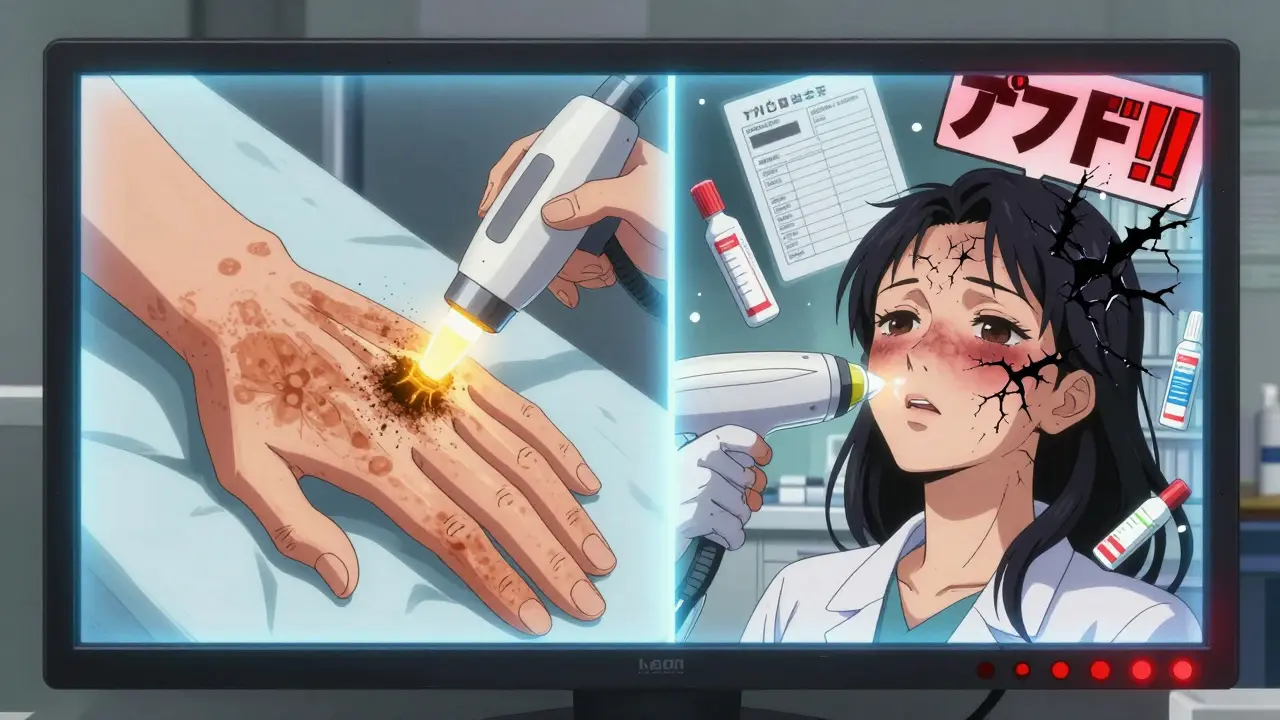
This is where people get it wrong. Many try laser treatments for melasma because they worked for sun spots. Big mistake. Lasers and IPL generate heat. And heat wakes up melanocytes in melasma, making the dark patches worse. Studies show up to 40% of melasma cases get darker after IPL. Dermatologists won’t even consider lasers for melasma until they’ve first suppressed the melanocytes with topical treatments for 8 to 12 weeks.
Sun damage? That’s a different story. IPL targets the pigment directly. The spots darken right after treatment, then flake off in a few days. Most people see 75-90% improvement in 2-3 months. Melasma? Even with the best treatment, only 40-60% see noticeable improvement in six months. And over 80% of those cases come back within a year if sun protection slips.
The Topical Agents That Actually Work
Not all creams are created equal. Here’s what dermatologists actually prescribe:
- Hydroquinone (4%): The gold standard. It blocks the enzyme tyrosinase, which makes melanin. Used alone, it helps-but it’s even better when combined with other ingredients. The risk? If you use it too long (over 3 months), you could develop ochronosis-a rare but permanent blue-black discoloration. That’s why it’s always used in short cycles.
- Tretinoin (0.025-0.1%): This is a retinoid. It doesn’t lighten skin directly. Instead, it speeds up skin cell turnover, so pigmented cells shed faster. It also helps hydroquinone penetrate better. Expect some peeling or redness at first. Start slow: use it every other night, then build up.
- Vitamin C (10-20% L-ascorbic acid): An antioxidant that neutralizes free radicals from UV and visible light. It also reduces existing melanin and blocks tyrosinase. It’s gentle, stable, and works well in the morning under sunscreen.
- Triple Combination Therapy: This is now the first-line treatment for moderate melasma. It’s a mix of hydroquinone, tretinoin, and a mild corticosteroid (like fluocinolone). This combo reduces irritation, boosts effectiveness, and speeds up results. Studies show 50-70% of patients see improvement in 12 weeks.
- Non-Hydroquinone Alternatives: Kojic acid, niacinamide, and tranexamic acid are gaining ground. Tranexamic acid (5% topical) showed 45% improvement in melasma in clinical trials with almost no side effects. Niacinamide (4-5%) reduces pigment transfer to skin cells. These are safer for long-term use and good for sensitive skin.
What Your Daily Routine Should Look Like
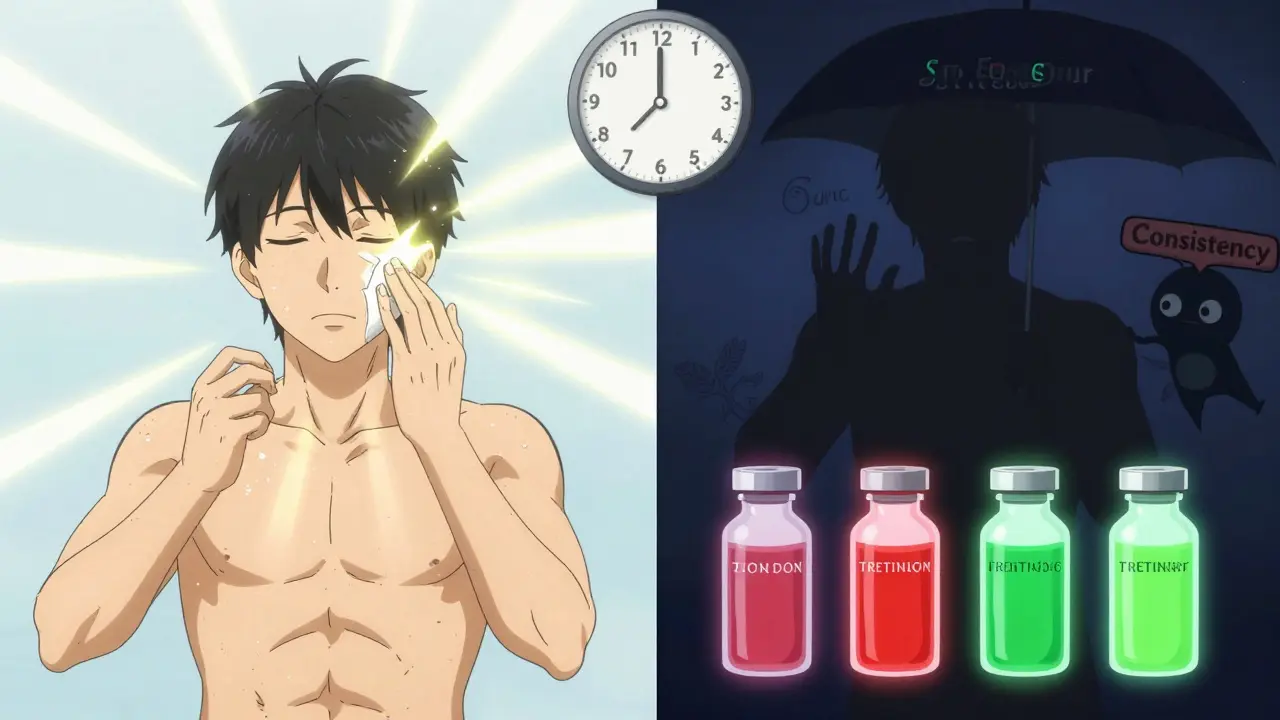
Consistency beats intensity. Here’s a real-world routine based on dermatologist protocols:
- Morning: Wash face gently. Apply a vitamin C serum (15% L-ascorbic acid). Then, put on a broad-spectrum SPF 50+ sunscreen with zinc oxide and iron oxides. Don’t skip the iron oxides-they block visible light. Use at least a quarter-teaspoon for your face and neck. Reapply every 2 hours if you’re outside.
- Evening: Cleanse again. On alternating nights, apply hydroquinone (4%) one night, tretinoin (0.05%) the next. Don’t use both on the same night-it irritates skin. If your skin feels dry or red, add a fragrance-free moisturizer. Wait 20 minutes after applying active ingredients before moisturizing.
- Every 4-6 weeks: Consider a chemical peel (like glycolic or salicylic acid) done by a dermatologist. This boosts results by 35-50%. But only if your skin is stable and you’ve been strict with sun protection.
The Biggest Mistake People Make
70% of patients fail because of sun protection-not the cream. They use too little sunscreen. They forget to reapply. They think they’re safe indoors. They’re not. Visible light passes through windows. UV rays hit you even on cloudy days. One study found that melasma patients who used SPF 50+ with iron oxides daily had 60% fewer flare-ups than those who didn’t.
Another big error? Quitting treatment too soon. Melasma doesn’t vanish in a month. It takes 8-12 weeks to see any change. And even after it fades, you need to keep up your routine. Nine out of ten people see it return within six months if they stop.
What About Lasers and In-Office Treatments?
Lasers aren’t off the table-but they’re not the first step for melasma. For sun damage, they’re great. For melasma, they’re risky. If you’ve tried topicals for 3-6 months and still have stubborn patches, a dermatologist might suggest a low-energy laser like the PicoSure or a non-ablative fractional laser. But only after melanocytes are quieted down. Otherwise, you risk making it worse.
Chemical peels and microneedling with tranexamic acid are safer alternatives for darker skin tones. They’re less likely to cause post-inflammatory hyperpigmentation (PIH), which is a common side effect in Fitzpatrick IV-VI skin types.
What’s New in 2026?
Research is moving fast. Cysteamine cream (10%) showed 60% improvement in melasma after 16 weeks in recent trials-with almost no irritation. That’s promising for people who can’t tolerate hydroquinone. Topical tranexamic acid is now available in some countries without a prescription. And the FDA is considering reclassifying hydroquinone from prescription to over-the-counter, with strict labeling and monitoring.
Future treatments may involve genetic testing to predict which patients respond to which agents. Dermatologists are already starting to classify melasma into subtypes based on depth and trigger-epidermal, dermal, or mixed-so treatment can be more targeted.
Cost and Accessibility
Prescription topicals cost $50-$150 a month. IPL sessions run $300-$600 each. Most insurance doesn’t cover these because they’re considered cosmetic. That’s why so many people start with OTC products-niacinamide serums, brightening creams, vitamin C. Some work, but they’re slower and weaker than prescription formulas. If you’re serious about clearing pigmentation, investing in a dermatologist’s plan saves money long-term by avoiding failed treatments and worsening conditions.
Final Thought: Patience and Protection
Hyperpigmentation isn’t a quick fix. Melasma is a chronic condition, not a bug to be eradicated. Sun damage is preventable, but once it’s there, it needs time and consistency to fade. The real secret? Sun protection every single day-even when it’s cloudy, even when you’re inside. No cream, no laser, no supplement will work if you’re still letting light and heat trigger your melanocytes.
Start with a simple routine. Stick with it. See your dermatologist if it’s not improving in 12 weeks. And remember: you’re not alone. Millions of people manage this every day. It’s not about perfection. It’s about persistence.
Can melasma go away on its own?
Sometimes, yes-but only if the trigger is removed. Melasma linked to pregnancy often fades within a year after delivery. Melasma caused by birth control may improve after switching medications. But if sun exposure continues, it won’t go away on its own. Most cases require active treatment and lifelong sun protection.
Is hydroquinone safe to use long-term?
No. Hydroquinone is effective for short-term use-typically 3 to 4 months. After that, the risk of ochronosis (a permanent darkening of the skin) increases. Dermatologists recommend cycling it: use for 12 weeks, then take a break for 4-8 weeks. Alternating with non-hydroquinone agents like tranexamic acid or niacinamide helps maintain results without the risks.
Why does my sunscreen need iron oxides?
Standard sunscreens block UV rays, but not visible light. Visible light-especially blue light from screens and sunlight-can trigger melasma and worsen pigmentation in darker skin tones. Iron oxides, found in tinted sunscreens, block this visible light. Studies show they reduce melasma flare-ups by up to 30%. Look for sunscreens labeled “tinted” or “with iron oxide.”
Can I use vitamin C and tretinoin together?
Yes, but not at the same time. Use vitamin C in the morning under sunscreen. Use tretinoin at night. Mixing them can cause irritation and reduce the effectiveness of both. Vitamin C is stable in the morning and boosts sun protection. Tretinoin breaks down in sunlight, so it’s only meant for nighttime use.
What’s the difference between melasma and post-inflammatory hyperpigmentation (PIH)?
Melasma appears in sun-exposed areas and is triggered by hormones and light. PIH happens after skin injury-like acne, eczema, or a scratch. It shows up where the inflammation occurred, not necessarily where the sun hits. PIH is more common in darker skin tones and often gets worse with laser treatments. Treatments for PIH focus on calming inflammation and using gentle lightening agents like niacinamide or azelaic acid.
How long until I see results from topical treatments?
Most people see slight improvement in 4-6 weeks. Noticeable changes usually take 8-12 weeks. Full results can take 3-6 months. If you don’t see any change after 12 weeks, your treatment plan may need adjustment. Don’t give up too soon-but don’t keep using something that’s irritating your skin either. Talk to your dermatologist.
Can men get melasma?
Yes, but it’s rare. Only about 10% of melasma cases occur in men. When it does, it’s often linked to hormonal imbalances, stress, or heavy sun exposure. Treatment is the same: sun protection and topical agents. Men are less likely to use sunscreen regularly, which can make melasma harder to control.
Are natural remedies like lemon juice or aloe vera effective?
No. Lemon juice is highly acidic and can burn your skin, especially under sun exposure. It can actually cause more pigmentation and irritation. Aloe vera is soothing and may help with inflammation, but it doesn’t reduce melanin. Don’t rely on home remedies for melasma or sun damage. They’re not backed by science and can make things worse.




Amelia Williams
January 25, 2026 AT 09:13Also, iron oxide sunscreen changed my life. I used to think tinted stuff looked cakey until I tried the EltaMD. Now I wear it even when I’m just walking the dog.
Heather McCubbin
January 27, 2026 AT 08:19Alexandra Enns
January 28, 2026 AT 20:49Dolores Rider
January 30, 2026 AT 11:52Kevin Waters
February 1, 2026 AT 06:14venkatesh karumanchi
February 1, 2026 AT 15:45Karen Conlin
February 2, 2026 AT 04:46Josh McEvoy
February 2, 2026 AT 20:35Sawyer Vitela
February 3, 2026 AT 15:53Marie-Pier D.
February 3, 2026 AT 18:22Viola Li
February 4, 2026 AT 01:00blackbelt security
February 4, 2026 AT 06:17asa MNG
February 5, 2026 AT 05:58Sushrita Chakraborty
February 5, 2026 AT 09:49