

🩺 Telehealth Readiness & Strategy Checker
Determine if you are ready for virtual side-effect tracking and identify the best monitoring approach for your specific medication needs.
Recommended Monitoring Strategy
Readiness Score
Key Action Steps for You
Living far from a hospital doesn't mean you have to guess if your new medication is working or hurting you. For millions of people in rural and remote areas, the drive to see a doctor can take hours, making it hard to catch early signs of trouble. Telehealth is changing that reality by bringing the clinic to your living room. It allows providers to track how you react to drugs like blood thinners, antidepressants, or heart medications without you leaving home. The goal here isn't just convenience; it's safety. Data shows that rural patients experience preventable adverse drug events at rates 23% higher than their urban counterparts. Why? Often because they don't get seen until the problem becomes an emergency. By using remote patient monitoring (RPM) tools, healthcare teams can spot trends before they turn into crises. This article breaks down how these strategies work, what technology is actually being used, and how to make sure you're getting the most out of your virtual care plan.
Why Rural Patients Face Higher Risks with Medications
Geography is a major health determinant. According to the National Rural Health Association, about 60 million Americans live in rural areas where access to timely care is limited. Since 2010, 120 rural hospitals have closed, as documented by the Chartis Center for Rural Health. When the nearest specialist is three hours away, routine check-ins for side effects often get skipped. Patients might tolerate nausea, dizziness, or mild tremors for weeks because getting help feels too difficult.
This delay has real consequences. A 2020 analysis in Health Affairs found that rural residents are more likely to suffer from preventable medication errors. The issue isn't just distance; it's also connectivity. While broadband speeds have improved, 28% of rural Americans still lack access to internet speeds meeting Federal Communications Commission standards. This digital divide means that even when telehealth is offered, not everyone can use it effectively. Understanding these barriers is the first step in designing a monitoring strategy that actually works for isolated communities.
The Core Technology Behind Virtual Side Effect Tracking
Modern telehealth isn't just a video call. It’s an ecosystem of devices and software designed to capture data continuously. At the center of this system are Remote Patient Monitoring platforms. These systems connect FDA-cleared wearable or handheld devices to a secure cloud dashboard where nurses and doctors can review your vitals in real-time.
- Blood Pressure Monitors: Devices with Bluetooth capability sync readings automatically. Industry-standard accuracy is typically ±3%, which is sufficient for detecting dangerous spikes associated with antihypertensive side effects.
- Smart Pill Dispensers: Systems like those from Hero Health track adherence. A 2021 study in the Annals of Internal Medicine showed these dispensers detect missed doses with 85% accuracy, helping identify if a side effect is due to a double-dose or a missed dose.
- Symptom Reporting Apps: These allow you to log feelings like fatigue, headache, or mood changes. Research from the Journal of Telemedicine and Telecare (2022) indicates that self-reported symptoms via apps have a 78% concordance rate with in-person clinical assessments, making them a reliable secondary signal.
For the tech to work, you need a baseline connection. Most platforms require at least 3G cellular or broadband with a 1.5 Mbps upload speed. If you’re on a weak signal, audio-only visits are a viable backup, especially since the 2023 CONNECT for Health Act expanded Medicare coverage for these types of consultations.
How Providers Monitor Specific Drug Classes Remotely
Not all medications carry the same risk profile, so the monitoring strategy varies by drug type. Here is how telehealth teams handle the most common high-risk categories in rural populations.
| Medication Class | Key Side Effects Tracked | Primary Telehealth Tool | Response Protocol |
|---|---|---|---|
| Anticoagulants (e.g., Warfarin) | Bleeding, INR fluctuations | Bluetooth INR monitors + Video consults | Weekly pharmacist review; immediate escalation if INR out of range |
| Psychotropics (e.g., Antidepressants) | Tremors, weight gain, mood shifts | Video assessment + Symptom logs | Bi-weekly video checks; AI-assisted movement analysis |
| Antihypertensives | Dizziness, low BP, electrolyte imbalance | Home BP cuffs + Heart rate trackers | Daily automated alerts if BP drops below threshold |
Take anticoagulation monitoring as an example. The University of Mississippi Medical Center launched a program in 2019 that uses Bluetooth-enabled INR monitors paired with weekly pharmacist video calls. The result? A 92% patient retention rate. Patients don't need to drive to a lab every week. They prick their finger at home, the device sends the data, and a pharmacist reviews it. If the number is off, they adjust the dose immediately. This proactive approach prevents the severe bleeds that often lead to rural hospital transfers.
Overcoming the Human Factors: Training and Literacy
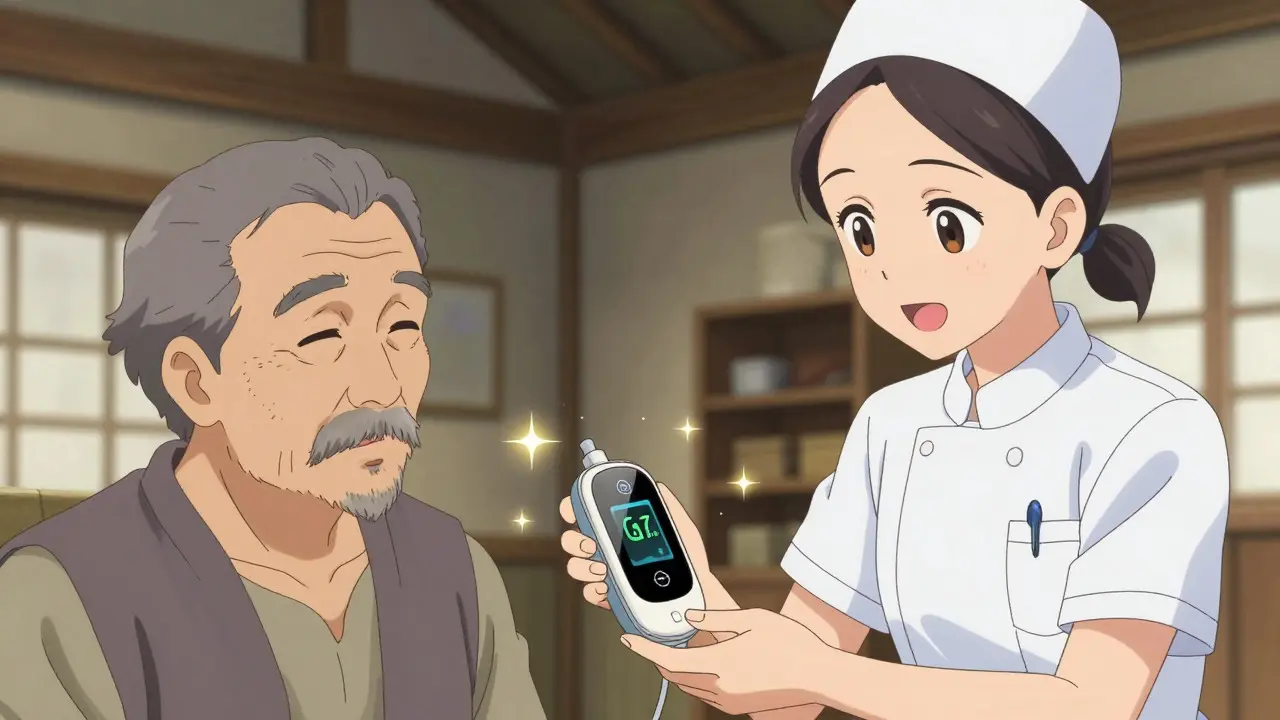
Technology fails if people can't use it. One of the biggest hurdles isn't the hardware; it's the user experience. Pew Research Center data shows that 34% of rural seniors aged 65 and older report difficulty using smartphone technologies. For many, a complex app interface is a barrier higher than the mountain road to the clinic.
Successful programs address this with dedicated human support. The Rural Health Clinics Association reports that 68% of patients need at least two training sessions to become proficient with monitoring tools. Older adults, specifically, average 3.2 sessions. This isn't a one-time setup. It involves a nurse navigator spending an average of 47 minutes per patient during initial configuration, ensuring the device pairs correctly and the patient understands how to log symptoms.
Health literacy also plays a role. Approximately 36% of rural adults have limited health literacy, meaning medical jargon can confuse them. Effective telehealth strategies use plain language. Instead of asking about "gastrointestinal distress," the app asks, "Do you have an upset stomach?" This small shift dramatically improves data accuracy. If the question is clear, the answer is reliable.
The Role of Pharmacists in Virtual Care Teams
In traditional settings, pharmacists are often underutilized. In telehealth, they are frontline defenders. The American Pharmacists Association's 2023 guidelines highlight that pharmacist-led telehealth monitoring programs achieve 89% medication adherence rates, compared to 62% in control groups. Why the difference? Pharmacists focus exclusively on drug interactions and side effects. They aren't distracted by acute infections or trauma; their job is to keep the medication regimen safe.
A study from Vanderbilt University Medical Center found a 43% reduction in severe side effects when pharmacists led the monitoring process. They act as a filter. If your blood pressure cuff reads low, the algorithm flags it. But the pharmacist decides if it's a blip or a trend. They might call you to ask if you took your pill with food, or if you've been sweating excessively. This personalized touch reduces false alarms and builds trust. For rural patients who feel disconnected from their primary care provider, this direct line to a medication expert is invaluable.

Reimbursement and Sustainability: Keeping the Lights On
Great tools are useless if no one pays for them. Reimbursement structures have evolved rapidly. As of 2023, the Centers for Medicare & Medicaid Services (CMS) pays $51 per 20 minutes of remote monitoring time. However, only 63% of private insurers follow this model. This inconsistency creates gaps in coverage for some rural families.
There is also a financial tension between urban and rural providers. Dr. Zihan Ye's research in the Journal of Health Economics revealed that when urban hospitals offer telehealth services to rural patients, local rural hospital revenue can drop by 15%. This threatens the sustainability of local clinics that provide the hands-on support necessary for comprehensive monitoring. To combat this, policy makers are pushing for equitable reimbursement structures. The FCC's Rural Digital Opportunity Fund, allocating $20.4 billion through 2025, aims to fix the infrastructure gap, but financial models must also ensure that local providers remain viable partners in the telehealth ecosystem.
Future-Proofing Your Monitoring Plan
The landscape is shifting fast. AI-powered prediction algorithms, like IBM Watson Health's MedSafety system, are now FDA-approved. These tools analyze your historical data to predict potential adverse reactions with 84% accuracy. Imagine an app that warns you, "Your potassium levels are trending low, which may interact with your new diuretic," before you even feel dizzy. This is moving from science fiction to standard practice.
Wearable sensors are also expanding detection capabilities. The University of Arkansas for Medical Sciences piloted a program using wearables to detect movement abnormalities associated with antipsychotic side effects, achieving 91% detection accuracy. These subtle tremors are often invisible to a casual observer but critical for adjusting dosage. As these technologies mature, the definition of "monitoring" will expand from vital signs to behavioral and physical markers.
For now, the best strategy is a hybrid approach. Use the technology for continuous data collection, but keep a human in the loop. Whether it's a pharmacist, a nurse navigator, or your primary care physician, ensure there is a clear path for escalation. If the app flags a red zone, who do you call? Having that protocol written down and understood by your whole care team is the single most important factor in preventing serious side effects while living remotely.
What is the minimum internet speed needed for telehealth side effect monitoring?
Most platforms require a minimum of 3G cellular connectivity or broadband internet with a 1.5 Mbps upload speed. This ensures that video calls remain stable and that data from connected devices, such as blood pressure monitors, syncs without significant lag.
How accurate are symptom reporting apps compared to in-person visits?
According to a 2022 validation study in the Journal of Telemedicine and Telecare, symptom reporting applications show a 78% concordance with in-person clinical assessments. While not perfect, this level of accuracy makes them highly effective for tracking trends over time rather than diagnosing acute issues in isolation.
Who should lead the telehealth monitoring team for chronic medications?
Pharmacists are increasingly recognized as leaders in this space. Studies show that pharmacist-led programs achieve 89% medication adherence rates and reduce severe side effects by 43%. They provide specialized expertise on drug interactions and dosing adjustments that complements general primary care.
Does Medicare cover audio-only telehealth visits for side effect checks?
Yes. The 2023 CONNECT for Health Act expanded Medicare coverage to include audio-only side effect monitoring. This is particularly useful for rural seniors who may have limited broadband access, as 58% of rural seniors currently utilize this method for their consultations.
How long does it take for a rural patient to become proficient with telehealth tools?
On average, it takes 2 to 4 weeks for patients to become comfortable with monitoring protocols. Older adults may require up to 3.2 training sessions on average. Successful programs assign nurse navigators to spend approximately 47 minutes per patient during the initial setup to ensure proficiency.