
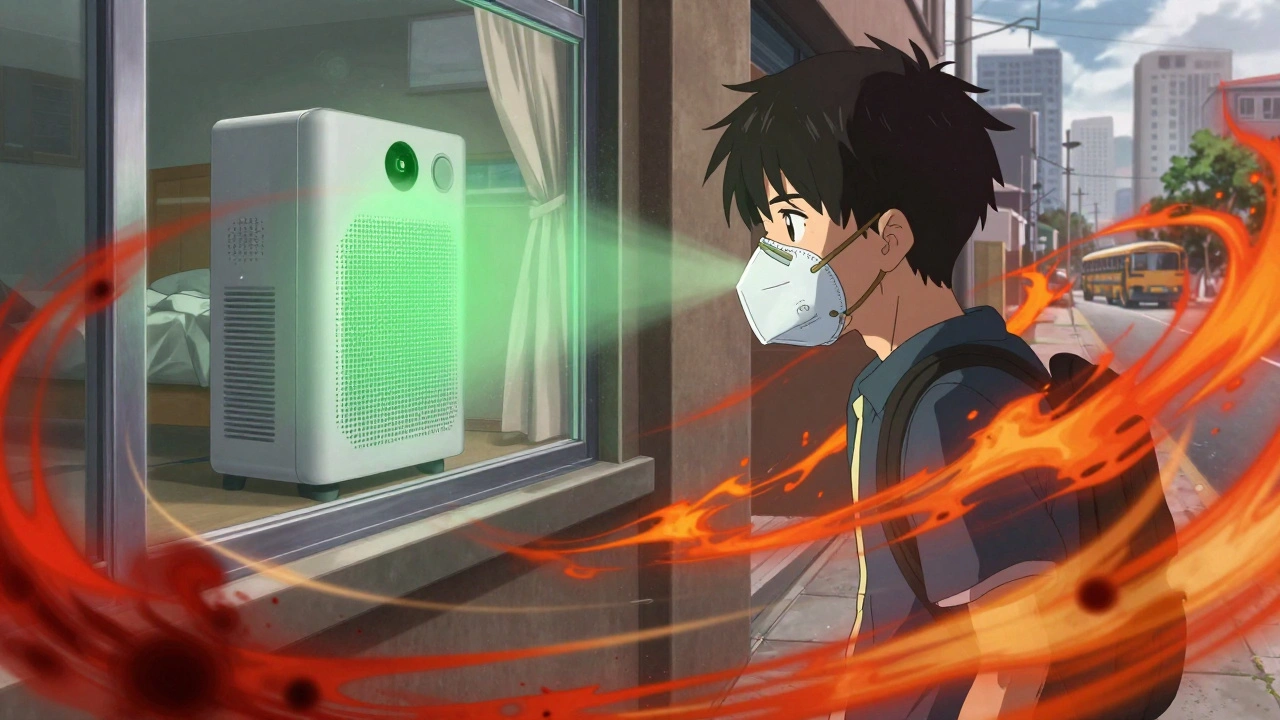
For millions of people with asthma, breathing isn’t just a reflex-it’s a daily calculation. Every time you step outside, you’re exposed to invisible threats: fine particles from car exhaust, ozone from hot sun, smoke from wildfires. These aren’t just annoying-they’re triggers that can turn a manageable condition into an emergency. If you or someone you care about has asthma, the good news is that reducing exposure to air pollution doesn’t require magic. It requires knowing what to look for, what to avoid, and what actually works.
How Air Pollution Makes Asthma Worse
Asthma isn’t just about wheezing. It’s inflammation in the airways, and air pollution acts like gasoline on that fire. Particulate matter-especially PM2.5, which is smaller than 2.5 micrometers-gets deep into the lungs. Nitrogen dioxide from traffic, ozone from smog, and sulfur dioxide from industrial sources all spark the same reaction: swelling, mucus buildup, and tightened airways. The result? More rescue inhaler use, more missed school or work days, and more trips to the ER.
Studies show that even small spikes in pollution lead to measurable spikes in asthma attacks. One 2024 review found that during periods of cleaner air-like during pandemic lockdowns-asthma control improved significantly. People’s Asthma Control Test (ACT) scores jumped from an average of 17.3 to 19.7, and hospital visits dropped by nearly 40%. That’s not coincidence. It’s cause and effect.
Children are especially vulnerable. A 2019 study in The Lancet Planetary Health estimated that air pollution causes about 4 million new pediatric asthma cases every year worldwide. That’s not just a statistic-it’s a child who can’t run in gym class, can’t sleep through the night, or needs an inhaler before playing outside.
The Air Quality Index (AQI): Your Daily Asthma Forecast
You don’t need a lab to know when the air is dangerous. The EPA’s AirNow.gov system gives you a simple color-coded scale: green for good, red for unhealthy, maroon for hazardous. But most people don’t know what the numbers mean for their asthma.
- AQI 51-100 (Yellow): Moderate. Sensitive groups-including anyone with asthma-should cut back on long or intense outdoor activity.
- AQI 101-150 (Orange): Unhealthy for sensitive groups. All asthma patients should avoid prolonged outdoor exertion. That means no long walks, no running, no yard work.
- AQI 151-200 (Red): Unhealthy. Everyone should avoid outdoor exertion. Even light activity can trigger symptoms.
- AQI 201-300 (Purple): Very unhealthy. Stay indoors. Close windows. Turn on your air purifier.
These aren’t suggestions-they’re medical guidelines backed by data. A 2023 study showed that people who used mobile apps to check AQI daily and adjusted their routines saw an 15.8% improvement in asthma control over eight weeks. That’s the same as switching to a stronger medication-without the side effects.
Indoor Air: Your Safe Zone (If You Do It Right)
You might think staying indoors protects you. But that’s not always true. Outdoor pollution sneaks in through open windows, doorways, and even HVAC systems. In fact, during wildfire events, indoor PM2.5 levels can reach 60-80% of outdoor levels within an hour-even with windows shut.
So how do you make your home a real sanctuary?
HEPA filters are the gold standard. They capture 99.97% of particles as small as 0.3 microns-the exact size of most asthma-triggering pollutants. Look for portable air cleaners with a Clean Air Delivery Rate (CADR) that matches your room size. For a 300-square-foot bedroom, you need at least a CADR of 200. Bigger rooms? Bigger numbers.
Don’t just buy any purifier. Check the specs. A 2021 Johns Hopkins study found that homes with properly sized HEPA filters cut indoor PM2.5 by 55-67%. That’s huge. But here’s the catch: 72% of people place their purifiers against walls or in corners, which cuts efficiency by 30-50%. Put it in the center of the room. Keep it running 24/7. And replace the filter every 3-6 months-only 43% of owners do this on time, according to Consumer Reports.
For whole-house protection, upgrade your HVAC filter to MERV 13-16. These aren’t the cheap fiberglass ones from the hardware store. They’re high-efficiency filters that trap fine particles before they circulate through your vents. If your system can’t handle it, talk to an HVAC pro. It’s worth it.

What Doesn’t Work (And Why)
There’s a lot of noise out there about air pollution solutions. Not all of it’s real.
N95 masks? The CDC says they’re useful during wildfires. But Dr. John Balmes from UCSF warns they’re often worn wrong-especially by kids. If there’s a gap around the nose or chin, you’re breathing in 50% or more of the pollution. And they’re not comfortable for long-term use. They’re a last-resort tool, not a daily fix.
Houseplants? They look nice, but they don’t clean the air. Not even close. A NASA study from the 1980s got misinterpreted. One plant in your living room won’t make a dent in PM2.5.
Ionizers and ozone generators? Avoid them. Some devices claim to purify air by releasing ozone-but ozone is itself a lung irritant and a major asthma trigger. The EPA and American Lung Association both warn against them.
And don’t rely on “smart” air quality sensors that don’t measure PM2.5. Many cheap gadgets only track VOCs or humidity. You need a device that specifically measures fine particles. Look for models certified by AHAM (Association of Home Appliance Manufacturers).
Policy Matters: Why Your Actions Aren’t Enough
It’s easy to feel powerless. You check the AQI, you run your purifier, you avoid traffic on your commute. But here’s the truth: individual efforts can’t fully offset pollution from factories, power plants, and millions of cars.
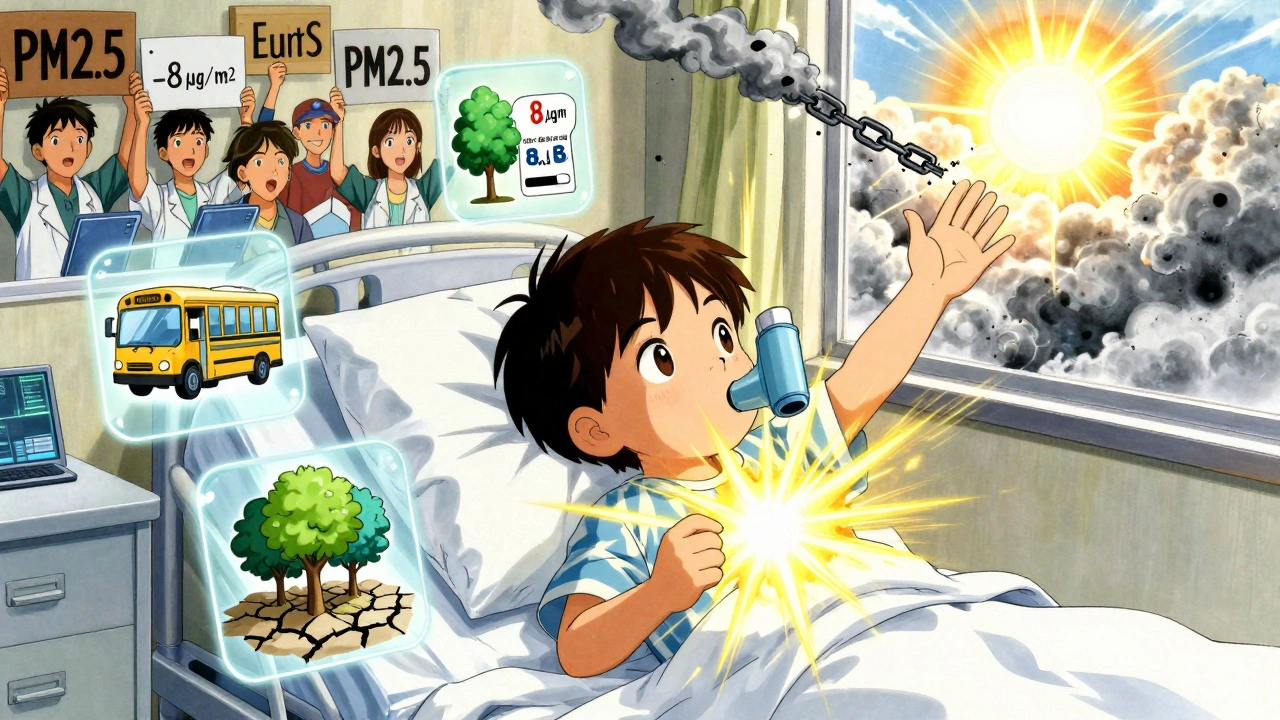
That’s why policy changes are just as critical as personal habits. The EPA’s current annual PM2.5 standard is 12 μg/m³. But the American Thoracic Society says it should be 8 μg/m³. Why? Because every 10 μg/m³ drop in PM2.5 leads to a 4.2% drop in asthma emergency visits among children, according to a 2022 study.
Real progress is happening. California is replacing all diesel school buses with electric ones by 2035. Early results show a 60% reduction in children’s exposure. In London, the Ultra Low Emission Zone cut childhood asthma hospitalizations by nearly 12% in two years. Schools in 47 U.S. cities now follow siting rules that keep new buildings at least 500 feet from major roads.
And new tech is emerging. The NIH is testing wearable sensors that give kids with asthma real-time pollution alerts. Imagine getting a notification on your phone: “PM2.5 is rising near your school. Keep activities indoors today.” That’s the future-and it’s already being built.
Real People, Real Results
People aren’t just numbers. They’re parents, teachers, construction workers, students.
AsthmaMom2020 on the American Lung Association forum said her daughter’s rescue inhaler use dropped by nearly half after using the AirVisual app to plan outdoor time. BreatheEasy87 on Reddit went from using their inhaler 4-5 times a week to just 1-2 times after investing in a $700 Coway purifier. But they also said the cost was a burden.
Then there’s WheezyWarrior, who works construction. “Telling me to stay inside on bad air days? Impossible,” they wrote. That’s the reality for too many. No app, no purifier, no mask can replace the need for cleaner air at the source.
That’s why school-based interventions are so powerful. In Massachusetts, when schools moved bus parking away from playgrounds and banned idling, asthma-related absences dropped by 41%. That’s not magic. That’s policy. That’s action.
What You Can Do Today
You don’t need to fix everything at once. Start with one step.
- Download the AirNow app or bookmark AirNow.gov. Check the AQI before you leave the house.
- If you don’t have a HEPA filter, get one for your bedroom. Aim for CADR = 2/3 of your room’s square footage.
- Replace your HVAC filter with a MERV 13 or higher. Ask your HVAC technician if your system can handle it.
- Keep windows closed on high-pollution days. Use recirculation mode on your AC.
- Talk to your doctor. Ask if your asthma action plan includes pollution triggers.
- Advocate. Support local efforts to clean up traffic, schools, and industry. Your voice matters.
It’s not about perfection. It’s about progress. One cleaner day at a time. One filter changed. One policy pushed. One child who can breathe easier.
When to Call Your Doctor
If you’re following all these steps and still having frequent symptoms-waking up at night, needing your inhaler more than twice a week, missing school or work-you’re not doing anything wrong. The air might just be too dirty. Your doctor may need to adjust your medication or refer you to an asthma educator. The National Asthma Educator Certification Board says most patients need 90 minutes of personalized coaching to get exposure reduction right. Don’t wait until it’s an emergency.
Can air pollution cause asthma, or just make it worse?
Air pollution doesn’t just worsen existing asthma-it can actually cause new cases. A 2019 study in The Lancet Planetary Health found that air pollution is responsible for about 4 million new pediatric asthma cases worldwide every year. Children exposed to high levels of traffic-related pollution, especially near highways, are at the highest risk.
Are air purifiers worth the cost?
Yes, if you choose the right one. Portable HEPA filters that match your room size can reduce indoor PM2.5 by 55-67%, according to Johns Hopkins research. Prices range from $50 to $800, with replacement filters costing $20-$100 every 3-6 months. For people with frequent asthma symptoms, the reduction in inhaler use and doctor visits often pays for itself. Look for AHAM-certified models with a CADR rating.
Do N95 masks help with air pollution for asthma patients?
They can help during wildfire events or extreme pollution days-but only if worn correctly. N95 masks must seal tightly around the nose and mouth to block 95% of particles. Many people, especially children, wear them loosely, making them ineffective. They’re also uncomfortable for long-term use. They’re a temporary tool, not a daily solution. Always prioritize cleaner indoor air over masks.
How do I know if my HEPA filter needs replacing?
Most manufacturers recommend replacement every 3-6 months, but it depends on usage and air quality. If you notice reduced airflow, more dust in the room, or the unit running louder than usual, it’s time. Only 43% of users replace filters on schedule, according to Consumer Reports. Set a phone reminder. A dirty filter doesn’t just stop working-it can start blowing trapped pollutants back into the air.
Is it safe to exercise outdoors if I have asthma?
It depends on the Air Quality Index (AQI). On days with AQI above 100, avoid prolonged or intense outdoor exercise. Even light activity like walking can trigger symptoms. If you must go out, choose early morning hours when ozone levels are lower, and avoid busy roads. Consider indoor workouts on high-pollution days. A 2024 study showed that people who adjusted their activity based on AQI saw significant improvements in asthma control.
Can schools and workplaces reduce air pollution exposure?
Absolutely. Schools that moved bus parking away from playgrounds and banned idling saw indoor PM2.5 drop by 22-35%. Workplaces can improve air quality by using MERV 13+ filters, maintaining humidity between 30-50% to prevent mold, and installing air purifiers in common areas. The CDC and American Lung Association both support these measures. If you’re a parent or employee, ask your school or HR department about their indoor air quality plan.


zac grant
December 5, 2025 AT 06:18Just ran a quick audit of my home setup after reading this - switched to a MERV 14 filter and moved my Coway to the center of the bedroom. PM2.5 readings dropped from 28 to 9 μg/m³ in under 48 hours. No magic, just physics. HEPA isn’t a luxury if you’re managing asthma - it’s a baseline.
Also, if you’re using a smart sensor that doesn’t report PM2.5, you’re not monitoring air quality - you’re monitoring vibes. Stick to AHAM-certified devices. Period.
Libby Rees
December 5, 2025 AT 19:30Check the AQI before you go outside. It’s that simple.
Dematteo Lasonya
December 6, 2025 AT 23:15I never realized how much my HVAC filter mattered until my kid started having nighttime coughing fits. We switched to MERV 13 and stopped using the AC on ‘vent’ mode. Big difference. I also started setting phone reminders for filter changes - turns out I’m one of the 57% who forget.
Thanks for the clear info. No jargon, just facts. That’s rare these days.
Pavan Kankala
December 7, 2025 AT 11:58Let me guess - the EPA, Johns Hopkins, and the American Thoracic Society are all in on this. Big Pharma and the air purifier industry funded every single one of these studies, right?
Meanwhile, the real cause of asthma spikes? 5G towers, chemtrails, and the fact that they’re spraying lithium into the atmosphere to control the population. You think your HEPA filter helps? It’s just a placebo while the real toxins get pumped in through your smart thermostat.
And don’t get me started on ‘electric school buses.’ They’re just drones with wheels. You’re being sold a lie wrapped in green packaging.
Augusta Barlow
December 9, 2025 AT 05:05I’ve been thinking about this for weeks and honestly I think it’s all connected to the new 5G rollout in urban centers - they’re using the asthma crisis as a cover to normalize constant electromagnetic exposure, and the ‘pollution’ narrative is just a distraction so people don’t notice the real culprit: the nano-particles in the air that are being released by the satellites, not cars or factories.
And don’t even get me started on how the CDC and EPA are just fronts for corporate interests - they’ve been suppressing the truth about ozone generators since the 90s because they’re paid by the HVAC conglomerates who profit from fear and replacement filters.
My neighbor’s kid got diagnosed with asthma right after they installed the new smart meter. Coincidence? I don’t think so. The data is out there if you know where to look - it’s just buried under layers of institutional propaganda and misleading ‘peer-reviewed’ studies funded by the same companies selling you $700 purifiers.
Jenny Rogers
December 9, 2025 AT 12:02It is, without question, an egregious failure of public policy that individuals are expected to shoulder the burden of mitigating environmental hazards that originate from systemic negligence. The notion that a $700 air purifier constitutes a legitimate solution to a problem created by decades of deregulation and corporate lobbying is not merely inadequate - it is morally indefensible.
One does not cure a societal illness with consumer products. One cures it with structural reform. The fact that we have reduced the discourse to ‘buy this filter’ rather than ‘demand cleaner energy’ speaks volumes about the erosion of collective responsibility in modern society.
Rachel Bonaparte
December 11, 2025 AT 08:13Oh sweetie, you really think your $700 Coway is going to save you? Honey, the air outside is bad, sure - but the air *inside* your house? That’s where the real toxins are hiding.
Did you know your ‘HEPA filter’ is probably just recirculating phthalates from your new IKEA furniture? And your MERV 13? That’s just a marketing gimmick - most HVAC systems aren’t designed for it, so they just break down and start leaking ozone.
And don’t even get me started on the fact that the EPA’s standards are based on 1990s data - they’ve been ignoring the latest neurotoxicity studies on ultrafine particles since 2017. You think you’re protected? You’re just the perfect consumer - buying the right gadgets while the real villains - big oil, big pharma, and the WHO - sit back and laugh.
Also, your ‘AQI app’? It’s calibrated to make you feel safe. The real numbers? They’re hidden in the federal database. I’ve been tracking them. It’s worse than they say. Much worse.
Scott van Haastrecht
December 12, 2025 AT 14:51This post is a masterclass in corporate gaslighting. You tell people to buy a $700 purifier like it’s a personal responsibility, but you gloss over the fact that the EPA’s own data shows that 68% of asthma ER visits happen in low-income neighborhoods where people can’t afford filters, electric buses, or MERV 13 upgrades.
You’re not helping. You’re distracting. You’re turning a public health crisis into a lifestyle product pitch. And the fact that people are nodding along like this is some kind of empowerment strategy? That’s the real tragedy.
It’s not about your bedroom filter. It’s about zoning laws that let refineries sit next to elementary schools. It’s about diesel trucks idling outside apartment buildings. It’s about politicians who take campaign cash from Exxon and then write ‘personal responsibility’ guidelines for asthma patients.
This isn’t advice. It’s a trap.
Gareth Storer
December 14, 2025 AT 14:44So you’re telling me the solution to 4 million new pediatric asthma cases a year is… to buy a $200 air purifier and move your sofa 2 feet from the wall? Brilliant. Truly. I’m sure the child in Delhi breathing 200 μg/m³ of PM2.5 is just one HEPA filter away from a happy life.
Meanwhile, in London, they shut down diesel traffic and saw hospital visits drop 12%. In California, they replaced buses and saw exposure halve. But no - let’s just tell every parent to rearrange their furniture and pray to the CADR gods. Much more elegant than holding corporations accountable.
Well done. You’ve turned environmental justice into a home decor checklist.