
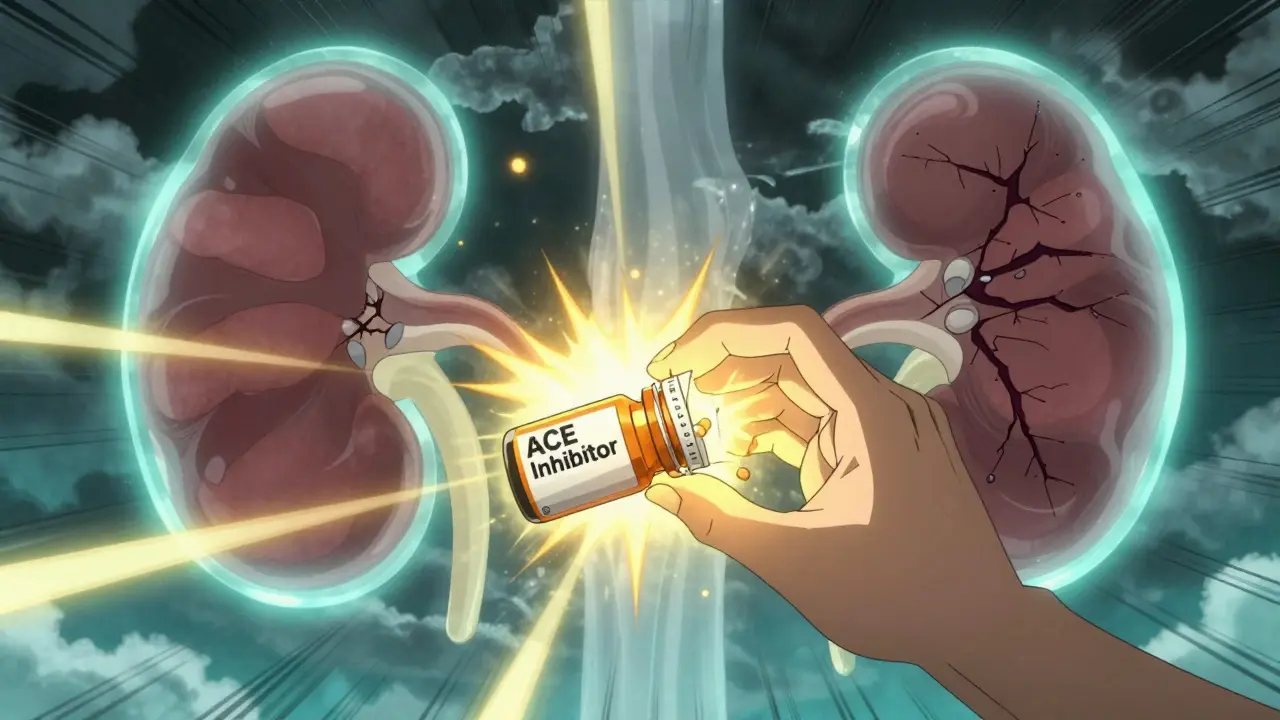
When diabetes damages the kidneys, it doesn’t happen overnight. It creeps in silently-first as tiny amounts of protein leaking into urine, then slowly eroding kidney function over years. This is diabetic nephropathy, the most common cause of kidney failure in people with diabetes. And while many focus on blood sugar control, the real game-changer for slowing this damage lies in two classes of blood pressure drugs: ACE inhibitors and ARBs. But here’s the catch: they only work if taken at the right dose, and for the right reason.
What Exactly Is Diabetic Nephropathy?
Diabetic nephropathy isn’t just "kidney problems from diabetes." It’s a specific pattern of damage: persistent albuminuria (more than 30 mg of protein in urine per day), often paired with a drop in kidney filtration rate. It shows up in about 30-40% of people with type 1 or type 2 diabetes after 20 years. Left unchecked, it leads to end-stage kidney disease, dialysis, or transplant.
What makes it worse? High blood pressure. The two feed each other. Damaged kidneys can’t regulate fluid and salt, so blood pressure climbs. High blood pressure then crushes the tiny filters in the kidneys, making them leak even more protein. It’s a vicious cycle.
Why ACE Inhibitors and ARBs Are First-Line
For over 20 years, ACE inhibitors and ARBs have been the go-to drugs for diabetic kidney disease-not because they lower blood pressure (though they do), but because they protect the kidneys in a way other drugs don’t.
Both work by blocking the renin-angiotensin-aldosterone system (RAAS). This system tightens blood vessels and signals the kidneys to hold onto salt and water. In diabetic kidneys, this system goes into overdrive, increasing pressure inside the kidney’s filtering units (glomeruli). That pressure is what crushes the filters and lets protein leak out.
By blocking RAAS, ACE inhibitors and ARBs reduce that internal pressure. Less pressure = less protein in urine = slower kidney damage. Studies like RENAAL and IDNT showed ARBs like losartan and irbesartan cut the risk of kidney failure by up to 30% in people with heavy proteinuria. ACE inhibitors like captopril and ramipril showed similar results.
And here’s the key insight: the kidney protection isn’t just from lowering blood pressure. Even when blood pressure is controlled with other drugs, ACE inhibitors and ARBs still reduce proteinuria more than any other class. That’s why they’re not just "blood pressure meds"-they’re kidney protectors.
Protein Control: The Real Target
Albuminuria isn’t just a symptom-it’s a warning sign and a target. Every gram of protein lost per day in urine raises the risk of kidney failure and heart disease. The goal? Get that number down.
Studies show that reducing proteinuria by 50% or more can cut the risk of kidney failure in half. ACE inhibitors and ARBs are the only drugs proven to reliably do this in diabetic patients. Other blood pressure pills-like calcium channel blockers or beta blockers-help with pressure, but they don’t cut protein leakage like these two.
That’s why guidelines from the American Diabetes Association (ADA) and Kidney Disease: Improving Global Outcomes (KDIGO) say: if you have diabetes, high blood pressure, and protein in your urine, start an ACE inhibitor or ARB. Not as an add-on. Not as a last resort. As the foundation.

Dosing Matters-More Than You Think
Here’s where things go wrong in real-world clinics.
Many doctors start with low doses-5 mg of ramipril, 25 mg of lisinopril-because they’re afraid of side effects. But the trials that proved these drugs work? They used maximum tolerated doses.
- Captopril: 25 mg three times daily (75 mg total)
- Ramipril: 10-20 mg daily
- Benazepril: 20-40 mg daily
- Losartan: 50-100 mg daily
- Irbesartan: 150-300 mg daily
Low doses? They barely move the needle on proteinuria. Maximum doses? They cut kidney failure risk by up to 30%. Yet, studies show only about 60-70% of eligible patients even get started on these drugs-and fewer than half reach the doses proven effective.
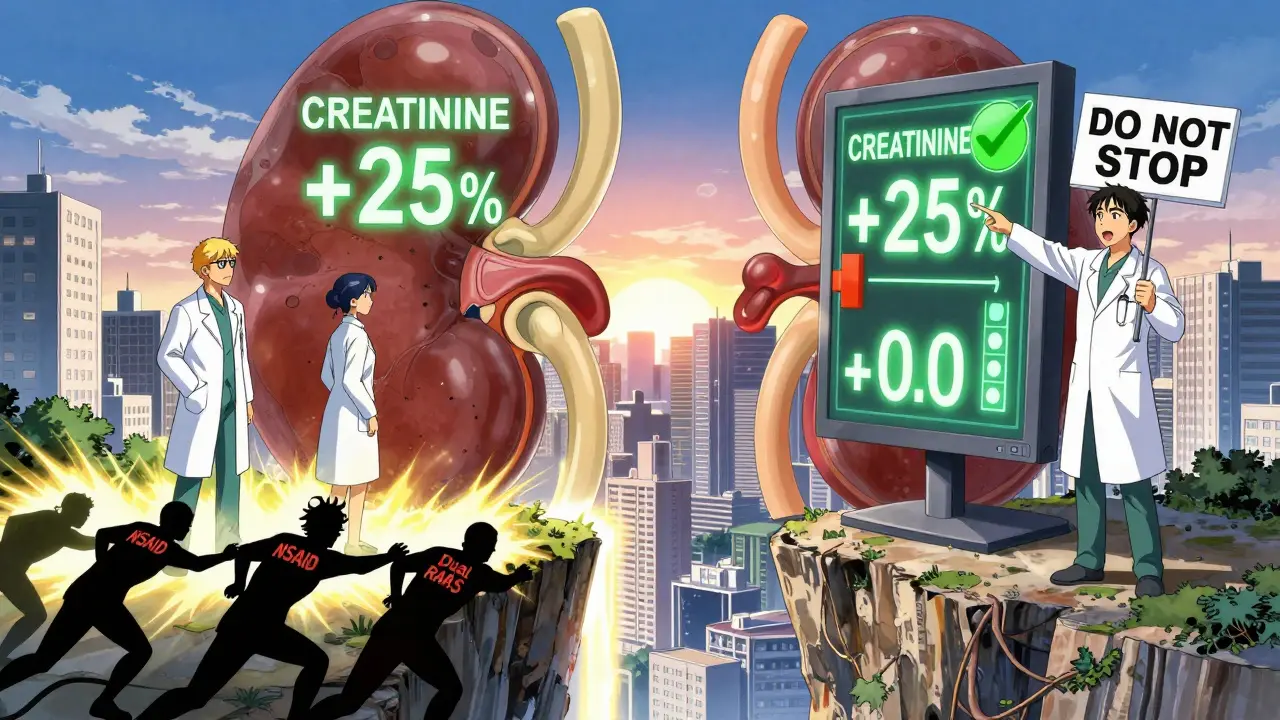
Why? Fear of rising creatinine. When you start an ACE inhibitor or ARB, your serum creatinine often goes up by 10-30%. That’s normal. It means the kidney’s filters are relaxing, reducing pressure. It’s not damage-it’s the drug working. If you stop the medicine because creatinine went up, you’re throwing away the benefit.
The ADA says: do not discontinue these drugs for creatinine increases under 30% unless there’s volume depletion. That’s a rule many doctors still ignore.
Why You Shouldn’t Combine ACE Inhibitors and ARBs
You might think: if one is good, two must be better. But that’s not true here.
Trials like VA NEPHRON-D, ONTARGET, and ALTITUDE tested combining ACE inhibitors with ARBs-or adding a direct renin inhibitor. The results? No extra kidney protection. Just more side effects.
- Hyperkalemia (high potassium) risk doubled or tripled
- Acute kidney injury rates went up 2-fold
- No reduction in death or dialysis
So if you’re on one, don’t add the other. Stick with the one that works best for you. If you can’t tolerate an ACE inhibitor, switch to an ARB. Not both.
What About Other Drugs? SGLT2 Inhibitors and MRAs
Newer drugs like SGLT2 inhibitors (empagliflozin, dapagliflozin) and nonsteroidal MRAs (finerenone) have shown amazing kidney and heart benefits. But here’s the catch: every major trial tested them on top of an ACE inhibitor or ARB.
They’re not replacements-they’re add-ons. If you’re not already on a maximally tolerated ACE inhibitor or ARB, adding an SGLT2 inhibitor won’t give you the full benefit. The foundation still matters.
And while these newer drugs are great, they’re not always accessible. ACE inhibitors and ARBs are cheap, generic, and have 20 years of proof. For most people, they’re still the best first step.
What to Avoid
Some combinations are dangerous.
- NSAIDs (ibuprofen, naproxen): These cut blood flow to the kidneys. With an ACE inhibitor or ARB, they can cause sudden kidney failure. Avoid unless absolutely necessary.
- Loop diuretics (furosemide, torsemide): Used for swelling, but they can trigger low blood pressure and kidney injury when paired with RAAS blockers. Monitor closely.
- Starting these drugs in normoalbuminuric patients: If you have diabetes, normal kidney function, no protein in urine, and normal blood pressure-don’t start an ACE inhibitor or ARB just "for prevention." Studies show no benefit. Save them for when you need them.
When to Start-and When to Keep Going
Start an ACE inhibitor or ARB if you have:
- Type 1 or type 2 diabetes
- High blood pressure
- Protein in urine (UACR ≥30 mg/g)
- eGFR below 60 mL/min/1.73 m²
And don’t stop just because:
- Your creatinine rose by 20%
- You feel fine
- Your blood pressure is "normal"
These drugs work best when you keep taking them-even if you feel perfectly healthy. The damage they prevent happens quietly.
Final Reality Check
Despite decades of evidence, most people with diabetic nephropathy aren’t getting the right treatment. Doctors underdose. Patients stop. Clinics don’t track proteinuria. The gap between guidelines and practice is wide.
If you have diabetes and kidney disease, ask: "Am I on the right dose?" and "Am I being monitored for protein in my urine?" If the answer is no, push for it. Your kidneys are still working. They can be protected. But only if you use the right tools, at the right strength.
ACE inhibitors and ARBs aren’t magic. But when used right, they’re the most effective shield we have against diabetic kidney failure. Don’t settle for half the benefit.
Can I take an ACE inhibitor and ARB together for better kidney protection?
No. Combining ACE inhibitors with ARBs doesn’t improve kidney outcomes and significantly increases the risk of high potassium levels and sudden kidney injury. Major trials like VA NEPHRON-D and ONTARGET showed no benefit but doubled the risk of dangerous side effects. Stick with one-either an ACE inhibitor or an ARB-and use it at the highest tolerated dose.
Why does my creatinine go up when I start an ACE inhibitor or ARB?
It’s normal-and a sign the drug is working. These medications reduce pressure inside the kidney’s filters, which can temporarily lower blood flow and raise serum creatinine by up to 30%. This isn’t kidney damage-it’s a hemodynamic change. Stopping the drug because of this rise means you lose its protective effect. Guidelines say to keep taking it unless creatinine rises over 30% or you’re dehydrated.
Should I start an ACE inhibitor if I have diabetes but no protein in my urine?
Not unless you have high blood pressure or reduced kidney function. Studies show no kidney benefit in people with normal urine protein levels and normal blood pressure. The NIH and ADA specifically advise against using these drugs for primary prevention in this group. Focus on blood sugar control and blood pressure management instead.
Are ACE inhibitors better than ARBs for diabetic nephropathy?
Both are equally effective at reducing proteinuria and slowing kidney damage. The choice often comes down to side effects. ACE inhibitors can cause a dry cough in about 10-20% of people, while ARBs rarely do. If you have a cough, switch to an ARB. If you can’t tolerate an ARB, try an ACE inhibitor. Captopril is the only ACE inhibitor with an FDA-specific indication for diabetic nephropathy, but other ACE inhibitors work just as well at maximum doses.
Can I stop my ACE inhibitor or ARB if my blood pressure is normal?
No. These drugs protect your kidneys even if your blood pressure is already normal. Their benefit comes from reducing pressure inside the kidney’s filters-not just lowering overall blood pressure. Stopping them increases your risk of kidney failure over time. Keep taking them as long as you have diabetes and protein in your urine, regardless of your BP numbers.




Tom Bolt
March 12, 2026 AT 10:34Let me just say this: if you're not taking an ACE inhibitor or ARB at max tolerated dose and you have diabetic nephropathy, you're not treating the disease-you're playing Russian roulette with your kidneys. The data is crystal clear. RENAAL. IDNT. These aren't just studies-they're wake-up calls. And yet, I see clinicians prescribing 5mg of lisinopril like it's a placebo. That's not medicine. That's negligence dressed up as caution.
And don't get me started on the creatinine myth. You start the drug, creatinine goes up 25%? Good. That means the glomerular pressure just dropped. You're not losing kidney function-you're saving it. Stop panicking over lab values that are literally proving the drug works. The ADA says don't stop unless it's over 30% AND you're volume-depleted. That's not a suggestion. It's a standard. Enforce it.
Mike Winter
March 13, 2026 AT 12:19It's fascinating how we've built an entire medical paradigm around a single physiological mechanism-the RAAS system-and yet, we still treat it like a switch rather than a dial. The real tragedy isn't that people underdose-it's that we've normalized underdosing as "safe practice."
There's a deeper philosophical question here: do we fear side effects more than we fear progression? Because the data says: the risk of not acting is far greater than the risk of acting. We've turned kidney protection into a gamble where the house always wins if you play it safe.
Randall Walker
March 13, 2026 AT 20:46Donnie DeMarco
March 15, 2026 AT 18:57Man, I wish my doc had explained this like 5 years ago. I was on 10mg ramipril for years thinking I was "doing good." Then I got my UACR test back-still at 80 mg/g. Turned out, max dose was 20mg. I switched. Three months later, down to 22 mg/g. I didn't even feel different. That's wild. This stuff works like a silent ninja. Don't sleep on it.
Shourya Tanay
March 17, 2026 AT 11:49From a nephrology standpoint, the RAAS blockade paradigm remains the most robustly validated intervention for proteinuric diabetic kidney disease. The hemodynamic effect on intraglomerular pressure is the primary mediator of renoprotection, independent of systemic BP reduction. The landmark trials consistently demonstrate a 30-35% relative risk reduction in ESRD endpoints with maximal dosing. The underutilization is not merely a clinical gap-it's a systemic failure of guideline adherence and pharmacoeconomic prioritization.
LiV Beau
March 17, 2026 AT 12:22Y'all. I just started my ARB at max dose and I'm crying. Not because I'm sick-because I finally feel like someone took my kidney health seriously. 🥹 I've been told "it's fine" for years. Now I'm getting monitored. Now I'm being proactive. This post? Lifesaver. Thank you. 🙌
Adam Kleinberg
March 18, 2026 AT 19:42Gene Forte
March 19, 2026 AT 10:45It is profoundly encouraging to witness the power of evidence-based medicine in action. The consistent, reproducible outcomes demonstrated by ACE inhibitors and ARBs in diabetic nephropathy represent one of the clearest successes in modern nephrology. When implemented appropriately-with proper dosing and monitoring-these agents provide not merely incremental benefit, but transformative, life-sustaining protection. We owe it to our patients to use them as intended.
David L. Thomas
March 19, 2026 AT 19:09Interesting how the creatinine rise is a "good sign"-kinda like how a fever means your immune system is working. I never thought of it that way. I've been avoiding these meds for years because I was scared of "bad labs." Now I get it. Time to go talk to my doc.
Bridgette Pulliam
March 21, 2026 AT 11:04Thank you for writing this. I'm a nurse, and I see this every day-patients stopped because their creatinine went up, or because their BP was "normal." I wish we had a simple handout for this. I'm printing this out and giving it to my patients tomorrow. You just made my job easier.
Miranda Varn-Harper
March 23, 2026 AT 04:35Alexander Erb
March 23, 2026 AT 09:42Bro, I had no idea these drugs were this powerful. I was on 5mg lisinopril for 3 years. Then my nephrologist upped me to 40mg. My proteinuria dropped from 200 to 45 in 4 months. I felt zero different. No dizziness, no cough. Just… better labs. Now I tell everyone. These aren't just BP pills. They're kidney armor.
Also-don't let your doc scare you with creatinine. It's not a red flag. It's a green light. 🛡️
Denise Jordan
March 24, 2026 AT 01:20Kenneth Zieden-Weber
March 25, 2026 AT 10:03Okay, so if I'm on an ARB and my creatinine goes up 20%, I shouldn't panic-but what if I'm also on an SGLT2i? Does that change anything? I've been reading conflicting stuff on this. And is there a point where you say, "Hey, this isn't working anymore," or do you just ride it out forever?
Also-why do we still call them "blood pressure meds" when they clearly do something else? That's just confusing for patients.