
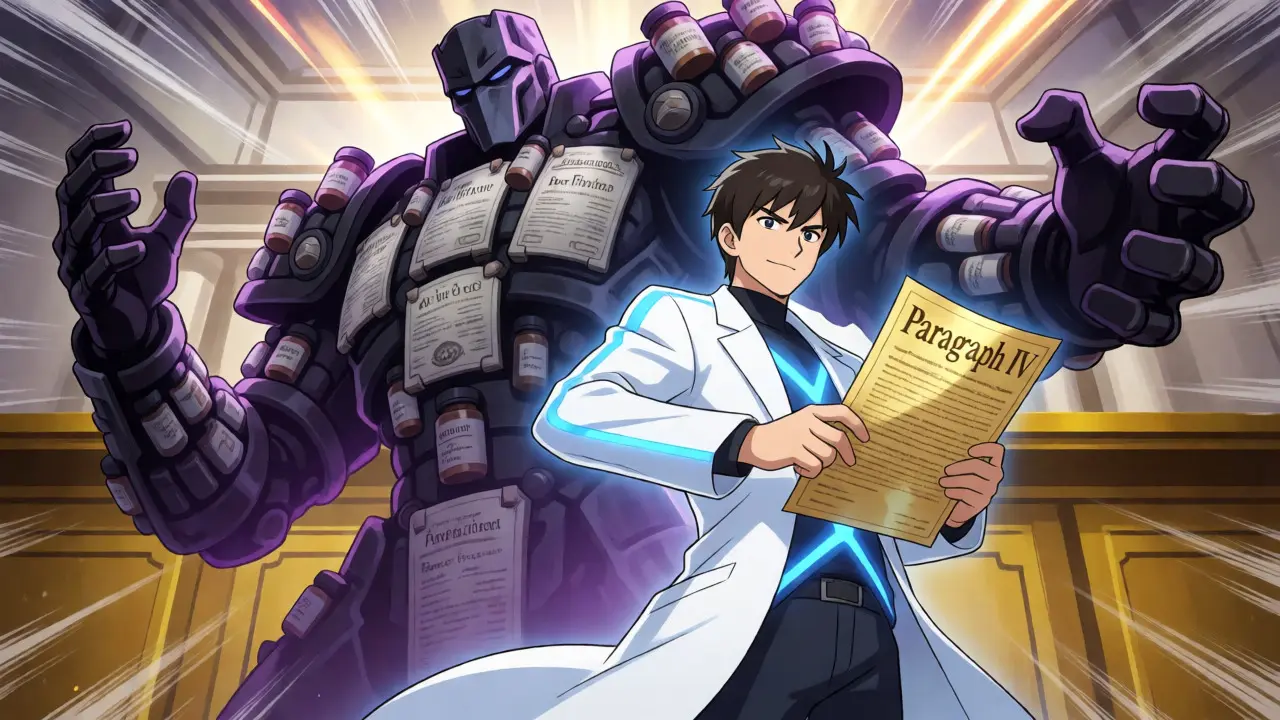
Imagine spending $500 million developing a new drug, only to have a competitor legally steal your market share before your patent even expires. That is the high-stakes game of Paragraph IV certifications. It is not just paperwork; it is a legal weapon used by generic manufacturers to attack brand-name patents. If you are in pharma, healthcare investing, or policy, understanding this mechanism is non-negotiable. It drives the massive savings we see in our pharmacy bills today.
| Concept | Why It Matters |
|---|---|
| The Legal Trigger | Filing an ANDA with a Paragraph IV certification counts as an "artificial act of infringement," letting brands sue immediately. |
| The Reward | The first successful challenger gets 180 days of exclusive marketing rights, often worth hundreds of millions. |
| The Risk | Litigation costs average $12.7 million per case, and losing means waiting years for patent expiry. |
| The Impact | This system has saved the U.S. healthcare system over $1.7 trillion since 1984. |
What Exactly Is a Paragraph IV Certification?
Let’s strip away the legalese. When a company wants to sell a generic version of a branded drug, they file an Abbreviated New Drug Application (ANDA). They look at the FDA’s Orange Book, which lists all active patents for that drug. Usually, they wait until those patents expire. But if they think a patent is weak, invalid, or doesn’t apply to their specific formula, they file a Paragraph IV certification.
This certification is a formal declaration stating: "We believe this patent is invalid, unenforceable, or won't be infringed by our product." By filing this, the generic manufacturer creates what lawyers call an "artificial act of patent infringement" under 35 U.S.C. § 271(e)(2). This sounds contradictory-how can you infringe before you sell? The law says the act of filing the application itself triggers the right for the brand owner to sue. This forces both sides into court early, resolving disputes before products hit shelves. It prevents the chaos of generics launching "at-risk" and getting sued later.
The Hatch-Waxman Framework: Why It Exists
You cannot understand Paragraph IV without knowing the Hatch-Waxman Act. Signed in 1984, this law balanced two competing interests: rewarding innovation and lowering drug prices. Before 1984, generics had to repeat expensive clinical trials, making them costly and slow to appear. Hatch-Waxman allowed generics to rely on existing safety data but gave brand companies a way to protect valid patents through litigation.
The core trade-off is simple. Generic makers get a faster path to market via the ANDA process. In exchange, they must notify brand owners if they plan to launch before patent expiry. This notification starts the clock. If the brand sues within 45 days, the FDA automatically puts a 30-month stay on approving the generic. This gives the brand time to prove their patent holds up in court. If the brand loses or settles, the generic gets approved. If the generic wins big, they might get exclusivity.
The Prize: 180-Day Marketing Exclusivity
Why do companies risk millions in legal fees? Because of the 180-day exclusivity period. The first company to file a substantially complete ANDA with a Paragraph IV certification gets six months where no other generic can enter the market. Even if the brand still has a valid patent, if the first challenger wins or settles favorably, they enjoy a monopoly among generics.
Think about a blockbuster drug like Lipitor or Humira. A six-month head start on a multi-billion dollar market isn't just nice-it's transformative. For example, when Apotex challenged GlaxoSmithKline’s Paxil patent in 2004, their exclusivity period generated over $1.2 billion in revenue. That single win paid for decades of R&D. However, this prize comes with strings attached. You can forfeit exclusivity if you fail to market the drug after certain events or if you change your certification. The Medicare Modernization Act of 2003 tightened these rules to prevent companies from gaming the system by delaying launches.
How It Compares to Other Certifications
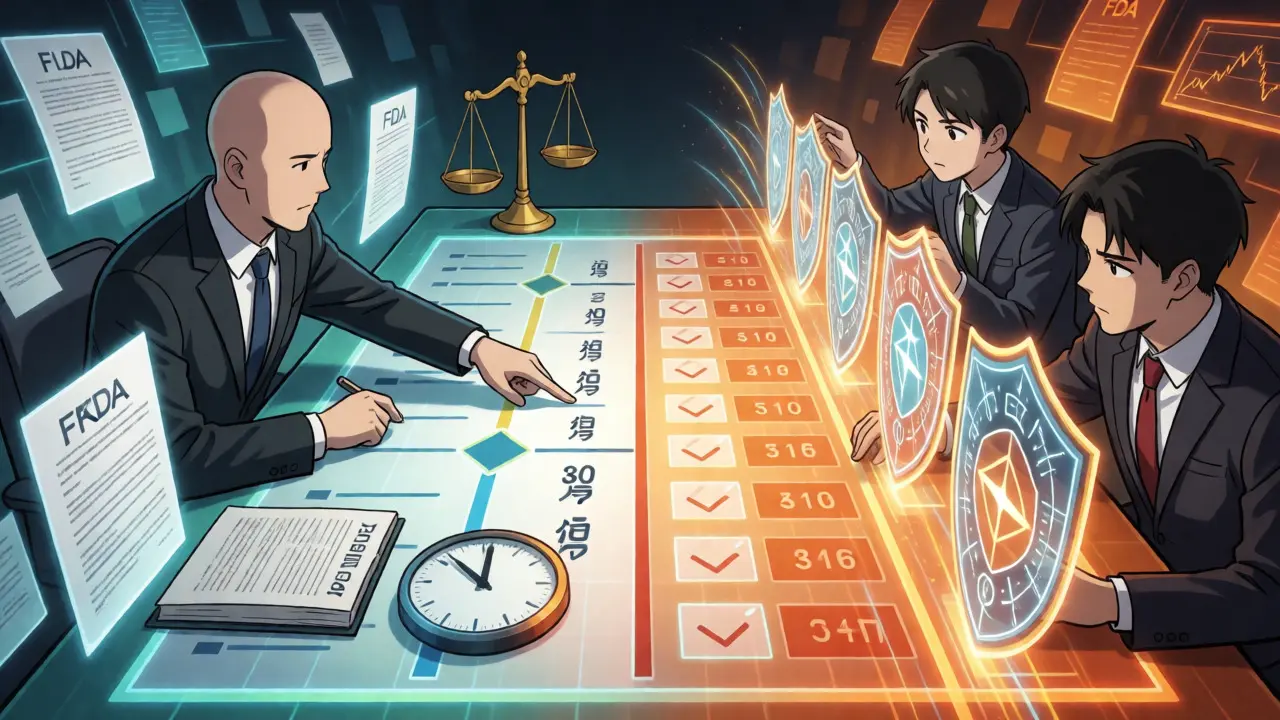
Not every generic fights. Most take the easy road. Understanding the alternatives highlights why Paragraph IV is so aggressive. Here is how the four types stack up:
| Certification Type | Meaning | Risk Level | Market Entry Speed |
|---|---|---|---|
| Paragraph I | No patent listed in Orange Book. | Low | Immediate upon approval |
| Paragraph II | Patent expired. | Low | Immediate upon approval |
| Paragraph III | Will wait until patent expires. | Low | Delayed until expiry date |
| Paragraph IV | Challenging validity/infringement. | High | Potentially years earlier |
Paragraph I and II are safe bets but offer no competitive advantage. Paragraph III is common for drugs with long patent tails. Paragraph IV is the outlier. While only about 60-70% of ANDAs include it, these challenges target the most profitable drugs. It is a high-risk, high-reward strategy designed for companies willing to litigate for market dominance.
The Litigation Reality: Costs and Delays
Filing the paperwork is just step one. Once the notice letter goes out, the real battle begins. Brand companies almost always sue. According to industry data, 92% of brand sponsors file suit within the 45-day window. This triggers the 30-month stay, effectively freezing FDA approval while courts decide who is right.
Is it worth it? The median cost of a Paragraph IV case hits $12.7 million. For smaller generic firms, this is a make-or-break investment. Large players like Teva or Viatris absorb these costs easily, but mid-sized companies often hesitate. Furthermore, winning isn't guaranteed. Courts uphold many patents, especially complex formulation or method-of-use claims. Recent trends show brands using "patent thickets"-filing dozens of secondary patents-to make challenges harder. If you lose, you don't just pay legal fees; you lose years of potential revenue.

Strategic Pitfalls and Expert Tips
Many failures stem from technical errors rather than legal weakness. The FDA rejects applications if the "detailed statement" in the notice letter is vague. You need a rational, reasonable basis for your opinion, backed by expert analysis. Leading law firms charge $750-$1,200 per hour to draft these opinions. Skimping here can delay approval by months.
Another trap is the "pay-for-delay" settlement. Sometimes, brands pay generics to stay off the market longer than necessary. The FTC scrutinizes these deals heavily. In 2013, the Supreme Court ruled in FTC v. Actavis that such settlements could violate antitrust laws. Today, regulators watch for authorized generics-where the brand launches its own generic during the exclusivity period-which can dilute the value of the 180-day window.
Future Outlook: Complex Drugs and Biologics
The landscape is shifting. Simple small-molecule drugs are easier to challenge. But the future belongs to complex generics and biologics. These involve intricate manufacturing processes, making "non-infringement" arguments harder to prove. The 2023 Amgen v. Sanofi ruling raised the bar for patent enablement, making it tougher to invalidate broad biologic patents.
Expect more parallel proceedings. Smart challengers now use Inter Partes Review (IPR) at the Patent Trial and Appeal Board alongside district court lawsuits. This dual-track approach increases pressure on brand holders. Despite rising complexity, the economic engine remains strong. With healthcare costs soaring, governments will continue supporting mechanisms that drive down prices. Paragraph IV certifications remain the primary tool for achieving that goal.
What happens if a brand company does not sue after a Paragraph IV notice?
If the brand sponsor fails to file a patent infringement lawsuit within 45 days of receiving the Paragraph IV notice letter, the automatic 30-month stay on FDA approval is not triggered. The FDA can then approve the generic application once it meets all other regulatory requirements, allowing the generic to enter the market much sooner, potentially before the patent expiration date.
Can multiple companies get 180-day exclusivity?
Generally, only the first applicant to submit a substantially complete ANDA with a Paragraph IV certification receives the 180-day exclusivity. However, if multiple companies file on the same day, they may share the exclusivity period. Subsequent filers usually wait for the exclusivity to expire or for the first filer to forfeit their rights before entering the market.
What is a "patent thicket" and how does it affect Paragraph IV?
A patent thicket refers to a dense web of overlapping patents covering a single drug, including formulations, methods of use, and manufacturing processes. It complicates Paragraph IV challenges because a generic manufacturer must successfully challenge or design around every relevant patent to avoid infringement. This increases litigation costs and the likelihood of failure, often discouraging smaller generic firms from entering the competition.
How does the 30-month stay work?
The 30-month stay is an automatic suspension of FDA approval for the generic drug. It is triggered if the brand-name patent holder files a patent infringement lawsuit against the generic applicant within 45 days of receiving the Paragraph IV notice. During this period, the FDA cannot approve the generic, giving the parties time to resolve the patent dispute in court. The stay can be shortened or extended by the court under specific circumstances.
What is an "authorized generic"?
An authorized generic is a generic version of a brand-name drug marketed by the brand company itself, often through a subsidiary or licensing agreement. During the 180-day exclusivity period granted to the first Paragraph IV challenger, the brand can launch an authorized generic. This increases competition during the exclusivity window, potentially reducing the profits for the first generic challenger and sparking antitrust debates about whether this practice undermines the incentives of the Hatch-Waxman Act.


Curtis Surpless
September 2, 2026 AT 04:34most of this is just rehashed law school 101 stuff but whatever i guess people need the basics spelled out like theyre five
the real issue isnt the certification its the pay for delay games big pharma plays to keep generics out until the last possible second while lining their pockets with billions in profit that could have gone to actual research instead of lawyers fees
Aaron Gragg
September 2, 2026 AT 18:29I appreciate the structured breakdown provided here as it serves as an excellent primer for those entering the pharmaceutical regulatory space who may not yet possess a comprehensive understanding of the intricate legal mechanisms at play within the Hatch-Waxman framework.
The distinction between Paragraph IV certifications and other forms of ANDA filings is indeed critical because it fundamentally alters the risk profile for generic manufacturers who must weigh the substantial litigation costs against the potential windfall of 180-day exclusivity rights which can be transformative for smaller firms seeking market entry.
It is worth noting that the artificial act of infringement doctrine under 35 U.S.C. § 271(e)(2) was specifically designed to prevent the chaos of post-launch litigation which would otherwise burden both consumers and companies with unpredictable legal exposure after products are already on shelves.
Furthermore the economic impact cited regarding $1.7 trillion in savings since 1984 underscores the societal value of this system despite the high friction costs involved in individual patent challenges which often require expert testimony and complex scientific analysis to succeed.
We must also consider how recent trends such as patent thickets and authorized generics are eroding the traditional incentives for first filers by allowing brand companies to launch their own generic versions during the exclusivity period thereby diluting the monopoly power intended by the original legislation.
The shift toward biologics and complex molecules presents a new frontier where the simplicity of small molecule chemistry no longer applies making non-infringement arguments significantly more difficult to prove without extensive comparative studies and manufacturing data.
As we look forward the integration of Inter Partes Review proceedings alongside district court lawsuits represents a strategic evolution that savvy generic challengers are utilizing to apply dual-track pressure on brand holders who rely on broad patent claims to maintain monopolies.
Ultimately the balance between rewarding innovation and ensuring access remains delicate requiring continuous legislative oversight to prevent abuse of the system by either side of the aisle whether through evergreening patents or aggressive settlement tactics.
This article correctly identifies that understanding these nuances is non-negotiable for healthcare investors and policy makers who wish to accurately forecast market dynamics and regulatory risks in the coming decade.
I hope this perspective adds some depth to the discussion and encourages further exploration of the specific case law that has shaped our current interpretation of these statutory provisions over the past forty years.
Akeem Feiton
September 3, 2026 AT 12:28typical elitist garbage written by someone who probably has never set foot in a pharmacy line waiting for meds they cant afford
you talk about "legal weapons" and "artificial acts" like its all so clean and fair but its rigged from the start for the big guys with deep pockets who can bleed the little guys dry in court before they even sell a single pill
and dont get me started on the "patent thickets" nonsense thats just corporate greed wearing a lab coat trying to hide behind jargon to keep prices sky high while americans go bankrupt paying for basic health care
this whole system is broken and needs to be torn down and rebuilt with common sense not lawyer speak that confuses regular people into thinking its complicated when its really just theft sanctioned by congress
Harry Falk
September 3, 2026 AT 22:58Concise summary. Useful for quick reference.
Rose Boerner
September 5, 2026 AT 09:45One must acknowledge the profound moral implications embedded within this legislative framework, for it is not merely a matter of dollars and cents but rather a testament to our collective responsibility toward the vulnerable members of society who suffer under the weight of exorbitant pharmaceutical pricing.
It is truly disheartening to observe how large corporations exploit every conceivable loophole in the law to extend their monopolistic reigns, often at the expense of human dignity and the fundamental right to accessible healthcare which should be guaranteed to all citizens regardless of socioeconomic status.
The narrative presented here highlights the tension between innovation and accessibility, yet one cannot help but feel a surge of righteous indignation when considering the sheer volume of resources wasted on litigation that could have been directed toward curing diseases rather than defending profits.
We must demand greater transparency and ethical conduct from these entities, for their actions reflect a lack of empathy that is frankly unacceptable in a civilized society that prides itself on fairness and justice for all individuals irrespective of their financial standing.
The concept of "pay-for-delay" settlements particularly offends my sensibilities as it suggests that money can buy silence and that truth is secondary to commercial convenience which is a dangerous precedent for any democratic nation striving for integrity.
Let us not forget that behind every patent challenge lies a patient waiting desperately for relief and it is our duty to ensure that the system serves them first rather than serving the shareholders of conglomerates who view medicine solely as a commodity to be maximized.
I urge all readers to consider the ethical dimensions of these transactions and to advocate for reforms that prioritize human welfare over corporate gain ensuring that the promise of medical advancement is fulfilled equitably across all strata of society.
This article provides a factual basis but lacks the moral urgency needed to drive meaningful change and I hope future discussions will incorporate a stronger emphasis on the humanitarian crisis caused by unchecked pharmaceutical profiteering.
Only through persistent advocacy and unwavering commitment to ethical standards can we hope to rectify the imbalances inherent in this system and restore faith in the institutions that govern our healthcare landscape today.
Let this serve as a reminder that knowledge without conscience is meaningless and that we must wield our understanding of these laws as tools for social good rather than mere academic curiosities detached from reality.
Kristina Rhodes
September 6, 2026 AT 00:53it’s fascinating how we frame this as a battle when really it’s just two sides playing a very expensive game of chess with human lives as the pieces 😐
i suppose the optimism comes from knowing that eventually the price drops but the journey there feels unnecessarily painful for everyone involved especially those who can’t wait for the courts to decide
maybe if we viewed patents less as property rights and more as temporary licenses we’d find a middle ground that doesn’t require millions in legal fees to resolve simple disagreements about who gets to sell what and when
anyway keep fighting the good fight folks the system works if you squint hard enough and ignore the cracks showing everywhere else 🤷♀️
Eryn Manchego
September 6, 2026 AT 11:55love the energy here
its wild how much money floats around these cases like literally hundreds of millions just for sitting pretty for six months while everyone else waits in line
kinda makes you wonder what other industries could learn from this model of strategic patience and aggressive filing
anyway stay chill and keep those orange books handy 📚✨
Crystal Torres
September 7, 2026 AT 18:02The explanation of the 30-month stay is particularly illuminating for those unfamiliar with procedural timelines.
It clarifies why immediate approval is rarely granted upon filing and highlights the importance of the 45-day window for brand sponsors to initiate litigation.
Understanding this mechanism is essential for accurate forecasting of generic entry dates and associated revenue projections.
I recommend reviewing the FDA guidance documents for further details on application requirements.
Thank you for sharing this informative piece.