

A pterygium isn't just a spot on the eye-it’s a warning sign. If you’ve ever looked in the mirror and noticed a fleshy, pinkish wedge growing from the white of your eye toward your pupil, you’re not imagining it. This is pterygium, often called Surfer’s Eye, and it’s not rare. In Australia, nearly 1 in 5 adults over 40 have it. The worse part? It doesn’t go away on its own. And if left unchecked, it can blur your vision, make contact lenses unbearable, and leave your eye red and irritated for years.
Here’s the truth: this isn’t about aging. It’s about sunlight. Every minute you spend outside without proper eye protection adds up. In Melbourne, even on cloudy days, UV levels hit 3 or higher over 200 days a year. That’s enough to trigger growth in people who work outdoors, surf, fish, or just walk the dog without sunglasses. The tissue starts on the side of the eye closest to the nose-95% of cases begin there-and slowly creeps forward like a tiny wing. When it reaches the cornea, that’s when problems begin.
What Does a Pterygium Look Like?
It’s easy to spot once you know what to look for. A pterygium looks like a triangular piece of tissue-pink, slightly raised, with visible thin blood vessels running through it. At first, it might be just 1 millimeter wide at the base. But under constant UV exposure, it can grow 0.5 to 2 millimeters per year. Some stay small for decades. Others race forward, especially in people who live near the equator or spend hours outside without protection.
It usually shows up in both eyes, but not always at the same time. One might be barely noticeable while the other is already covering part of your pupil. That’s when vision gets blurry. The cornea, which should be perfectly smooth to focus light, starts to warp. This causes astigmatism. You might not realize it at first. You just think your glasses don’t work as well anymore. But the real culprit? That growth on your eye.
Why Does Sunlight Cause This?
It’s not just heat. It’s UV radiation-specifically UVA and UVB rays. These rays damage the delicate cells on the surface of your eye. Over time, the body tries to repair the damage by creating extra tissue. That’s how the pterygium forms. Research from the University of Melbourne shows that people who’ve absorbed more than 15,000 joules of UV energy per square meter over their lifetime have a 78% higher chance of developing it. That’s roughly 20 years of daily outdoor exposure without sunglasses.
And yes, genetics play a role. If your parent had pterygium, you’re more likely to get it too. But studies show environment is the bigger factor-up to 85% of cases are tied to sun exposure. People who work in construction, farming, or fishing have double the risk. Men are more affected than women-about 3 out of every 5 cases are male. Why? More outdoor work. Less consistent use of eye protection.
How Is It Diagnosed?
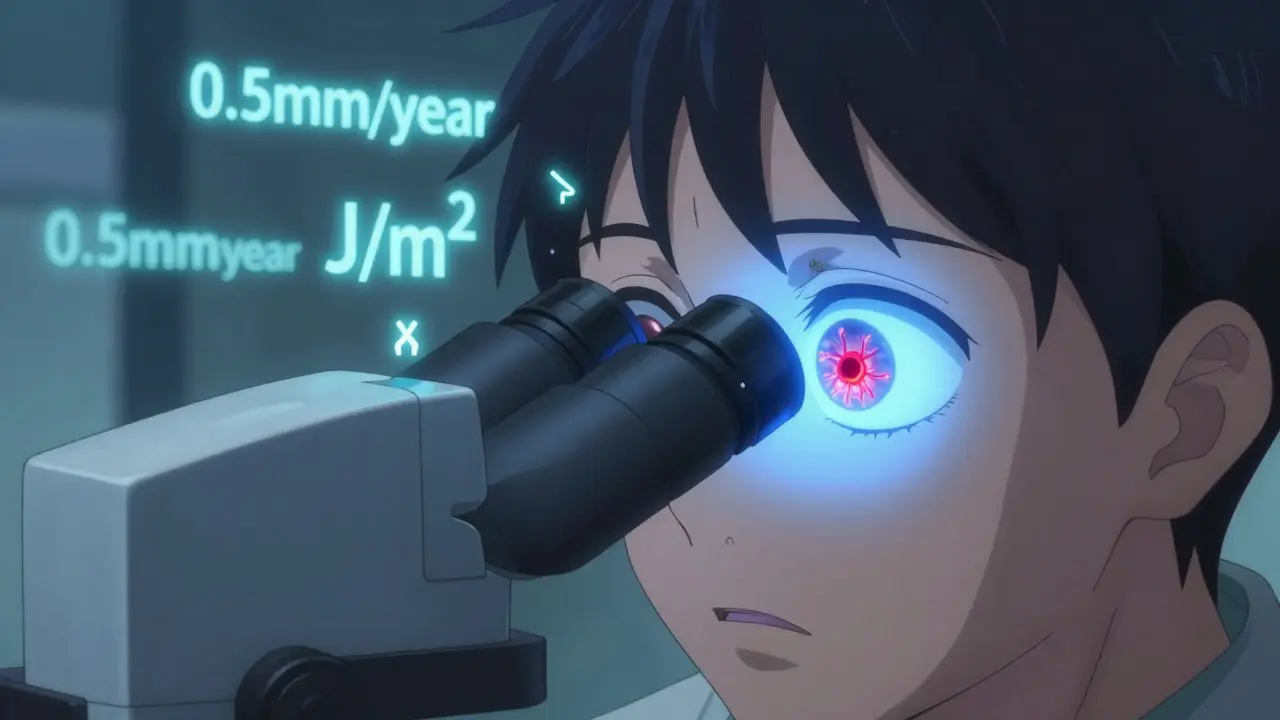
No blood test. No scan. Just your eye and a doctor with a slit-lamp. This small, bright-light microscope lets the ophthalmologist see your eye at 10 to 40 times magnification. They’ll check how far the growth has reached the cornea, how thick it is, and whether blood vessels are crossing into the pupil area. If it’s still on the white of the eye, it’s not yet a pterygium-it’s a pinguecula. That’s a different, less dangerous bump that stays on the conjunctiva and never crosses onto the cornea.
There’s no standard way to measure growth over time, which is a problem. Some doctors measure in millimeters. Others just say “it’s getting bigger.” That inconsistency means some people wait too long before acting. If your pterygium is growing, you need regular check-ups-once a year at least.
Surgery: When and Why?
Most pterygia don’t need surgery. If it’s small, not bothering you, and not growing, eye drops and sunglasses are enough. But if it’s causing blurred vision, constant irritation, or making contact lenses impossible to wear, surgery becomes the only real solution.
There are three main surgical options today:
- Simple excision-cutting it out. This used to be common, but recurrence rates were 30-40%. Not good.
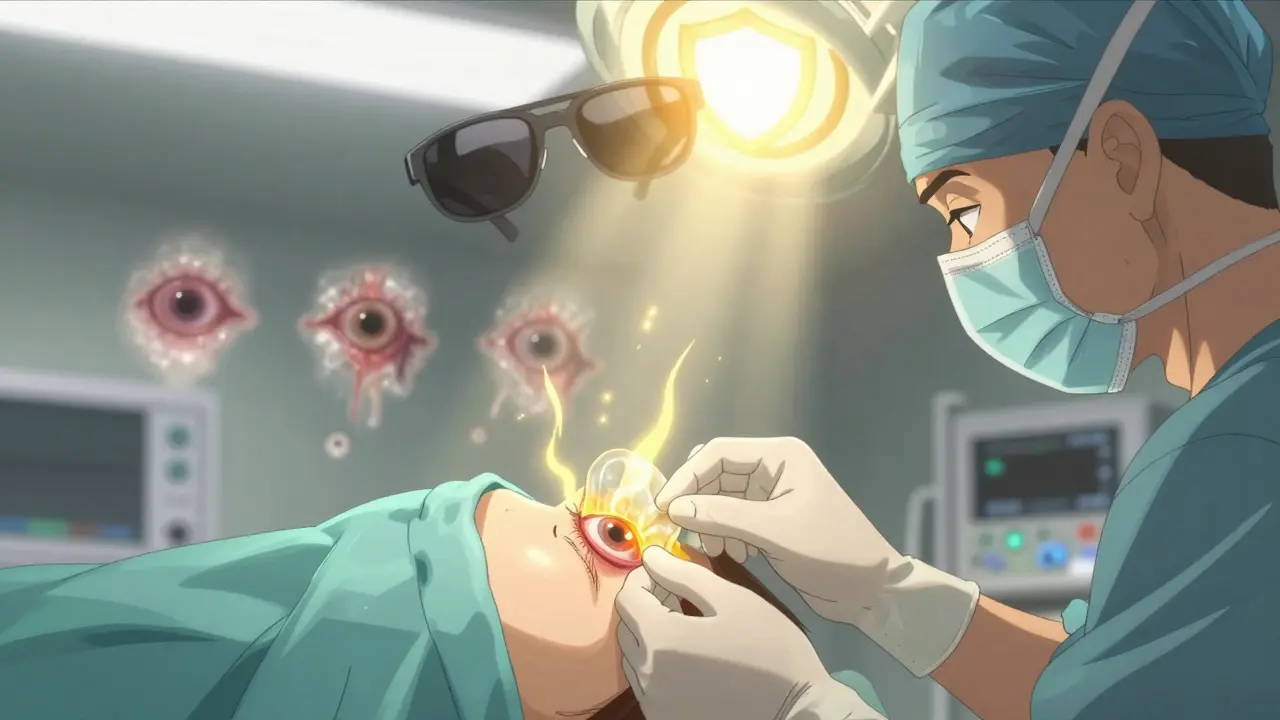
- Conjunctival autograft-removing the pterygium and replacing it with a patch of healthy tissue taken from under your eyelid. This is now the gold standard. Recurrence drops to just 8.7%.
- Mitomycin C + autograft-adding a mild chemotherapy drug (mitomycin C) during surgery to kill off any leftover abnormal cells. This brings recurrence rates down to 5-10%.
Most surgeries take under an hour. You’re awake, but your eye is numbed. You won’t feel pain, just pressure. Recovery takes about two weeks, but full healing can take months. Your eye will be red and watery for a while. That’s normal. But if it gets more painful or starts leaking pus, call your doctor-signs of infection.
What About Recurrence?
Here’s the tough part: even with surgery, pterygium can come back. About 1 in 3 people who had surgery in the past saw it grow again within 18 months. That’s why modern techniques matter. A 2022 meta-analysis of 15 studies found that patients who got a conjunctival autograft with mitomycin C had less than a 10% chance of regrowth. Without it? Over 30%.
Patients who’ve been through it say the same thing: “The surgery itself was quick. The drops afterward were the real challenge.” You’ll need steroid eye drops for 6-8 weeks to keep inflammation down. Skipping doses? Big mistake. That’s when the tissue starts coming back.
One patient on RealSelf.com wrote: “I thought I was done after surgery. Then it came back in 14 months. Second time, they did the graft. No regrowth after 2 years. Best decision I ever made.”
What’s New in Treatment?
The field is changing fast. In March 2023, the FDA approved a new eye drop called OcuGel Plus. It’s preservative-free and designed specifically for post-surgery healing. In trials, it gave 32% more relief than regular artificial tears.
Another big shift? Amniotic membrane transplantation. In June 2023, European eye surgeons updated their guidelines to recommend it as first-line treatment for recurrent pterygium. It uses tissue from the placenta-yes, really-to promote healing and block scar tissue. Success rates? 92% in preventing regrowth across 15 countries.
And the future? Topical rapamycin. It’s a drug already used for organ transplants. Now, in Phase II trials, it’s being tested as a daily eye drop to stop pterygium cells from multiplying. Early results show a 67% drop in recurrence at one year. That could mean no surgery for many people.
How to Prevent It
You don’t need to live in a cave to avoid pterygium. You just need to protect your eyes like you protect your skin.
- Wear sunglasses labeled UV400 or 100% UV protection. ANSI Z80.3-2020 is the standard. If it doesn’t say that, it’s not enough.
- Wear a wide-brimmed hat. Even a baseball cap isn’t enough. You need shade over your whole face.
- Don’t rely on clouds. UV penetrates them. Check your local UV index daily-anything above 3 requires protection.
- Use lubricating eye drops if your eyes feel dry. Dryness makes the surface more vulnerable.
- Get an annual eye exam. If you’re over 40 and spend time outdoors, don’t wait for symptoms.
One Reddit user, an outdoor photographer, said: “I started wearing UV-blocking sunglasses every day. My last two check-ups showed no growth. That’s all it took.”
The Bottom Line
Pterygium isn’t cancer. It’s not life-threatening. But it’s persistent. And it’s preventable. If you’re in Australia, or anywhere with strong sun, your eyes are at risk. The growth doesn’t happen overnight. It’s the slow accumulation of sun exposure-day after day, year after year.
Surgery works. But it’s not a cure. It’s damage control. The real win is stopping it before it starts. Protect your eyes like you protect your skin. Wear the right sunglasses. Cover your head. Get checked. Don’t wait until your vision blurs.
Because once it reaches your cornea, you’re not just dealing with an eye problem. You’re dealing with a lifestyle change.
Can pterygium cause permanent vision loss?
Pterygium doesn’t usually cause permanent vision loss, but it can lead to significant blurriness if it grows over the cornea. The growth can warp the surface of the eye, causing astigmatism. If left untreated, it may block your line of sight entirely. Early intervention and surgery can restore clear vision, but delaying treatment increases the risk of lasting changes to your cornea.
Are there non-surgical treatments for pterygium?
Yes, but only for mild cases. Lubricating eye drops can reduce redness and irritation. Anti-inflammatory drops may help slow growth temporarily. However, these don’t remove the tissue. If the pterygium is growing toward the pupil or causing blurry vision, surgery is the only way to restore normal eye function. Prevention-through UV protection-is the best non-surgical strategy.
How long does pterygium surgery take to heal?
Most people feel better within 1-2 weeks, but full healing takes 2-3 months. The eye will stay red and sensitive during this time. You’ll need steroid eye drops for 6-8 weeks to prevent inflammation and recurrence. Avoid swimming, dusty environments, and rubbing your eye. Returning to outdoor work? Wait at least 4 weeks and wear UV-protective sunglasses.
Can pterygium come back after surgery?
Yes, recurrence is common without proper techniques. Simple removal has a 30-40% chance of returning. With a conjunctival autograft and mitomycin C, recurrence drops to 5-10%. The biggest risk factor for regrowth? Skipping post-op steroid drops or returning to high UV exposure without eye protection. Always follow your surgeon’s recovery plan.
Is pterygium more common in certain countries?
Yes. Over 65% of cases occur within 30 degrees of the equator, where UV exposure is strongest. Australia has the highest national rate-23% of adults over 40 have it. Other high-risk areas include parts of Africa, Southeast Asia, South America, and the southern U.S. Men are more affected than women, likely due to higher outdoor occupational exposure.



Anil bhardwaj
February 25, 2026 AT 11:56Been seeing this in my dad’s eyes for years-he’s 62, works in rice fields in Uttar Pradesh. Never wore shades till last year. Now he’s got that pink wedge creeping in. Guess I’m buying him UV400 sunglasses for Diwali. No way he’s gonna let me pay for surgery.
Joanna Reyes
February 25, 2026 AT 15:30I read this whole thing twice because I’m terrified now. I live in Arizona. I ride my bike to work every day. I wear a hat. I thought that was enough. Turns out, even on overcast days here, UV index hits 5. I’ve been outside for 15 years without proper eye protection. My eyes feel dry all the time. I just assumed it was the heat. Now I’m wondering if I’ve already got a pinguecula that’s about to turn into a pterygium. I’m going to the eye doctor Monday. If I’m already showing signs, I need to know. This isn’t just about aesthetics-it’s about not being able to see my grandkids clearly when they’re older. I’m not waiting.
Stephen Archbold
February 26, 2026 AT 00:48Man I just had surgery last year-autograft + mitomycin C. Took me 3 months to stop feeling like my eye was full of sand. The drops were brutal. 8 weeks of steroid drops. Felt like I was in rehab. But hey-no regrowth after 14 months. My advice? Don’t wait till it’s blocking your vision. Get it checked yearly. And wear shades even when it’s cloudy. I used to think that was dumb. Now I look like a sunglasses snob. Worth it.
Nerina Devi
February 26, 2026 AT 19:41My mom had pterygium in Kerala. She never wore sunglasses. Said they made her feel like a tourist. By the time she went to the doctor, it had crossed halfway to her pupil. Surgery was expensive, and recovery was rough. But the real tragedy? She never understood why it happened. People here think it’s just aging. It’s not. It’s the sun. Every single day. I’ve started wearing my UV400s even when I’m just walking to the market. My eyes feel better. I’m not taking chances.
Dinesh Dawn
February 27, 2026 AT 13:28My uncle’s a fisherman in Goa. He’s got it in both eyes. Looks like he’s got two little wings growing toward his pupils. He says he doesn’t care. But he can’t wear contacts anymore. And his vision’s blurry in the mornings. He thinks it’s just cataracts. I showed him this article. He shrugged. Said, ‘I’ve been outside since I was 8. What’s one more thing?’ But I worry. He’s 57. I’m 32. I wear my shades every single day now. No exceptions.
Vanessa Drummond
March 1, 2026 AT 13:01Ugh. I just looked up ‘pterygium’ because I’ve had this weird red spot for months. I thought it was allergies. Now I’m convinced it’s this. I live in Florida. I walk my dog at 7am. I’ve been doing it for 12 years. No sunglasses. Just a hat. That’s not enough. I’m going to get a slit-lamp exam tomorrow. If this is real, I’m never going outside without UV400s again. I’m not losing my vision because I was lazy.
Nick Hamby
March 3, 2026 AT 00:42There’s a philosophical layer here that’s rarely discussed: the human body’s response to environmental trauma is not a failure-it’s an adaptation. The pterygium is not a defect. It’s the eye’s attempt to heal itself from chronic UV assault. The problem isn’t the tissue growth-it’s our collective denial of environmental risk. We treat the eye like a disposable lens, not a living organ. We wear hats, but not shades. We think ‘I’m not in the desert’ means ‘I’m safe.’ But UV doesn’t care about geography. It cares about cumulative exposure. And we’ve normalized it. We’ve normalized it like we’ve normalized screen time, air pollution, and sleep deprivation. The real question isn’t ‘How do we treat pterygium?’ It’s ‘Why do we wait until our bodies scream before we change?’
Haley Gumm
March 3, 2026 AT 16:58Okay but let’s be real-how many of these ‘surgery success stories’ are just people who had the money to afford the autograft and mitomycin C? Meanwhile, people in rural India or rural Texas just get eye drops and hope. And yeah, OcuGel Plus? $120 a bottle. Most people can’t afford that. And amniotic membrane? That’s not available in 90% of the world. This article reads like a luxury health pamphlet. For the rich. The rest of us? We just deal. And we don’t get to choose whether we work outside. So stop pretending this is just about personal responsibility.
Gabrielle Conroy
March 5, 2026 AT 13:09OMG I just realized-I’ve been wearing sunglasses for years, but they’re just fashion ones from the mall! No UV400 label! I’m so mad at myself!! I’ve been outside since I was 10. I’m 41. I’m booking an eye exam RIGHT NOW!! Also, I just bought 3 pairs of UV400s on Amazon (one for the car, one for hiking, one for work). I’m obsessed now. I’m even wearing them indoors at night because I’m paranoid 😅. Also, I got a wide-brimmed hat!! I’m turning into a sun safety nerd!!
Spenser Bickett
March 6, 2026 AT 08:35So let me get this straight-after 20 years of being outside, your eye grows a ‘wing’ and now you need surgery? Sounds like evolution in reverse. Maybe we should just stop going outside. Or maybe the real problem is that we’re all just too soft. I’ve never worn sunglasses. I’ve never had a pterygium. I’ve got 20/15 vision. Maybe the solution isn’t more drops and more surgery. Maybe it’s just… stop being a baby. Sun’s not out to get you. Your eyes are built for it. Or maybe they’re not. I don’t know. But I’m not paying $5k to have someone cut my eye open.
Ashley Johnson
March 6, 2026 AT 21:03Did you know that the FDA approved OcuGel Plus because Big Pharma wanted to replace contact lens sales? Also, amniotic membrane? That’s from aborted fetuses. And rapamycin? That’s a transplant drug. They’re testing it on your eyes so they can patent it. This isn’t medicine. It’s a control system. Wear your sunglasses. But don’t trust the ‘experts.’ They’re selling you fear. And if you get surgery? They’ll keep billing you. For drops. For follow-ups. For ‘maintenance.’ Stay skeptical. The sun isn’t your enemy. The system is.