

To get this right, we first need to define what we are actually talking about. Sulfonamide antibiotic allergy is an immune response to antimicrobial drugs that contain a specific chemical structure called an arylamine group. While these are commonly called "sulfa drugs," this category is much smaller than most people think. Only about 3% of people report this allergy, and a study by Macy et al. (2019) found that only 1.5% to 2.0% actually have a confirmed IgE-mediated allergic reaction. The rest are often reacting to side effects or have been mislabeled entirely.
The Science of Cross-Reactivity: Why Some Sulfa Drugs Are Safe
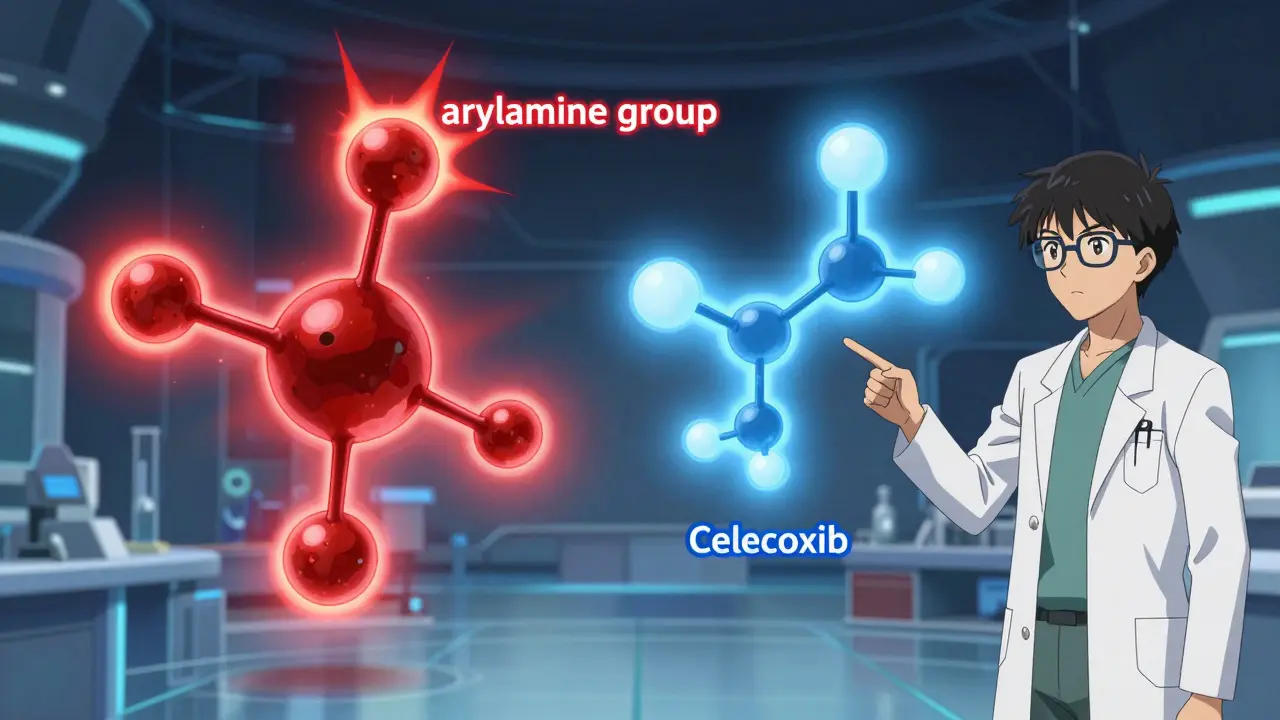
The big question is: if I'm allergic to one sulfa drug, am I allergic to all of them? The short answer is no. The risk of a reaction depends on the molecular structure, not just the presence of sulfur. sulfa drug allergies are triggered by a specific part of the molecule known as the N4 aromatic amine (the arylamine group). When your body breaks down an antimicrobial sulfonamide, this group turns into hydroxylamine, which binds to proteins and alerts your immune system.
Here is the catch: non-antibiotic sulfonamides don't have this arylamine group. Because they lack the "trigger," your immune system generally doesn't recognize them as the same threat. This is why a patient can have a severe reaction to an antibiotic but take a diuretic for a decade without a single itch. Data from the Journal of Allergy and Clinical Immunology: In Practice showed that among 1,200 people with antibiotic sulfa allergies, only 0.8% reacted to non-antibiotic versions-a rate almost identical to the general population.
| Feature | Antimicrobial Sulfonamides | Non-Antimicrobial Sulfonamides |
|---|---|---|
| Chemical Trigger | Contains Arylamine Group | Lacks Arylamine Group |
| Common Use | UTIs, Skin Infections | Blood Pressure, Inflammation, Glaucoma |
| Examples | Sulfamethoxazole, Sulfadiazine | Furosemide, Hydrochlorothiazide, Celecoxib |
| Cross-Reactivity Risk | High (with other antibiotics) | Very Low / Negligible |
Medications to Avoid and Those That Are Generally Safe
If you have a confirmed allergy to sulfonamide antibiotics, you need to be careful with specific drugs. The most common one is Sulfamethoxazole, which is the "sulfa" part of the popular combination drug Bactrim or Septra. Other high-risk medications include sulfadiazine and sulfacetamide. You should also be cautious with dapsone, as it shares a similar structural backbone.
On the flip side, there are many medications that are’t typically problematic. For example, Celecoxib (Celebrex) is a common anti-inflammatory that the American College of Rheumatology explicitly endorses for people with sulfa antibiotic allergies. Similarly, diuretics like Furosemide (Lasix) and Hydrochlorothiazide (HCTZ) are generally safe. Even common items like saccharin (artificial sweetener) or sulfites in wine don't carry the same risk because they don't have that problematic arylamine structure.
There is one notable exception: Sulfasalazine. This medication is used for inflammatory bowel disease and shows about a 10% cross-reactivity rate. This happens because your body breaks it down into sulfapyridine, which is an antimicrobial sulfonamide. If you've had a severe reaction to sulfa antibiotics, talk to your doctor before using this one.
The Danger of the "Sulfa Allergy" Label
Having a vague "sulfa allergy" listed in your electronic health record can actually be dangerous. When doctors see that label, they often avoid the most effective first-line antibiotic and switch to a broader-spectrum alternative. For example, they might prescribe fluoroquinolones instead. While these work, they carry a higher risk of causing C. difficile infections-increasing the odds by more than double according to the Patient Safety Network.
Beyond the risk of infection, the economic cost is staggering. The Agency for Healthcare Research and Quality estimated that inappropriate restrictions on these drugs cost the US healthcare system about $1.2 billion annually. This comes from using more expensive alternative drugs and keeping patients in the hospital longer because they aren't getting the most targeted therapy available.

How to Manage Your Allergy Properly
If you aren't sure about your allergy status, the best move is to get a specific diagnosis. Don't settle for a generic "sulfa" label. The American College of Physicians now recommends that records specify "sulfonamide antibiotic allergy" to avoid confusion.
Depending on your history, there are different ways to handle this:
- For mild reactions (like a simple rash): A doctor might suggest a single-dose challenge. This involves taking a small amount of the medication under supervision. In a study of 327 patients, 98.7% successfully tolerated hydrochlorothiazide after a challenge.
- For severe reactions (SJS or TEN): If you've experienced Stevens-Johnson Syndrome, a severe skin reaction where the epidermis separates from the dermis, you must avoid all antimicrobial sulfonamides for life. However, non-antibiotic sulfonamides are often still an option.
- For uncertainty: Ask your doctor about component-resolved diagnostics. New tests can identify if you have IgE antibodies to the hydroxylamine metabolite with nearly 95% sensitivity, giving you a definitive "yes" or "no."
Practical Tips for Patients and Caregivers
The next time you visit a pharmacy or a new clinic, be specific. Instead of saying "I'm allergic to sulfa," try saying, "I have a reaction to sulfonamide antibiotics like Bactrim." This one small change in language can prevent a pharmacist from blocking a medication you actually need.
If you are a caregiver for an elderly patient, check their medication list. If they are taking HCTZ or Furosemide but have a "sulfa allergy" warning, it might be worth asking the physician to clarify the record. Correcting this doesn't just clear up a chart-it ensures the patient gets the most effective treatment without unnecessary fear or restrictive medication choices.
Can I take Celebrex if I have a sulfa allergy?
Yes, in most cases. Celecoxib (Celebrex) is a non-antibiotic sulfonamide. It lacks the arylamine group that causes the allergic reaction associated with sulfa antibiotics. The Mayo Clinic and American College of Rheumatology note that patients with sulfonamide antibiotic allergies can safely use celecoxib with no increased risk compared to the general population.
Is there a difference between sulfur and sulfa?
Yes, a huge difference. "Sulfur" is a chemical element found in many things, including Epsom salts (sulfates) and wine preservatives (sulfites). "Sulfa" refers to sulfonamides, which are synthetic drugs. Being allergic to sulfa antibiotics does not mean you are allergic to sulfur in general, and you can safely use sulfate-based products.
What are the most dangerous reactions to sulfa drugs?
The most severe reactions are Stevens-Johnson Syndrome (SJS) and Toxic Epidermal Necrolysis (TEN). These are medical emergencies where the skin blisters and peels off. If you have a history of these reactions to an antibiotic, you must avoid all antimicrobial sulfonamides for the rest of your life.
Why do some doctors still tell me to avoid all sulfa drugs?
Many healthcare providers were taught an older model of medicine that didn't distinguish between antimicrobial and non-antimicrobial sulfonamides. A 2023 survey found that 67% of primary care physicians still believe all sulfonamides should be avoided, even though major medical societies like the AAAAI have stated there is no clinically significant cross-reactivity.
Which sulfa antibiotics are the most common?
The most common is Sulfamethoxazole, often paired with Trimethoprim (sold as Bactrim or Septra). Others include sulfadiazine, sulfacetamide, and dapsone.




Rauf Ronald
April 8, 2026 AT 10:14This is such a critical distinction for patients to understand. I've seen so many cases where people are terrified of a drug because of a label they don't actually understand. Getting a specific diagnosis like "sulfonamide antibiotic allergy" instead of just "sulfa" can literally change the course of a patient's treatment plan and save them from unnecessary side effects of alternative drugs.
Darius Prorok
April 8, 2026 AT 18:54Everyone knows the arylamine group is the real culprit here. It's basic chemistry.
Grace Lottering
April 9, 2026 AT 00:54Big Pharma loves these vague labels. Keeps us scared. Controls the narrative.
charles mcbride
April 9, 2026 AT 04:08It is truly heartening to see this information made available to the public. Many of us simply trust whatever is written in our files without questioning it, but with the right guidance, we can advocate for our own health and ensure we receive the most effective care possible.
Victoria Gregory
April 10, 2026 AT 16:35Wow!!! I had no idea about the difference between sulfur and sulfa!!! 🤯 This is so helpful for anyone who's always worried about their wine or supplements!!! ✨💖
GOPESH KUMAR
April 11, 2026 AT 21:03The irony of modern medicine is that we have all this data yet 67% of GPs are still stuck in the dark ages. It's almost poetic how inefficiency is baked into the system. Most of these doctors just copy-paste records without thinking. It's a systemic failure of intellectual curiosity in the medical field.
Toby Sirois
April 12, 2026 AT 13:25Imagine actually believing your doctor just because they have a degree. I've been telling people for years that these labels are garbage. If you're not checking the actual chemical structure, you're just guessing. It's honestly pathetic how many people just follow the chart like sheep without doing five minutes of research.
Nathan Kreider
April 13, 2026 AT 16:41I really hope people read this and feel more confident talking to their doctors. It can be so scary to feel like you're missing out on a good medicine just because of a word on a page.
Laurie Iten
April 15, 2026 AT 00:55the way we categorize illness and allergy often misses the nuance of the human experience... it is interesting how a single chemical group defines the boundary between safe and dangerous in the eyes of the state
Michael Flückiger
April 15, 2026 AT 13:47This is just great!!! So many of us can finally stop worrying about HCTZ!!! Let's get these records updated everywhere!!!
Kathleen Painter
April 16, 2026 AT 02:14I've spent quite a bit of time mentoring young nursing students on this very topic, and it's always a bit of a revelation for them because the textbooks often gloss over the cross-reactivity specifics. I think it's so important to approach this with an open mind and remember that each patient's reaction is unique, even if the chemistry suggests a general rule, so we should always prioritize the patient's lived experience while still utilizing the best available scientific data to guide our clinical decisions in a way that is both safe and inclusive of all possibilities.
Windy Phillips
April 16, 2026 AT 18:26It is simply exhausting to realize how many professionals are neglecting their continuing education... One would think that a basic understanding of sulfonamides would be mandatory, yet here we are, dealing with billion-dollar mistakes because someone couldn't be bothered to read a journal article!!!
Sarabjeet Singh
April 17, 2026 AT 13:45Good info. Keep it up.