
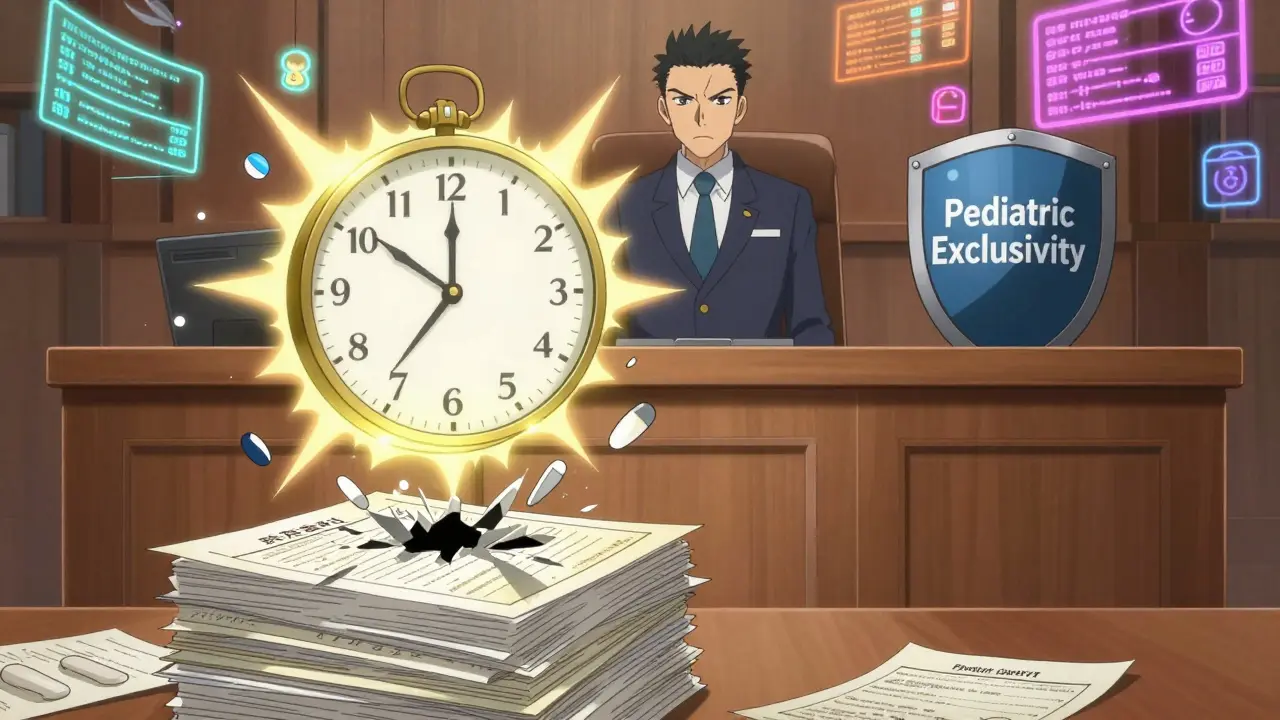
When a drug company gets approval for a new medicine, it doesn’t just get a patent-it gets a clock. But what if that clock runs out before the company makes back its investment? That’s where pediatric exclusivity comes in. It’s not a patent extension. It’s not a new law. It’s a clever regulatory trick the FDA uses to keep generics off the market for six extra months-without touching a single patent number.
What pediatric exclusivity actually does
Pediatric exclusivity doesn’t change the patent expiration date. You won’t find it listed as a patent extension in the USPTO database. Instead, it blocks the FDA from approving generic versions of a drug-even if the patent has already expired. This is key. Most people think patents are the only thing stopping generics. They’re wrong. Pediatric exclusivity works even when there’s no patent left.
Here’s how it works: A drugmaker gets a Written Request from the FDA asking them to study their drug in children. If they do the studies, submit the results, and the FDA says they’re good, the company gets six months of extra market protection. That protection applies to every version of the drug-the pill, the liquid, the cream, the injection-all of them, as long as they contain the same active ingredient.
This isn’t just a bonus. It’s a lifeline. For drugs that treat chronic conditions like epilepsy or ADHD, six months of exclusivity can mean hundreds of millions in revenue. In 2023, one major antidepressant earned an extra $420 million in sales because of pediatric exclusivity. That’s not a small perk-it’s a core part of how drug companies manage their product lifecycles.
How it stacks on top of other protections
Pediatric exclusivity doesn’t start from scratch. It attaches to whatever else is already protecting the drug. If the drug has five-year new chemical entity exclusivity, the six-month clock starts after that five years end. If it’s protected by a three-year exclusivity for new clinical data, the six months get tacked on after that. Even orphan drug exclusivity-usually seven years-can be extended by pediatric exclusivity.
But there’s a catch: the underlying exclusivity must have at least nine months left when the pediatric exclusivity is granted. If the patent expired two years ago and there’s no other protection, pediatric exclusivity won’t kick in-unless the drugmaker is also asking to add a new pediatric indication. In that case, the FDA can grant exclusivity based on the new application, even if the original drug had no protection left.
This is why companies often delay submitting pediatric studies until just before their main exclusivity runs out. Timing matters. One day too early, and they lose the benefit. One day too late, and generics jump in.
The Orange Book trick
Every drug in the U.S. has a listing in the FDA’s Orange Book. It’s the official list of approved drugs and their patents. When pediatric exclusivity is granted, the FDA doesn’t just add a note. It lists the patent twice: once with the original expiration date, and again with the six-month extension. To anyone looking at the book, it looks like the patent was extended. But it wasn’t. The patent itself didn’t change. The FDA just made it illegal to approve a generic until that second date.
Generic companies sometimes get confused here. They see the second date, assume the patent was renewed, and file a Paragraph IV challenge-only to realize the real barrier isn’t the patent. It’s the exclusivity. And you can’t challenge exclusivity the way you challenge a patent. Courts have ruled: pediatric exclusivity is a regulatory shield, not a legal claim. You can’t sue to invalidate it.
When generics can still get through
There are only four ways a generic company can get approval during the six-month exclusivity window:
- The brand company gives written permission (a waiver).
- A court rules the patent covered by the exclusivity is invalid, not infringed, or unenforceable.
- The brand company doesn’t sue within 45 days of the generic filing, and the generic gets a waiver.
- The civil lawsuit is dismissed, and the generic gets a waiver.
That last one is tricky. Even if a generic wins a patent lawsuit, the FDA still won’t approve the drug unless the brand company agrees to waive exclusivity. The FDA won’t make that call on its own. The law is clear: pediatric exclusivity is a mandatory pause, not a suggestion.
Why biologics don’t get this
Here’s something most people don’t realize: pediatric exclusivity doesn’t apply to biologics. Insulin, vaccines, monoclonal antibodies-none of them qualify. That’s because biologics are regulated under a different law, the Biologics Price Competition and Innovation Act (BPCIA). Unlike small-molecule drugs, biologics don’t have a patent linkage system. The FDA doesn’t wait for patents to expire before approving biosimilars. So even if a biologic company does pediatric studies, the FDA can still approve a biosimilar the day after the original product’s exclusivity ends.
This creates a big gap. Companies that make traditional pills and syrups can use pediatric exclusivity to squeeze out competition. Companies that make complex biological drugs? They’re stuck with whatever exclusivity they got from the original approval. No extra six months. No second shot.
The real power: it works after patent expiry
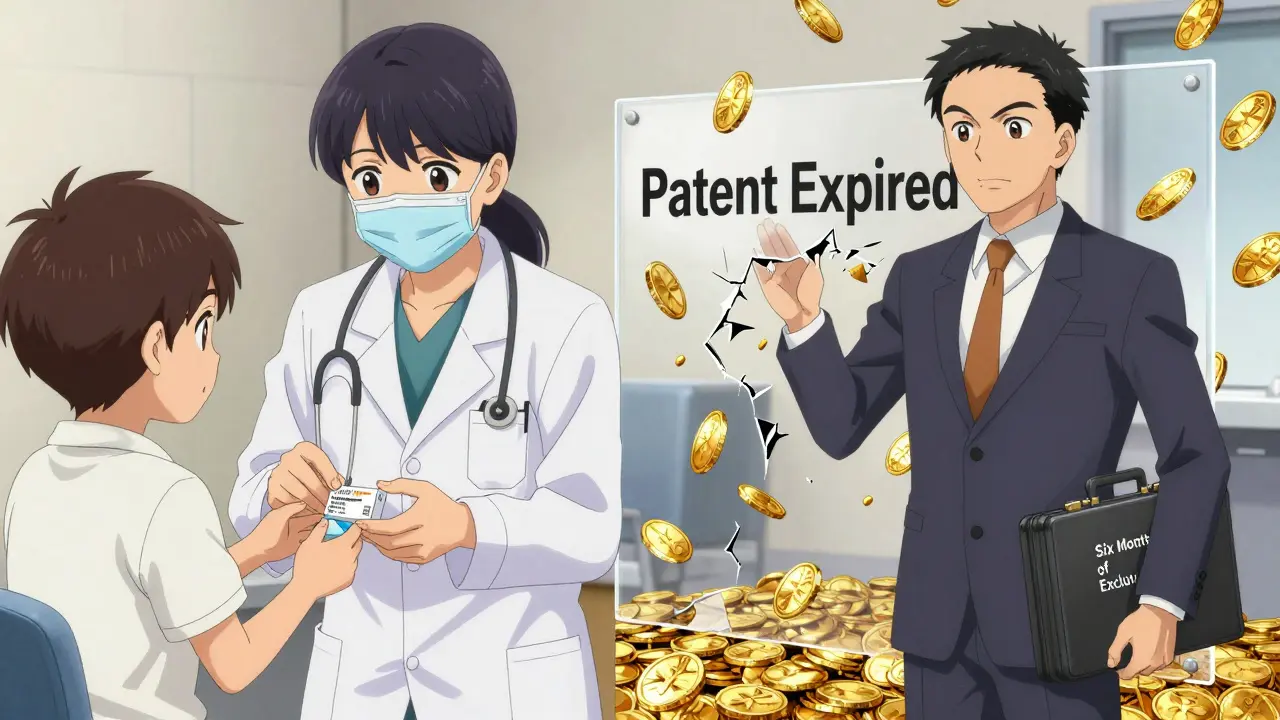
The most misunderstood part of pediatric exclusivity is what happens after the patent dies. Most people think: no patent = no barrier. But that’s not true. If a drug has pediatric exclusivity, the FDA can’t approve a generic-even if the patent expired five years ago. The exclusivity becomes the only barrier.
That’s why some drugs stay off the market for years after patent expiry. Take a common blood pressure medication approved in 2005. The patent expired in 2012. But because the company did pediatric studies in 2010, the FDA blocked generics until 2018. Why? Because the exclusivity clock didn’t start until after the patent expired. It ran for six months after 2012-and that six months was the only thing holding back generics.
That’s the hidden power. Pediatric exclusivity doesn’t just extend protection-it can outlive patents entirely. And because it applies to all dosage forms and indications, a company can protect a whole family of products with one set of pediatric studies.
Why the FDA does this
It sounds like a corporate perk. But the reason exists for a good one: kids were being treated with adult drugs for decades without proper dosing or safety data. Doctors guessed. Parents worried. Kids got sick. The FDA couldn’t force companies to test drugs on children-until they offered something valuable in return.
Pediatric exclusivity was created in 1997 and made permanent in 2002. Since then, over 500 drugs have received pediatric exclusivity. That means hundreds of new labeling updates for children. Dosing instructions. Side effect warnings. Safety data. All because a company wanted six more months of market control.
It’s not perfect. Some companies do the bare minimum. Others delay studies until the last minute. But the result? More accurate, safer medicine for kids. And for the companies? A powerful tool to protect revenue without needing to file another patent.
What this means for patients and generics
For patients, pediatric exclusivity means better labeling. It means knowing how much of a drug a child should take. It means fewer side effects from guesswork.
For generic makers, it’s a frustrating roadblock. They can prepare their application. They can run tests. They can even win patent lawsuits. But if pediatric exclusivity is active, the FDA can’t say yes. No matter how ready they are.
For the public, it’s a trade-off: a little more time before generics arrive, in exchange for better, safer pediatric data. It’s not free. But it’s not just corporate greed either. It’s a system designed to fix a real problem-by giving companies a reason to care about children’s health.
Does pediatric exclusivity extend the actual patent term?
No. Pediatric exclusivity does not change the patent expiration date. Instead, it prevents the FDA from approving generic versions of the drug for six months, even after the patent has expired. It’s a regulatory delay, not a legal extension of the patent.
Can a generic drug be approved during pediatric exclusivity if the patent has expired?
No, unless one of four exceptions applies: the brand company grants a waiver, a court rules the patent invalid or not infringed, the brand company doesn’t sue within 45 days, or the lawsuit is dismissed and a waiver is obtained. The FDA cannot approve generics during this period without one of these legal clearances.
Does pediatric exclusivity apply to biologics?
No. Pediatric exclusivity only applies to small-molecule drugs regulated under the Hatch-Waxman Act. Biologics, such as insulin or monoclonal antibodies, are regulated under the BPCIA and are not eligible for pediatric exclusivity, even if pediatric studies are completed.
How long does pediatric exclusivity last?
Pediatric exclusivity lasts for six months. It applies to all dosage forms and indications of the same active ingredient, regardless of whether the original patent or exclusivity has expired, as long as the underlying protection had at least nine months remaining when the exclusivity was granted.
What triggers pediatric exclusivity?
Pediatric exclusivity is triggered when a drug company completes and submits pediatric studies in response to a Written Request from the FDA. The FDA then reviews the data to confirm it meets the required standards. Approval of the application is not required-only acceptance of the study reports.
Can pediatric exclusivity be granted to a drug with no patent or exclusivity left?
Yes, but only if the company is seeking approval for a new pediatric indication. In that case, the supplemental application itself qualifies for new exclusivity, and pediatric exclusivity can attach to that new approval-even if the original drug had no remaining protection.
Does pediatric exclusivity apply to all forms of the same drug?
Yes. If a company conducts pediatric studies on one form of a drug-say, an oral tablet-pediatric exclusivity applies to all other forms containing the same active ingredient, including liquids, creams, injections, or eye drops, as long as they are marketed under the same NDA.
Is pediatric exclusivity used to delay generic competition unfairly?
Some critics argue it delays generics too long. But the system was designed to fix a real public health issue: children were being treated with untested drugs. The six-month delay is the price paid for generating critical safety and dosing data for pediatric patients. While companies benefit financially, the FDA requires that the studies produce meaningful data-not just paperwork.
ryan Sifontes
January 30, 2026 AT 10:49paul walker
January 30, 2026 AT 13:13Alex Flores Gomez
January 30, 2026 AT 14:01Frank Declemij
January 31, 2026 AT 20:40Pawan Kumar
February 1, 2026 AT 17:50Kristie Horst
February 2, 2026 AT 13:59Andy Steenberge
February 2, 2026 AT 20:32Laia Freeman
February 4, 2026 AT 04:17rajaneesh s rajan
February 5, 2026 AT 01:32Jasneet Minhas
February 5, 2026 AT 01:38